Leuchtenburg: A Medieval Hilltop Castle Ruin in Italy




Site at a Glance
- Rating
- 4.5
- Popularity
- Low
- Country
- Italy
- Primary era
- Medieval
- Eras represented
- Iron Age, Classical, Medieval
- Civilizations
- Holy Roman Empire, Roman
- Site type
- Military
- Remains
- Castle
On this page9 sections
History
Leuchtenburg is a ruined hilltop castle in Italy, above Lake Kaltern in South Tyrol, whose present castle form is probably earlier than 1200. Its construction date remains uncertain: commonly proposed dates place it between 1200 and 1250, while later interpretations assign its origins to the first half of the fourteenth century. The castle occupies the Mitterberg, a landscape that had already been used for defense in prehistoric and Roman times.
Earlier defenses and medieval origins
The hill contains traces of fortifications associated with the Raetians, an ancient Alpine people who lived in parts of the eastern and central Alps before and during Roman rule. These defenses were later modified during the Roman period. A prehistoric defensive wall also runs beside the path approaching the castle, showing that the strategic value of the elevation predates the medieval ruin.
By the fourteenth century, Leuchtenburg belonged to the lords of Rottenburg, a medieval noble family whose possessions included castles and territories in Tyrol. In 1339, the Bishop of Trent, the territorial and ecclesiastical ruler of the medieval Bishopric of Trent, captured Leuchtenburg together with nearby Varco Castle. The castle changed hands several times thereafter.
Abandonment and conservation
Leuchtenburg was abandoned around 1610 and has remained uninhabited since then. Its masonry gradually deteriorated until the municipality of Caldaro acquired the ruin during the twentieth century and arranged for the surviving structure to be conserved.
A local legend links the castle with the creation of Lake Kaltern. In the story, a wealthy and miserly lord refuses help to an orphan. A destructive storm lasting three days then submerges his vineyards and forms the lake. The legend adds that the town church bells, believed to lie beneath the water, may still be heard during storms.
Remains
Setting and overall layout
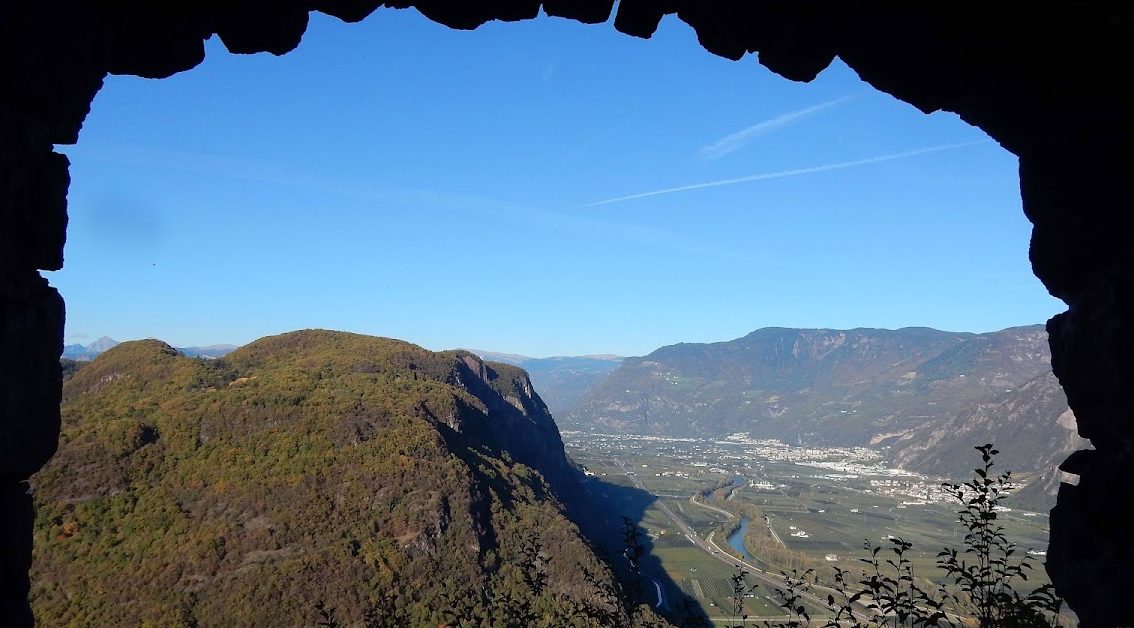
Leuchtenburg stands at about 576 metres above sea level on an elevation in the southern part of Mitterberg, above Lake Kaltern. From this position, the ruin overlooks the Adige Valley in the area between the Überetsch, the region west of the valley around Bolzano and Lake Kaltern, and the South Tyrolean lowlands.
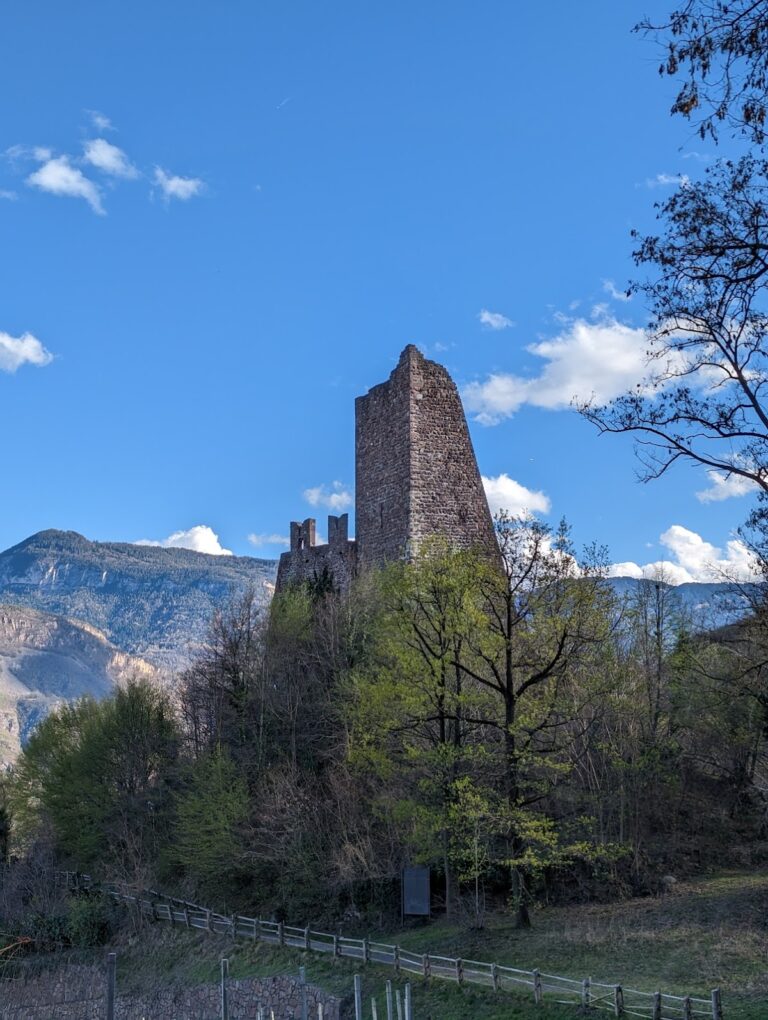
The castle is arranged around a tall, oval mantle wall enclosing several residential buildings. Two outer baileys, or fortified courtyards, were added later, extending the complex beyond its original core.
Fortifications and approach
Core castle and mantle wall
A massive shield wall, also called a mantle wall, dominates the surviving castle. This particularly high and thick section of fortification protected the most vulnerable side of a castle and emphasized its defensive strength. At Leuchtenburg, the wall is unusually substantial despite the natural protection provided by the hilltop. The oval enclosure and the residential buildings within it remain the principal elements of the ruined core.
Prehistoric and earlier defenses
A prehistoric defensive wall follows the path leading toward the ruins. Elsewhere on Mitterberg, traces of Raetian fortifications survive beneath or alongside alterations made during the Roman period, placing the medieval castle within a much older defensive landscape.
Decorative remains
The palace walls retain traces of an exterior grey-and-white checked pattern. Some remains of interior fresco decoration also survive within the ruin, adding evidence of the castle’s former residential character alongside its heavy defensive construction.
Nearby sites