La Cuma Archaeological Area: A Hellenistic Sanctuary in Monte Rinaldo
Site at a Glance
- Popularity
- Low
- Country
- Italy
- Primary era
- Classical
- Eras represented
- Classical
- Civilizations
- Roman
- Site type
- Religious
- Remains
- Sanctuary
On this page10 sections
History
La Cuma archaeological area is a Hellenistic sanctuary and Roman-period archaeological site in Monte Rinaldo, in Italy’s Marche region. Its visible sanctuary construction dates to the second century BCE, when Rome ruled the area. The Hellenistic period followed Alexander the Great’s conquests and spread Greek cultural influence.
Sanctuary and its use
The sanctuary may have been monumentalized with wealth from the East after Rome established the province of Asia in western Asia Minor. It probably served settlements on the surrounding hills, although it was not part of a town. A place of worship from the earlier Picene period, associated with an ancient people of central Italy, has been proposed, but remains uncertain.
How the sanctuary connected to the Roman road network is debated. Roads, perhaps including smaller routes that followed older paths, may have linked nearby centers with the valley site. The sanctuary’s deity is also uncertain. A female divinity comparable to the Picene goddess Cupra has been proposed, as has worship connected with healing waters. Neither interpretation is established.
Identification and investigation
Early excavators suggested that La Cuma might be Novana, a Picene city mentioned in Pliny the Elder’s Natural History, a Roman encyclopedia. Archaeological finds did not confirm the identification.
Archaeological evidence came to attention in 1953. Agricultural work exposed large tuff blocks and columns in 1957, and excavations began the following year, revealing other structures at the site. Investigation has covered only part of the complex. The area was placed under archaeological protection between 1958 and 1960.
Remains
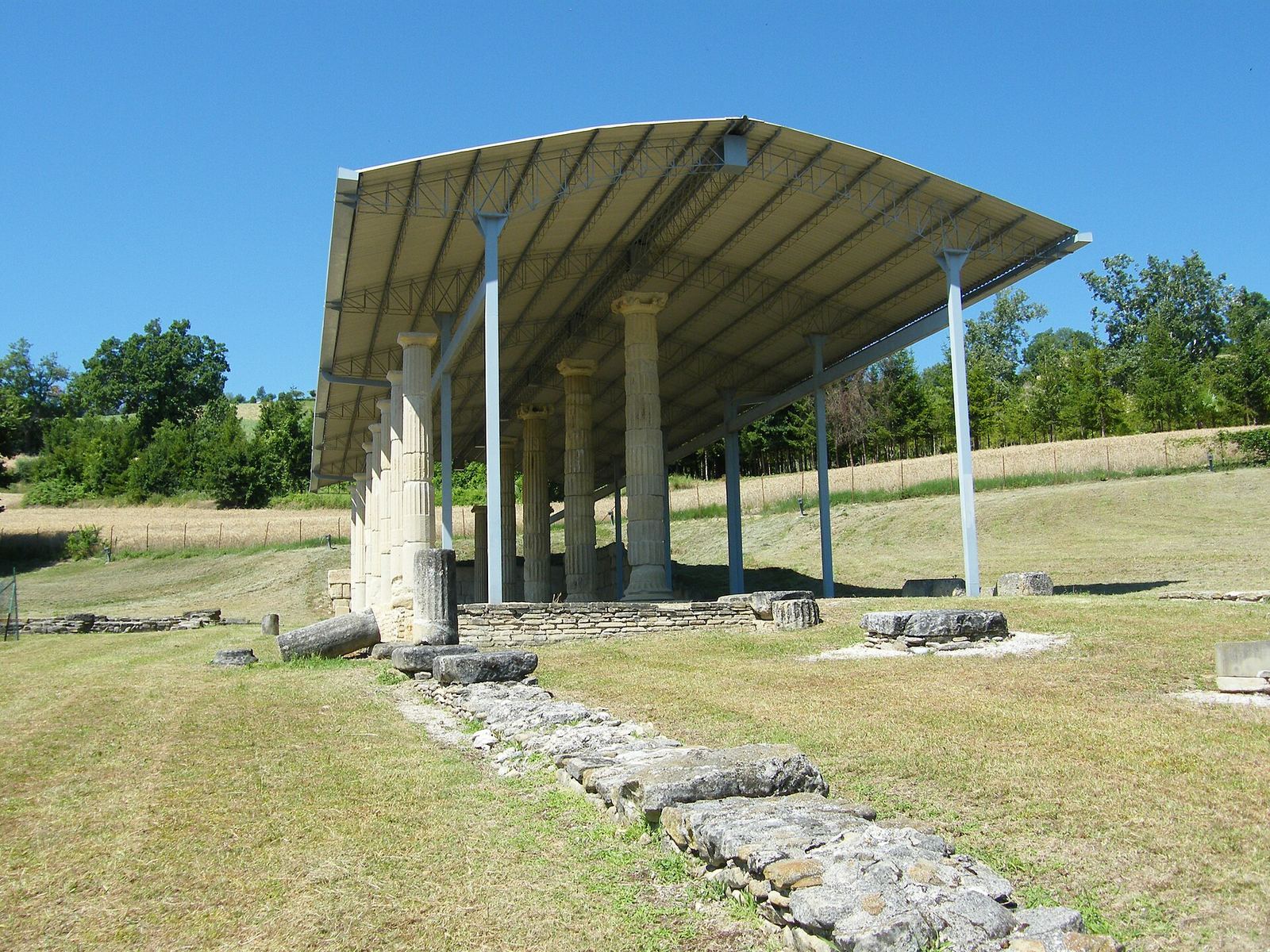
The sanctuary occupies the western slope of a hill and is laid out on artificial terraces. Its main group consists of a temple, a large portico, or roofed colonnade, and a third building between them. A well also formed part of the complex, though it is no longer visible. The sanctuary may have been visible from Picene settlements in the valley.
Temple and portico
Temple
The temple is known chiefly from its foundations. Its raised base is divided into three parts, which some interpretations identify as cellae, or enclosed inner chambers. The proportions have been compared with the Tuscan temple type, an Etruscan-Italic form described by the Roman architect and architectural writer Vitruvius. Temple A at Pyrgi, an ancient Etruscan coastal settlement, is another example cited in this comparison. Architectural terracottas, or fired-clay building decorations, place the temple broadly in the third to second centuries BCE; the decorations may not all belong to one period.
Portico
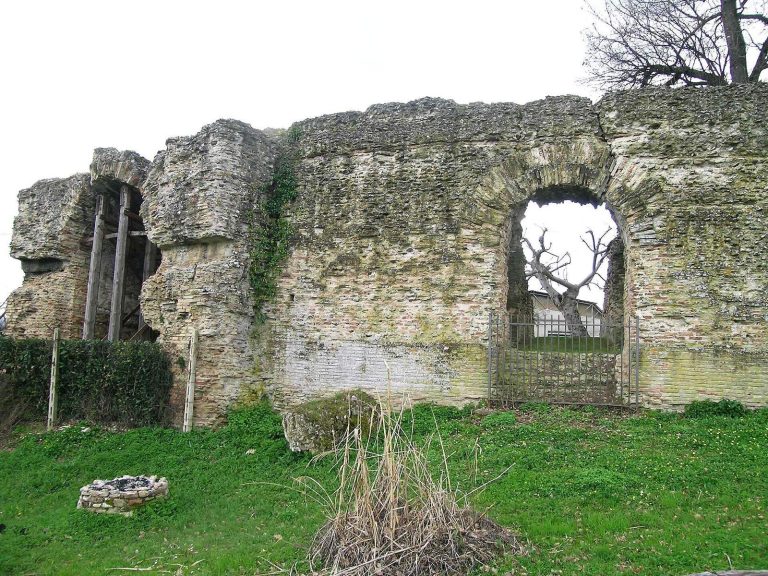
At the northern end of the terrace, the portico survives on two sides. Its thick rear wall is built of local tuff and may first have served to hold back the slope before becoming part of the colonnade. Two lines of columns stood in front of it, with Ionic and Doric, two Greek column styles, used for the inner and outer rows respectively. A small room occupied the western end; a matching room may have stood at the eastern end. The plan has been compared with Greek sanctuaries at Athena Lindia on Rhodes and Asclepius’s healing sanctuary on Kos. The portico’s monumental phase dates to the second or first century BCE.
Other structures and finds
Building between the temple and portico
The building between the temple and portico contains five rooms. One has been interpreted as a basin. Together with the well, it has prompted the suggestion that water played a part in the sanctuary’s rites.
Architectural decorations and ceramic fragment
Architectural decorations from the sanctuary are kept at the Monte Rinaldo Civic Archaeological Museum. Among them are roof-edge ornaments called antefixes, including examples depicting Hercules and the female divine figure Potnia theròn, or “Mistress of Animals.” A ceramic fragment bearing Jupiter’s name has also been linked to discussion of the sanctuary’s cult. The mark is stamped, not a votive inscription, and the fragment may have belonged to an object for pilgrims to take away.