Ripatransone Cathedral: A Co-Cathedral and Minor Basilica in Italy
Site at a Glance
- Country
- Italy
- Primary era
- Early Modern
- Eras represented
- Early Modern, Modern
- Civilizations
- Italian, Papal States
- Site type
- Religious
- Remains
- Cathedral
On this page15 sections
History
Ripatransone Cathedral is a Roman Catholic co-cathedral in Italy, dedicated to Saint Gregory the Great and Saint Margaret of Antioch. The present church was built from 1597 to 1623 for the Diocese of Ripatransone, established in 1571. It is now a co-cathedral, sharing cathedral status within its diocese, and a minor basilica, an honorary title granted by the Catholic Church. The cathedral was formerly the diocese’s episcopal seat. It is also called a triple sanctuary because the Madonna of San Giovanni chapel and the Crypt of Mercy and Death are regarded as sanctuaries in their own right.
Diocese and construction
When Pope Pius V, pope from 1566 to 1572, established the Diocese of Ripatransone in 1571, he designated San Benigno as its first cathedral. That church was small and stood at the edge of town, so Bishop Pompeo De Nobili selected the existing parish church of Saint Gregory and Saint Margaret for a new cathedral. San Benigno survives only as its bell tower.
The cathedral’s design was carried out between 1597 and 1623. Its planned size was reduced: the main arm of the cross-shaped plan was intended to continue through four arches, extending either toward the square in front of the churchyard or toward the area above a precipice.
Later building and devotional history
After the dome was built in the eighteenth century, extensive work between 1837 and 1842 replaced the roof and floor, completed the façade, and added another sacristy, a room for clergy and church objects. The Madonna of San Giovanni chapel was built from 1846 to 1858. Its statue had been commissioned in 1620 by the Brotherhood of Saint John, which soon adopted the name Brotherhood of the Madonna of San Giovanni. The Madonna has been regarded as Ripatransone’s patroness since 1893, and the church’s polyphonic choir is also known by her name.
An earlier, smaller bell tower was demolished in 1884 to make way for the present one. The new tower was completed on 3 August 1902, when a statue of the Redeemer was installed at its summit. A restoration in 1987 and 1988 returned the cross to the statue, which had originally held one.
Twentieth-century restoration and status
The cathedral was declared an Italian National Monument in 1940. During the 1950s, Bishop Vincenzo Radicioni commissioned new frescoes by Marcantonio and Michelangelo Bedini, replacing nineteenth-century paintings by Giuseppe Capparoni. A restoration completed on 15 May 1960 included a floor mosaic bearing Radicioni’s coat of arms. In 1965, Pope Paul VI, pope from 1963 to 1978, raised the church to the rank of minor basilica.
Remains
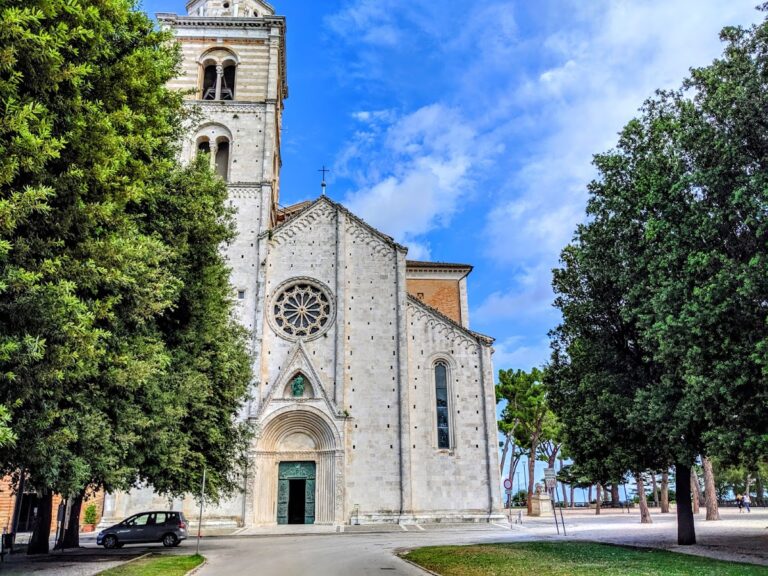
The cathedral follows a three-aisled, Latin-cross plan, with a long main arm intersected by shorter arms. Its surviving features combine the brick-faced exterior, a raised structure above the crossing, a separate bell tower, richly decorated interiors, and two distinct sanctuaries.
Exterior and upper structures
Façade and lantern
The façade, completed in 1842, has brick facing and two horizontal levels divided by a projecting cornice. Three portals framed in stone open across the lower level, separated by pairs of shallow columns with travertine tops. A rectangular window sits above the central nave, and a triangular form crowns the façade. Above the crossing, an octagonal lantern, a raised structure over the dome, was built in 1786. Its four oval windows admit light.
Bell tower and bells
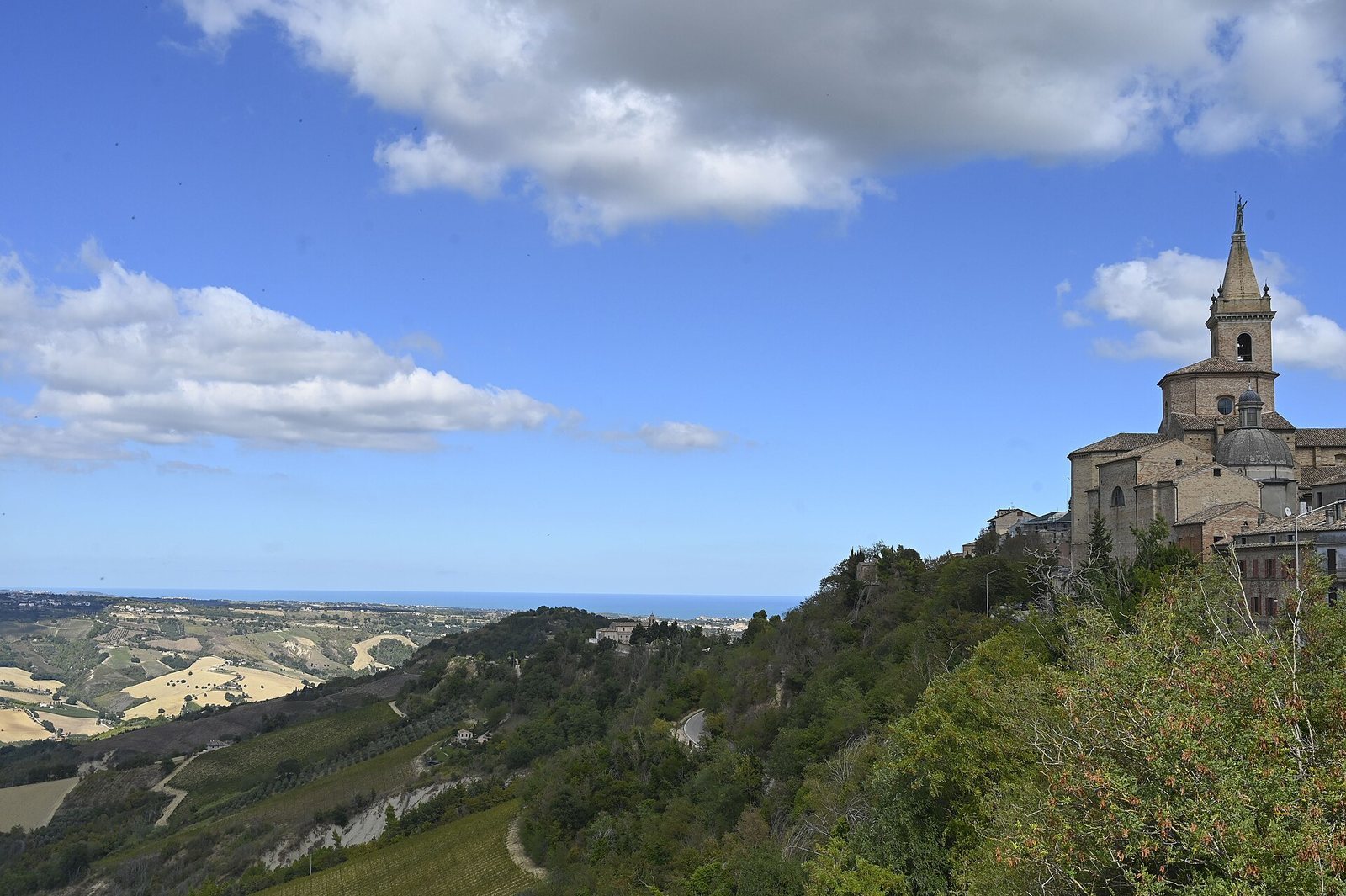
The bell tower and the statue of the Redeemer together rise 52 metres. The gilded-copper statue is 7 metres tall and weighs one tonne. Four bells hang in the tower: Annunziata faces the Capodimonte district, Sant’Antonio faces the countryside, and the smaller Santa Margherita faces the Roflano and Agello districts. San Gregorio, known as the Great Bell, hangs centrally and rings only for major observances, including Christmas, Easter, the Octave, an eight-day period following a feast, Corpus Christi, a Catholic feast honoring the Eucharist, and the feast of the Magdalene.
Interior decoration and furnishings
Frescoes
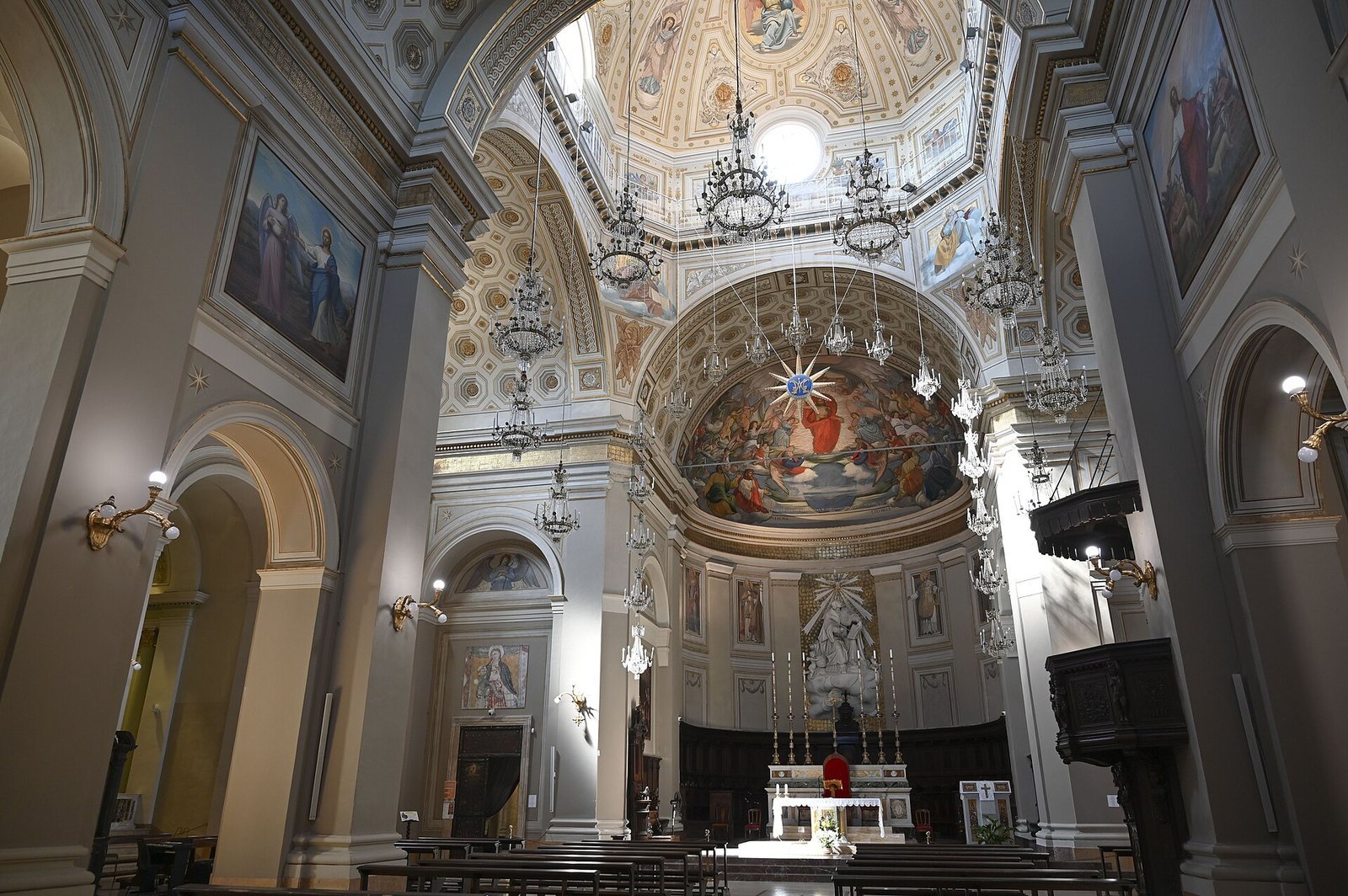
Frescoes by Marcantonio and Michelangelo Bedini decorate the interior, including the curved sanctuary end of the church. The curved triangular surfaces connecting the dome to its supports depict the four Evangelists. The dome’s gold background frames the four cardinal virtues: prudence, justice, fortitude, and temperance. One vault painting by Giuseppe Capparoni survives in a sacristy.
Choir and furnishings
Wooden choir stalls in the sanctuary end were made by Agostilio Evangelisti in 1620. Nearby stands a plaster statue of Saint Gregory the Great by Fedele Bianchini. The church also contains a marble altar by Poscetti and seventeenth-century wooden furnishings by Desiderio Bonfini, including a pulpit, a bishop’s chair, and a magistrate’s bench. Panels on the pulpit represent the Glorious Mysteries, events in the lives of Jesus and Mary contemplated in the Catholic rosary.
Altars, paintings, and sculpture
Two paintings in the sanctuary portray Saint Gregory the Great on a seventeenth-century canvas and the Nativity in an eighteenth-century work. A polychrome, gilded wooden crucifix occupies a niche in the right aisle. It is attributed to Giovanni Battista Casignola and associated with Michelangelo’s school; it may have been given by Pope Pius V in 1571. A seventeenth-century wooden altar by Angelo Ripano and an altarpiece by Orazio Gentileschi are also in the cathedral.
Three canvases dated 1579 by Simone de Magistris show the Madonna and Child with Saints Peter, Roch, Anthony of Padua, and John the Baptist. A painting of Carlo Borromeo dated 1623 is attributed to Alessandro Turchi. Another altarpiece is by S. Ciannavei, an artist active in the eighteenth and nineteenth centuries.
Pipe organ
The Callido organ was built by Gaetano Callido in 1783 for the Franciscan Church of the Magdalene, a church belonging to the Catholic order founded by Francis of Assisi. It now stands on the choir loft at the entrance end of the cathedral. Later modified, it has entirely mechanical action, with keys operating the pipes through mechanical linkages. Its wooden case is neoclassical and uses a Serlian layout, with a central arch flanked by lower openings. The front displays 27 principal pipes, the organ’s main front pipes, arranged in a central rising group with side wings. The window console has one 56-note keyboard, including a chromatic first octave with semitone steps, and a straight 24-note pedalboard permanently linked to the keyboard.
Madonna of San Giovanni chapel
The chapel opens at the end of the left aisle. Its entrance has a copper door made by sculptor Cleto Capponi in 1953. Inside are four sculptures by Luigi Fontana, Murano glass chandeliers, and a wooden choir by Morelli. A papier-mâché statue of the Virgin, made by Sebastiano Sebastiani in 1620, is housed in a small architectural shrine designed by Francesco Vespignani in 1881.
Crypt of Mercy and Death
Also called the Church of Death, the crypt is an underground chamber whose dome rises along the cathedral’s right side. It contains the tombs of four bishops of Ripatransone and a polychrome ceramic crucifix by Giuseppe Marinucci.