Co-Cathedral of Saint Peter the Apostle: Renaissance Church in Guastalla
Site at a Glance
- Popularity
- Low
- Country
- Italy
- Primary era
- Early Modern
- Eras represented
- Early Modern, Modern
- Civilizations
- Duchy of Parma and Piacenza, Holy Roman Empire, Italian
- Site type
- Religious
- Remains
- Cathedral
On this page13 sections
History
The Co-Cathedral of Saint Peter the Apostle is the principal Catholic church of Guastalla, Italy. Construction began in 1569 at the initiative of Count Cesare Gonzaga, and the Renaissance church was completed in 1575. It is now an active co-cathedral of the Diocese of Reggio Emilia-Guastalla. A co-cathedral shares cathedral status within a diocese, an ecclesiastical district overseen by a bishop. Dedicated to Saint Peter, the church identifies Peter and Paul as its patron saints.
Foundation and consecration
On 18 February 1575, Charles Borromeo consecrated the church. A cardinal and archbishop of Milan, Borromeo was a leading figure in Catholic reform. He had come to Guastalla after the death of his brother-in-law, Cesare Gonzaga.
Episcopal seat
From 13 September 1828, the church served as the episcopal seat of the Diocese of Guastalla. This role ended on 30 September 1986, when that diocese was united with the Diocese of Reggio to form the present Diocese of Reggio Emilia-Guastalla.
Alterations and restoration
The original façade was simple and aligned with the bell towers. It acquired a more elaborate Baroque appearance in 1716, the same year the two towers were erected. A major interior restoration in 1841 changed the moldings, floor, and large dome windows. The towers and roof vault were renovated in 1858, and the façade underwent further work in 1889.
The Serassi organ received several restorations during the nineteenth century. It was returned to working order in 1979 and restored again in 2018.
Remains
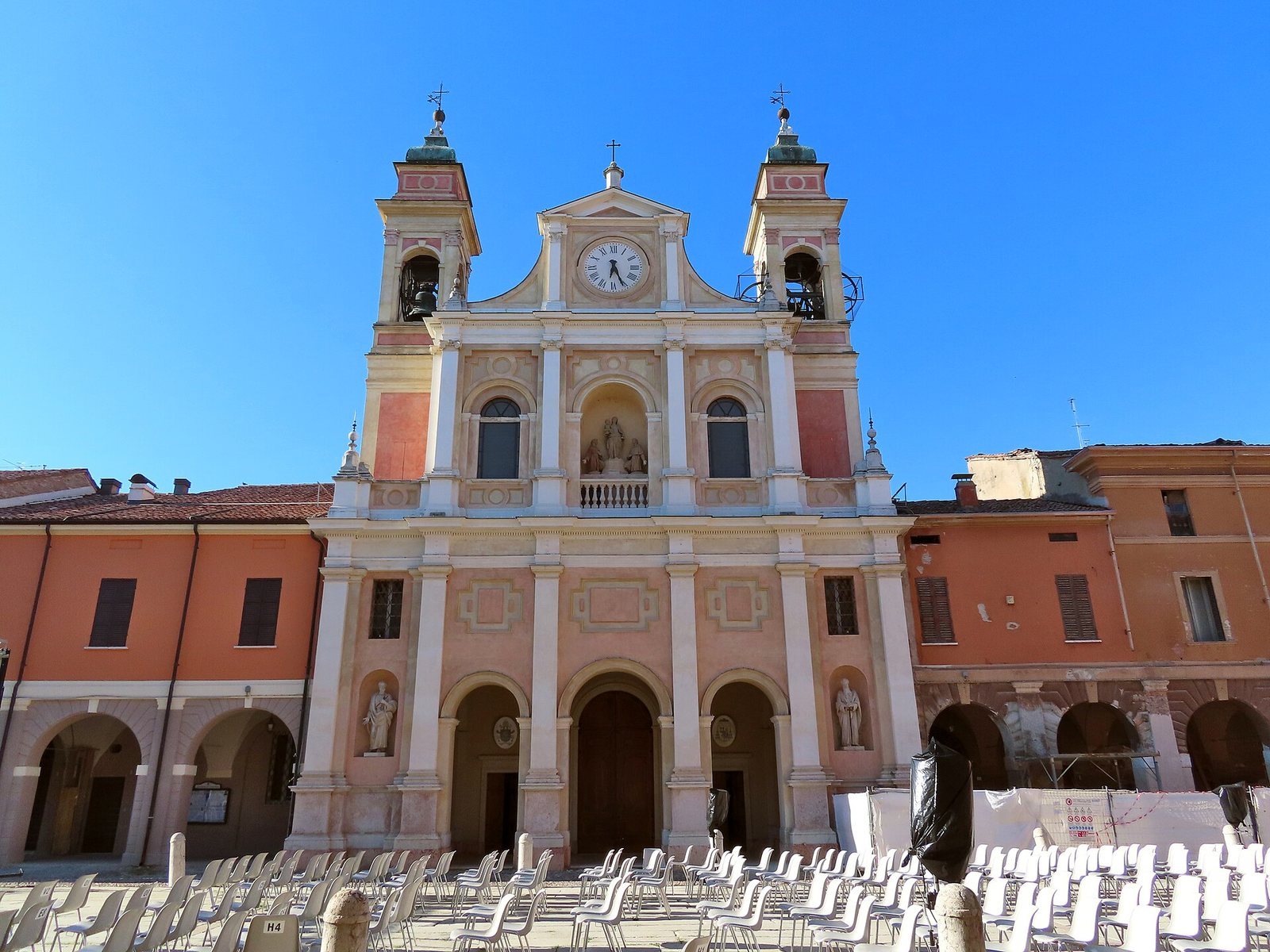
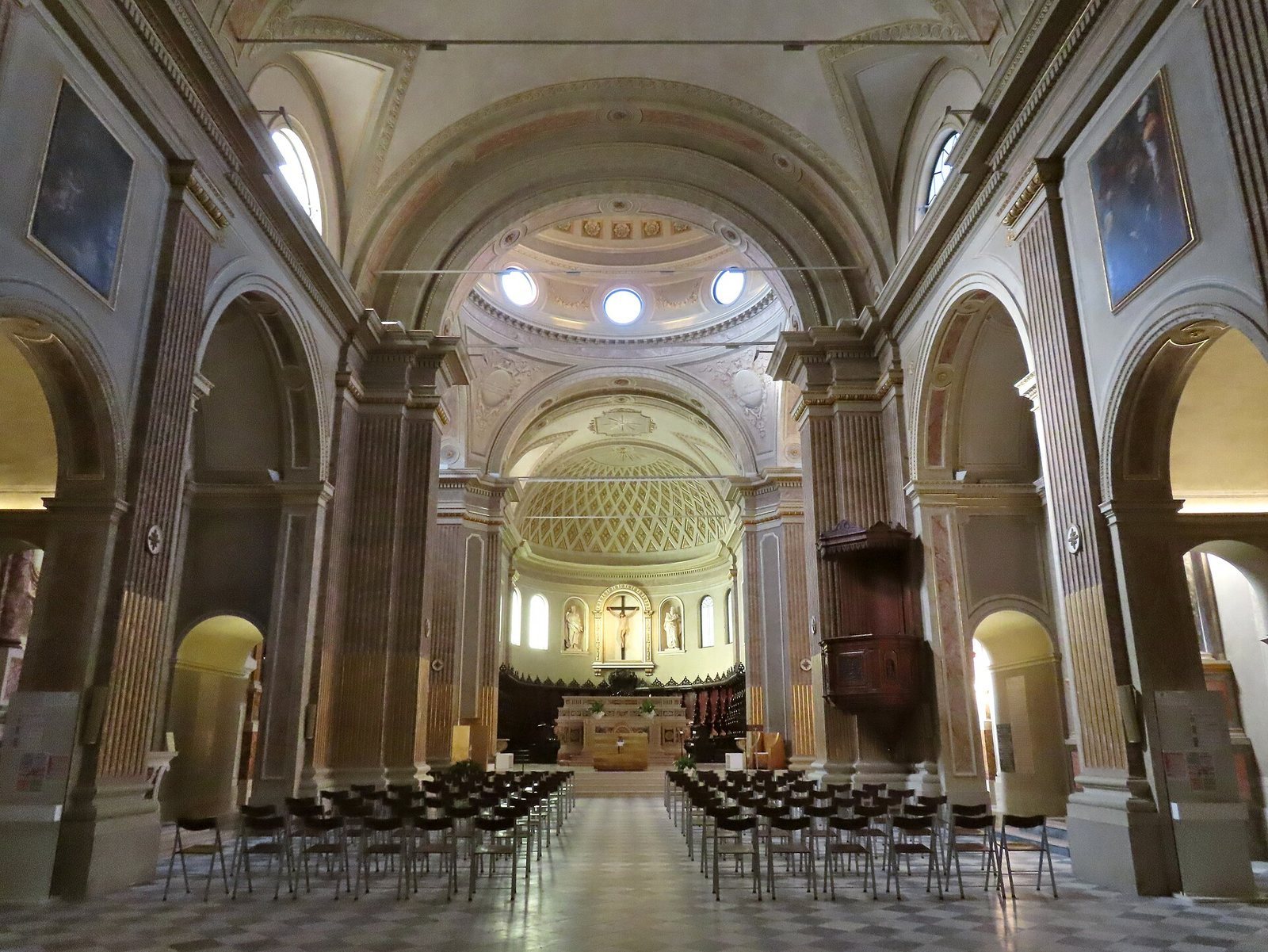
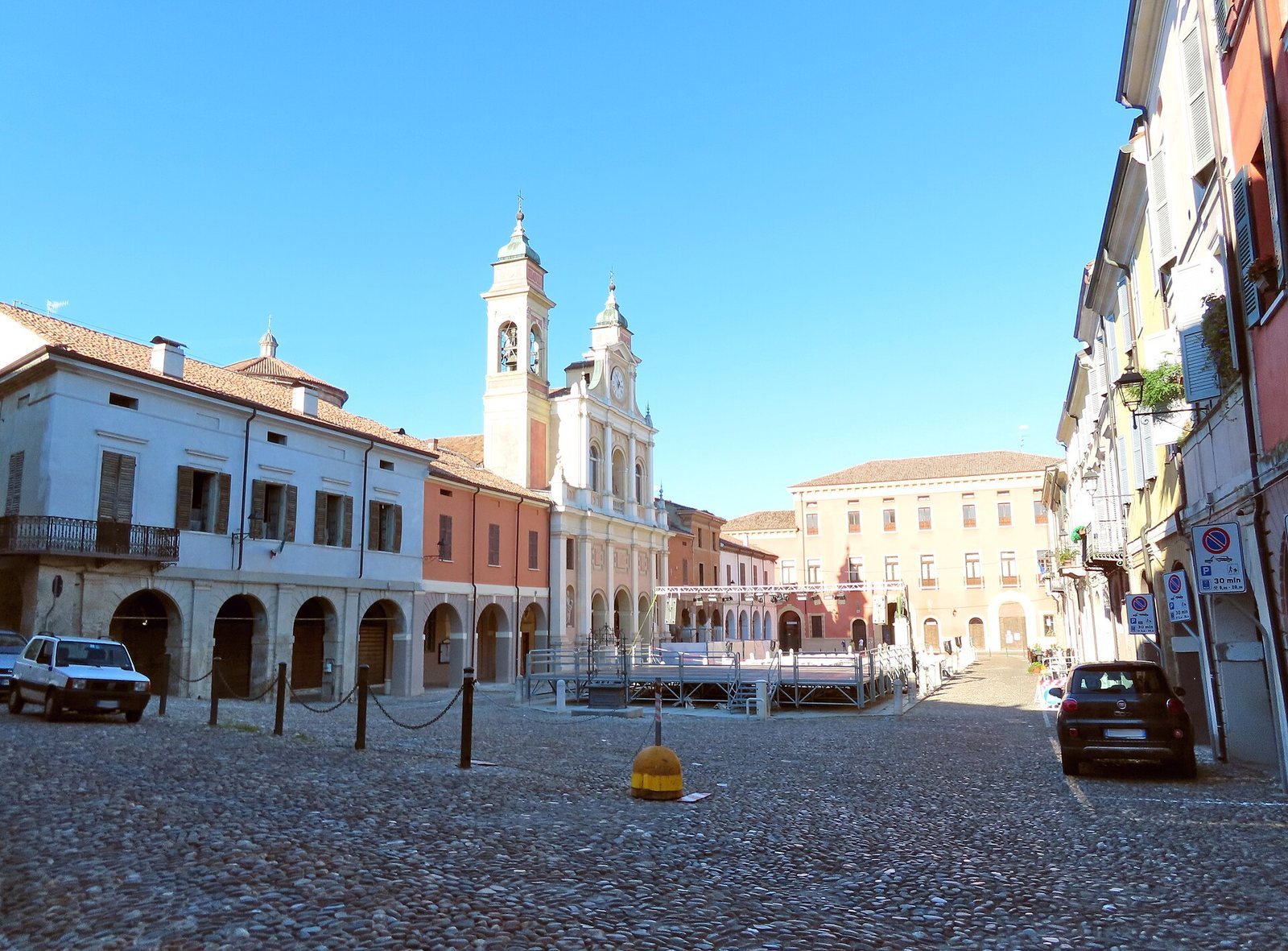
The church combines Renaissance architecture with a more ornate Baroque façade. Facing Piazza Mazzini, its front is flanked by two bell towers. Inside are a chapel, altars, choir stalls, paintings, sculptures, an organ, and five bells.
Façade and bell towers
A cornice divides the façade into two levels. On the lower level, three arches are separated by shallow wall projections resembling columns, with statues of Peter and Paul at either side. The upper level has an arched window at each side and a central sculptural group showing the enthroned Virgin Mary and Child between two saints. A clock face sits in the central field of the pediment.
Interior and furnishings
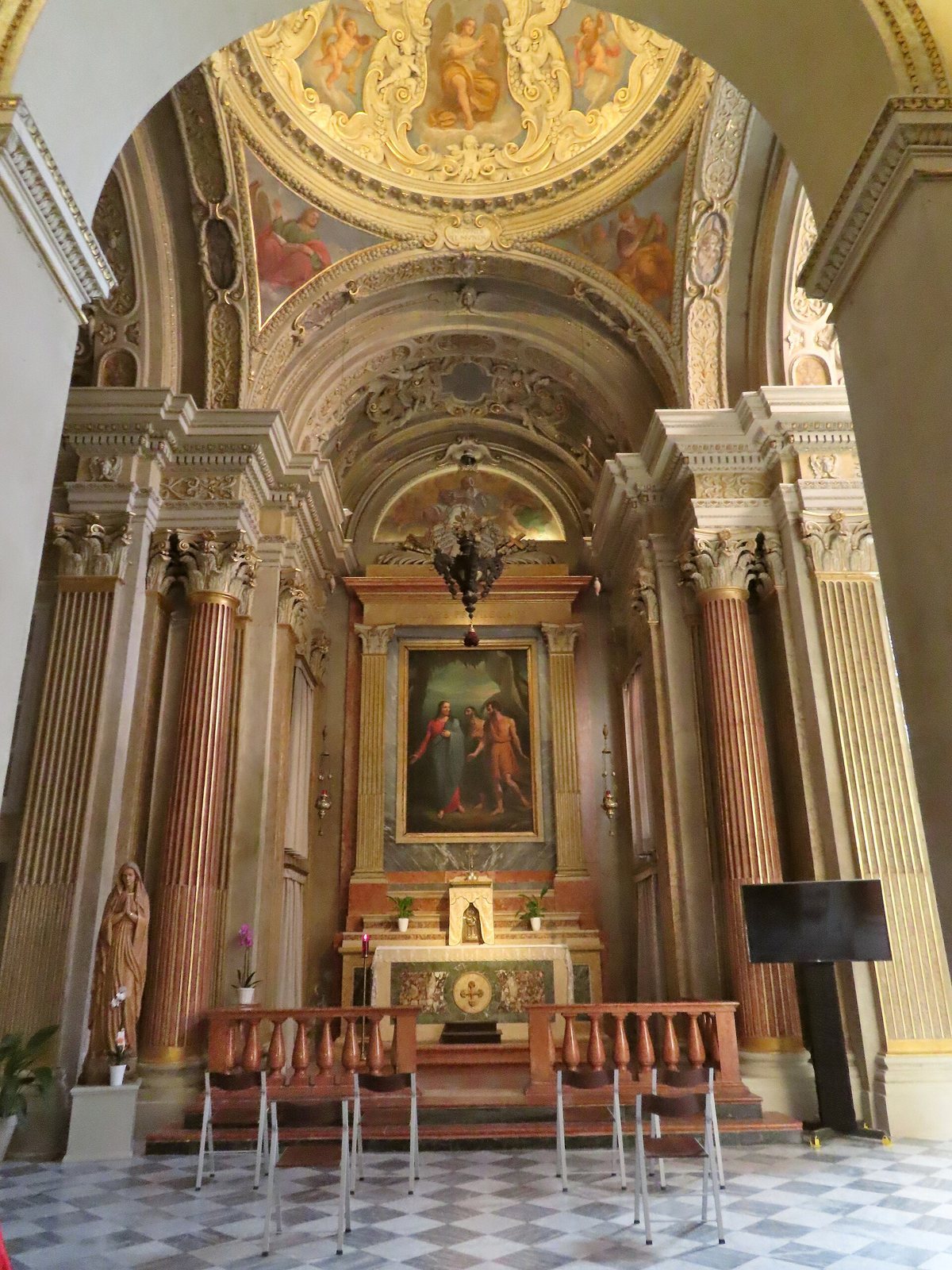
Chapel of the Blessed Sacrament
The Chapel of the Blessed Sacrament, the consecrated Eucharist, was embellished in 1670 with ornament and wall paintings.
Paintings and sculpture
An oil painting by Ludovico Cardi, known as Cigoli, shows Saint Francis receiving the stigmata, wounds corresponding to those of Christ’s crucifixion. The work dates to the late sixteenth century. A painting of the Virgin Mary and Child by Giovanni Battista Crespi dates to the mid-seventeenth century. The church also contains a late-seventeenth-century wooden statue of Saint Joseph with the Child, by Girolamo De Giovanni, and a seventeenth-century wooden sculptural group known as the Sepulchre, painted in several colors.
The Castle Madonna altar is associated with a statue thought to have once been kept in the fifteenth-century fortress. Other sacred works include an eighteenth-century oil painting of Saint Francis Xavier and an oil painting of the Madonna of Pilar.
Choir stalls
The Gonzaga family’s heraldic emblems remain visible among the choir stalls.
Organ and bells
Serassi organ
Built between 1790 and 1794 by the Serassi family of organ builders, the organ stands on the choir loft above the entrance wall. It has two keyboards and a pedalboard, with a mechanical linkage connecting the keys and pedals to the pipes.
Church bells
Five bells in the Ambrosian ringing system, associated with the Milan area, hang in the towers. The largest is in the left tower, while the four smaller bells are in the right. All were cast in 1955 by the Colbachini Foundry of Padua, with pitches of C3, D3, E3, F3, and G3.