Kyz-Kermen: A Fortified Settlement and Refuge in Ukraine
Site at a Glance
- Popularity
- Medium
- Country
- Ukraine
- Primary era
- Medieval
- Eras represented
- Iron Age, Classical, Medieval
- Civilizations
- Ancient Greek
- Site type
- Military
- Remains
- Fortified Town
On this page13 sections
History
Kyz-Kermen is a fortified settlement on a mountain plateau in Ukraine, associated with the Crimean cave-town tradition. Its name means “Maiden Fortress” in Crimean Tatar. The settlement’s foundation is dated to the ninth century, while its peak is placed in the eighth and ninth centuries.
Early occupation
An earlier fortification, dated to the fourth to third centuries BC, was probably built with the participation of people from Chersonesus, an ancient Greek city in Crimea. In antiquity, the fortified area served as a refuge rather than a built-up settlement. A separate settlement to its north, dated to the first century BC through the first century AD, consisted of adjoining walled farmsteads, sometimes divided by narrow passages.
Medieval fortress and later use
The medieval fortress is attributed to Khazar inhabitants. Much of the plateau was kept open so local people could shelter there with their belongings during enemy attacks. Kyz-Kermen is classified as part of the Kachin group, a regional category of Crimean cave settlements, and may be the early medieval city of Fulla mentioned in records from the eighth and ninth centuries.
The settlement ceased to exist after the Byzantine Theme of Cherson was established in Crimea. A theme was an administrative province that could also have military responsibilities. After the fortress was abandoned, an artificial cave became a dwelling for Orthodox hermit monks.
Archaeological excavations took place in the late 1970s under the Bakhchisarai Historical and Architectural Museum. Kyz-Kermen is designated a federal-level cultural heritage site in Russia and a monument of national importance in Ukraine.
Remains
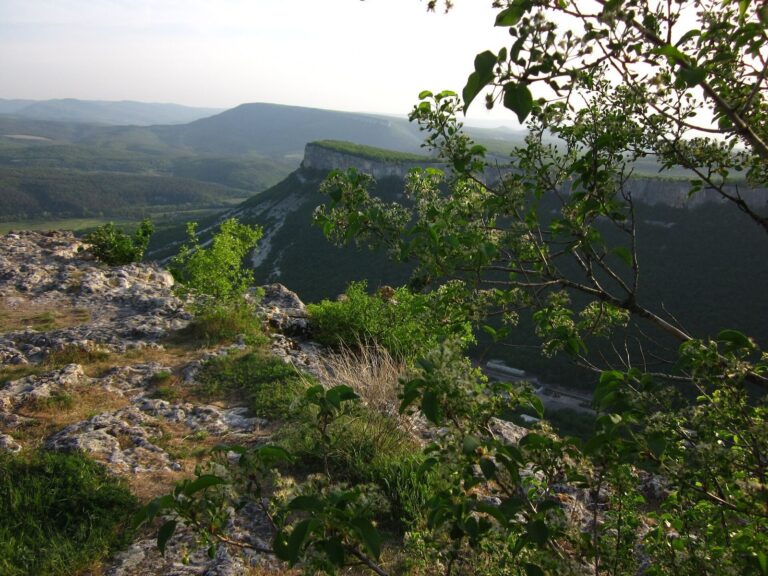
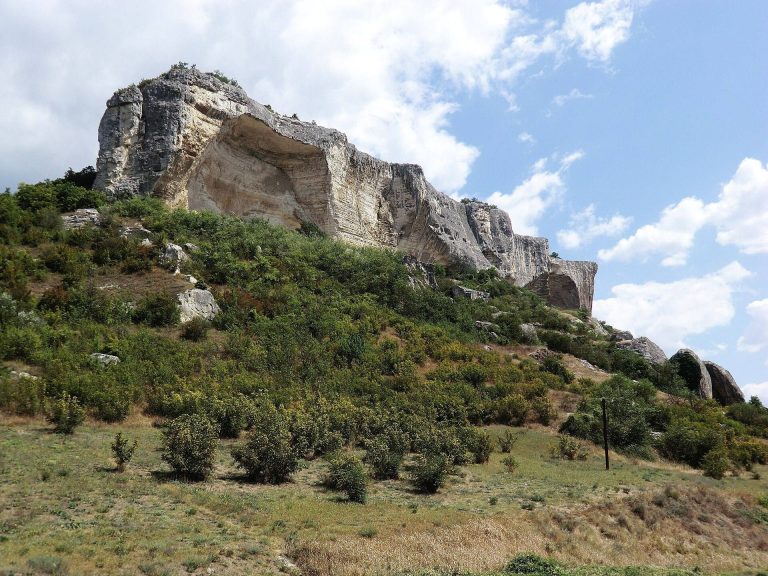
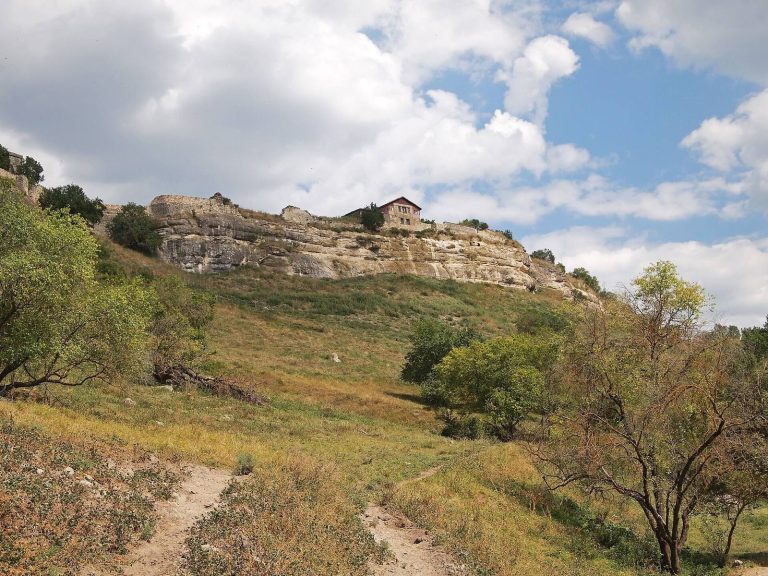
The remains occupy a plateau more than one kilometre long and up to 250 metres wide, at the end of a promontory. Cliffs protect it on three sides; a gorge bounds its western side and a ravine its eastern side. A limestone wall crosses the plateau at its narrowest point, enclosing the principal concentration of buildings while leaving a broad area open.
Fortified plateau
Defensive wall
The wall is 130 metres long and reaches up to 8 metres thick at its base. Built from limestone blocks, it has two semicircular towers and a gate at its eastern end. Earlier masonry survives at the base, where the medieval wall was constructed over an older fortification. A child was buried at the wall’s centre; the burial is interpreted as a construction sacrifice.
Residential compounds and interior
Seven residential compounds stood near the wall, each comprising several buildings arranged around a courtyard. Their houses were made of rubble stone bonded with clay, and the settlement’s population is estimated at up to 100 people. Farther inside, a large building with several rooms stood in the southeast and is thought to have been the settlement leader’s residence. The southern part of the settlement remained open and unbuilt.
Caves and water features
Artificial caves
Three artificial caves are identified as a hermit’s dwelling, a lookout or guard post, and a utility space. A large rock-cut cave is described as a cistern.
The Turtle grotto and spring
The grotto known in English as the Turtle lies on a lower ledge of the plateau’s right-hand slope and contains a spring. A basin was cut there earlier, and a stairway descends from the plateau summit to the water. Near the spring, a cistern with a capacity of 240 litres was cut in the fourteenth or fifteenth century.
Agricultural and religious features
Grape presses and terraces
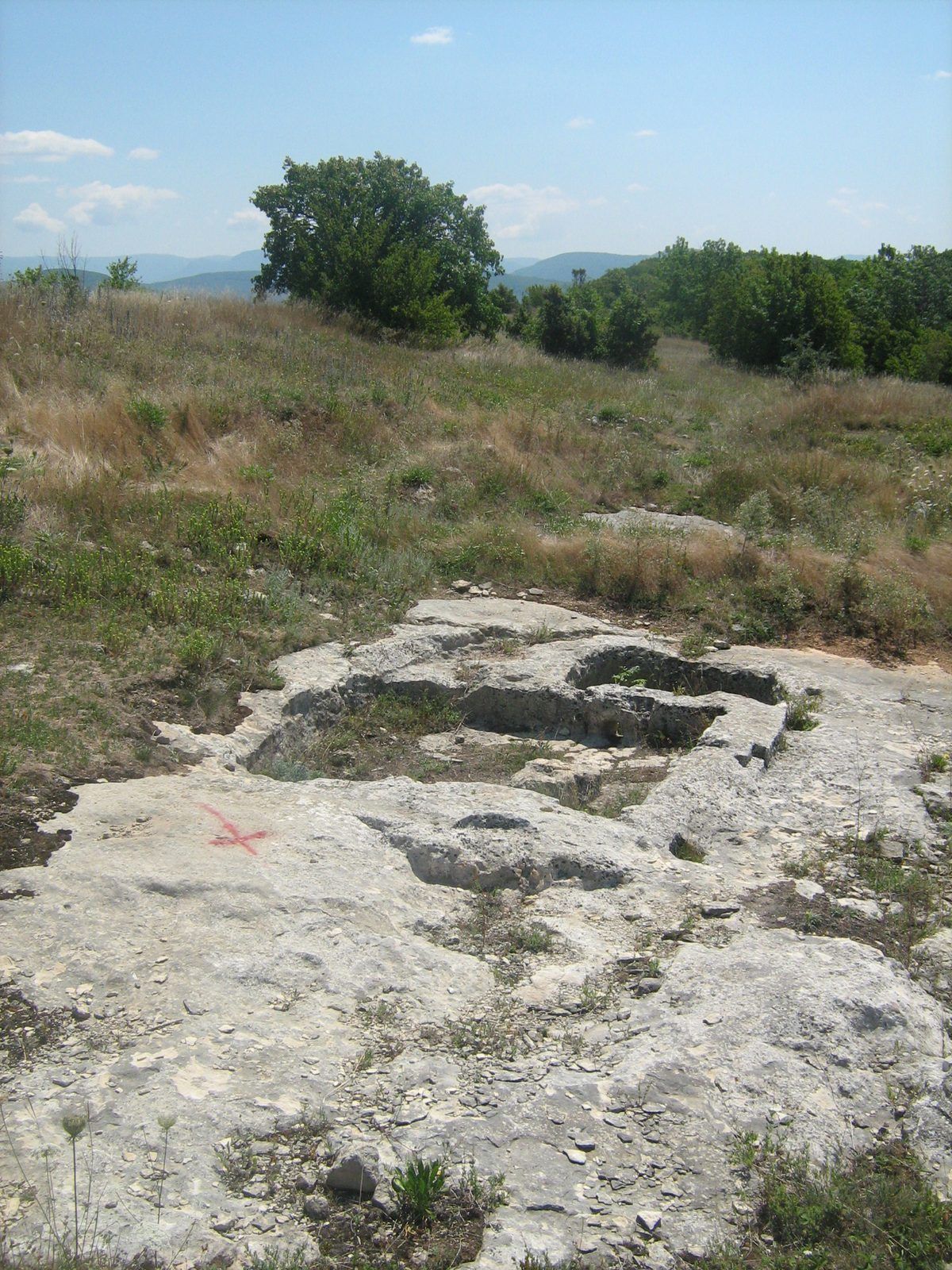
Four grape-press installations form a group at the plateau’s eastern edge, while separate installations lie along its western edge. Traces of terraces used for growing grapes also remain.
Church
A small church stood beyond the defensive wall in the fourteenth or fifteenth century.