Bakhchisaray Cave Monastery: An Orthodox Monastic Complex in Ukraine


Site at a Glance
- Rating
- 4.9
- Popularity
- Medium
- Country
- Ukraine
- Primary era
- Medieval
- Eras represented
- Medieval, Modern
- Civilizations
- Byzantine, Russian
- Site type
- Religious
- Remains
- Monastery
On this page16 sections
History
Bakhchisaray Cave Monastery is an Orthodox monastic complex in Ukraine, located near Bakhchysarai in the Mariam-Dere ravine. Its origins are disputed: one tradition attributes its foundation to Byzantine monks who venerated religious images no later than the eighth century, while another places the present monastic establishment in the fifteenth century. The earliest building is identified as the Dormition Church, the principal church dedicated to the Christian belief and feast concerning the death and bodily assumption of the Virgin Mary.
Early origins and medieval role
Nearby Christian graves dated to the sixth century have been used to support an early Christian presence around the monastery. One proposed explanation connects its foundation with monks who fled Byzantine iconoclasm, a period when imperial authorities opposed the veneration of religious images and sometimes ordered churches, paintings, and icons destroyed. Another interpretation places the foundation in the fifteenth century. The monastery may have ceased operating during part of the thirteenth or fourteenth century before being revived in the fourteenth century.
After avoiding destruction during the Ottoman invasion of 1475, the monastery became a residence of the Gothian metropolitans. A metropolitan was a senior bishop responsible for a major ecclesiastical territory. From the fifteenth through the eighteenth century, the monastery was a principal center of Orthodox religious life in Crimea. In the fifteenth century, its metropolitan was also associated with the divan, the governing council of the Crimean Khanate.
Religious center in the Crimean Khanate
The monastery served Christians fleeing persecution in Greece, and Russian ambassadors attended services there. The Russian state supported the institution through letters and financial assistance. Its continuing religious traditions became associated with the Bakhchysarai Icon of the Mother of God and with a holy spring.
Several traditions explain the icon’s connection with the monastery. One says that it was repeatedly found on the same cliff after being moved. Another relates that inhabitants followed a candle and discovered it beside a dead serpent. A third tradition holds that it came from the Byzantine monastery of Sumela near Trebizond. These accounts preserve the icon’s place in the monastery’s religious memory, although the foundation date itself remains contested.
Expulsion and decline
In 1778, under Russian authority, more than 30,000 Greek Christians were removed from Crimea and relocated northward. The monks carried the Bakhchysarai Icon of the Mother of God to the new settlement, where it was installed in a church built for it. Migrants from Mariampol later founded or settled the city known as Mariupol. Alexander Suvorov supervised the security of the relocation, and Empress Catherine II rewarded Metropolitan Ignatius of Gothia, who led the resettlement, with a diamond panagia, an Orthodox bishop’s medallion.
The monastery declined and was largely emptied after the expulsion. Only one monk may have remained, and from 1781 the complex functioned as a parish church under a Greek priest. The icon carried to the new settlement was lost there after 1918.
Nineteenth-century restoration and expansion
A monastic community returned in 1850, when the Dormition cave skete was established under the Russian Orthodox Church. A cave skete is a small monastic settlement organized around rock-cut or cave buildings. The restored monastery opened ceremonially on 15 August 1850. In 1851, Konstantin Gonyayev, the Taurida provincial architect, prepared the plan and supervised the works, receiving formal recognition from the Holy Synod.
During the First Defense of Sevastopol in the Crimean War of 1854 to 1855, the monastery’s cells, pilgrim house, and other buildings became a hospital, including a hospital for officers. Those who died of their wounds were buried in the monastery cemetery. By the beginning of the twentieth century, more than 60 monks and novices lived at the monastery. It also maintained a courtyard in Simferopol and the Saint Anastasia cenobitic community in the Kacha River valley, where monks lived under a common rule and shared communal property.
Soviet closure and renewed monastic life
After the fall of the monarchy, Soviet authorities closed and desecrated the monastery in 1921. Its property was looted, and monks were shot. The institution was finally closed under Soviet anti-religious policies. During the Second World War, the complex housed a military hospital. After the 1944 deportation of Crimean Tatars, a psychoneurological dispensary occupied the site.
In 1993, the monastery was transferred to the Ukrainian Orthodox Church of the Moscow Patriarchate. Monks returned, and restoration and reconstruction began. Four of the five churches, the residential buildings, the abbot’s house, the bell tower, the water source, and the stairway were restored or reconstructed. Archimandrite Siluan has served as abbot since 13 June 1993. The monastery is active and is described as Crimea’s largest monastic community by number of residents. New churches dedicated to Saint Panteleimon and Saint Spyridon of Trimythous were under construction, alongside a gate chapel and further repairs.
The complex is protected as an immovable monument of national significance in Ukraine and as a cultural-heritage site of federal significance in Russia, a designation dating from October 2015. The monastery was reported as occupied by Russia in February 2014.
Remains
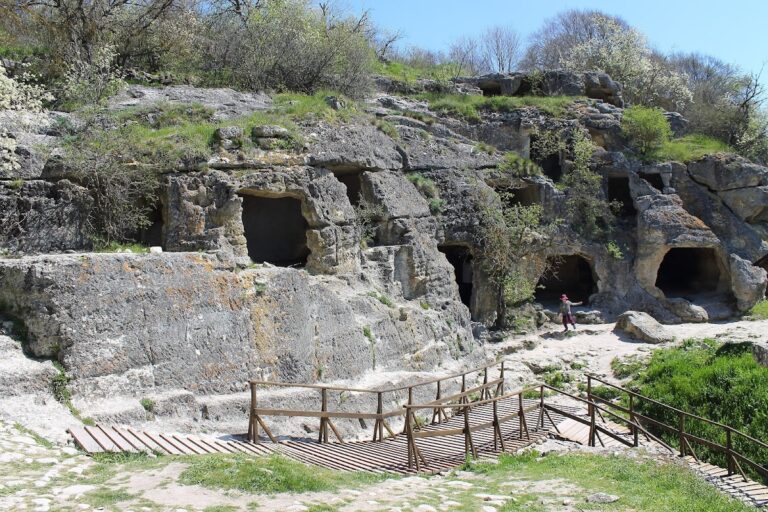
Bakhchisaray Cave Monastery occupies a vertical rock face in the Mariam-Dere ravine on the route toward Chufut-Kale. It forms an unfortified settlement that combines a cave church with rock-cut residential and utility spaces and above-ground monastic buildings. A broad stairway rises from the road into the mountain and reaches a platform on the second level. Narrower steps continue to the principal Dormition Church, which is cut into the sheer cliff.
Cave churches and rock-cut spaces
Dormition Church
The Dormition Church is identified as the complex’s earliest building and is dated to the eighth century. Its interior includes a vaulted hall, columns, and painted images. Descriptions of the church also characterize it as relatively small, with low ceilings and an interior divided into two parts by a separating ribbon. Windows cut into the rock walls overlook the ravine and the remains of Mariampol, the former Christian settlement at the foot of the monastery.
Rock-cut cells and water source
Rock-cut cells, a fountain, and the abbot’s house remain identifiable within the complex. During the nineteenth century, the caves and exposed rock surfaces were expanded and fitted out, while images of saints were painted on the cliffs. A holy water source was later arranged as part of the restored monastery and remains connected with its religious traditions.
Nineteenth-century church group
Church of Saint Mark
By the beginning of the twentieth century, the complex contained five churches. The cave Church of Saint Mark was dated to 1859 and formed part of the expanded monastic settlement.
Church of Saints Constantine and Helena
The Church of Saints Constantine and Helena was built in 1857. Its dedication honors the Roman emperor Constantine the Great and his mother, Helena, who are especially venerated in Christianity for their association with the legalization and promotion of Christianity in the Roman Empire.
Church of Saint George the Victorious
The cemetery Church of Saint George the Victorious was built in 1875. Its position within the cemetery connected the church with the burial grounds of the monastic complex.
Church of Saint Innocent of Irkutsk
The Church of Saint Innocent of Irkutsk was built in 1896 on the lower platform beside the road to Chufut-Kale. Together with the cave churches and cemetery church, it completed the five-church arrangement present by the early twentieth century.
Monastic buildings and surrounding features
The nineteenth-century complex included several residential buildings, the abbot’s house, pilgrim houses, fountains, and a fruit garden. A Gethsemane Chapel was built in the garden in 1867. The adjoining territory contains a cemetery for those who died during the Crimean War, while a mass grave of Soviet soldiers lies on the monastery grounds beside the road.
Across from the monastery are remains associated with Mariampol, including houses, rock-cut caves, and stairs. The Bakhchysarai Icon of the Mother of God was historically kept within the monastery before being carried away during the 1778 resettlement. Its former presence, together with the holy spring, continues to shape the religious identity of the complex.