Kachi-Kalon: A Medieval Cave Monastery in Ukraine

Site at a Glance
- Rating
- 4.8
- Popularity
- Low
- Country
- Ukraine
- Primary era
- Medieval
- Eras represented
- Medieval, Modern
- Civilizations
- Byzantine
- Site type
- Religious
- Remains
- Monastery
On this page16 sections
History
Kachi-Kalon is a medieval cave monastery in Ukraine, developed by Christian monastics in Byzantine-era Taurica and dedicated to St Anastasia the Deliverer from Bonds. Its artificial caves are generally dated from the sixth to eighth centuries, while the monastery’s formation is considered most probable in the eighth century. The settlement flourished especially during the eighth and ninth centuries.
Byzantine foundations
During Byzantine iconoclasm, a period when religious images became the subject of intense political and theological conflict, monks moved from the empire’s central regions to Taurica and founded cave monasteries there. Kachi-Kalon adopted the rule of Theodore the Studite in 826. Theodore was a Byzantine monastic leader who strongly defended the veneration of religious images. A correspondence between John of Gothia, a Christian bishop associated with a historical ecclesiastical region in Crimea, and Stephen of Sourozh mentions the monastery. No written records of its contemporary daily life have survived.
The monastery’s religious dedication was connected with St Anastasia the Deliverer from Bonds, a Christian martyr traditionally invoked in relation to deliverance from suffering and confinement. Kachi-Kalon was organized as a coenobium, a monastery where monks lived communally under a shared rule. Whether this community operated independently or was subordinate to the nearby Uspensky Anastasiyevsky cave monastery remains uncertain. That neighboring monastery later housed the residence of the Metropolitan of Gothia in the eighteenth century.
Crimean Khanate and eighteenth-century upheaval
Kachi-Kalon remained active during the period of the Crimean Khanate. In 1598, Tsar Boris Godunov granted alms to the church of St Anastasia, and Tsar Michael Fyodorovich later provided financial support to the monastery.
The community was deeply affected by the political transformation of Crimea and the removal of its Christian population in the eighteenth century. Metropolitan Ignatius of the Gothia-Kafa diocese, the Orthodox diocese serving Christian communities in parts of Crimea, helped organize the Christian resettlement to the Azov region. Pursued by Crimean Tatar nobles, he hid at Kachi-Kalon for about a month and a half. The Christians leaving Crimea passed through the Kacha Valley and carried away the monastery’s revered icon of St Anastasia.
After the expulsion of Christians from Crimea to the Azov region in 1778, the monastery declined. By the end of the eighteenth century only one hermit remained. The community was then emptied, and the church and other monastic buildings gradually deteriorated.
Revival and twentieth-century suppression
The monastery was revived in 1850 on the initiative of Archbishop Innocent Borisov. In 1849, following an appeal from Archpriest Mikhail Rodionov, Innocent proposed to the Holy Synod that ancient holy places in the Crimean mountains be restored. He recommended the Athonite skete form, a smaller and more secluded type of Orthodox monastic establishment. Emperor Nicholas I approved the proposal, and the restored skete was placed under the nearby Uspensky cave monastery.
Archbishop Innocent visited Kachi-Kalon and its spring on 13 August 1850, consecrating a second side chapel in the church of St Anastasia to the Passion Icon of the Mother of God. In 1851, the estate passed to the jurisdiction of the Bakhchisaray Uspensky skete through the testament of its owner, G. Khvitsky, and a decision of the Synod. In 1888, a second ancient church was restored with donations from pilgrims from Moscow and the participation of nuns from the monastery. It was dedicated to the martyrs Sophia, Faith, Hope, and Love, who are commemorated together in the Orthodox tradition.
By the early twentieth century, the Anastasia community was known to local Christians and pilgrims. After the Bolsheviks came to power, the monastery was suppressed. A decision dated 20 June 1932 ordered the liquidation of the monastic compound and church, the confiscation of church property, and their transfer to a state farm for cultural use. The fate of the monks is unknown. The church and cells were later blown up and dismantled, reportedly for road construction.
Modern foundations and protection
A new skete bearing the name Kachi-Kalon was established in 2005, some distance from the historic monastery, on a mountain slope at an abandoned stone quarry dating from the middle of the twentieth century. Hieromonk Dorotheus Voloshin of the Bakhchisaray Holy Dormition Monastery initiated the revival with the blessing of its abbot, Archimandrite Siluan. The skete regards 28 May 2005 as its founding date and is headed by Abbot Dorotheus.
The modern skete was severely damaged by fire on 28 January 2018. The kitchen, nine cells, boiler room, refectory, two-storey church shop, and workshops burned, destroying almost half of the monastery’s buildings. No people were harmed, and the bead-decorated church survived. Archaeological and volunteer expeditions in 2016, 2018, and 2020 cleaned more than twenty cave structures of vandalism inscriptions. The 2020 work involved staff from the Bakhchisaray Historical and Cultural Reserve.
Kachi-Kalon is protected in Ukraine as a nationally significant cultural-heritage monument. In Russia, which has controlled Crimea since its occupation in 2014, it is designated a cultural-heritage site of federal significance. The complex forms part of the Bakhchisaray Historical and Cultural Reserve and is included in the Bakhchisaray Regional Landscape and Recreational Park. The protected area includes the cave monastery and material dated from the eighth century to the end of the nineteenth century.
Remains
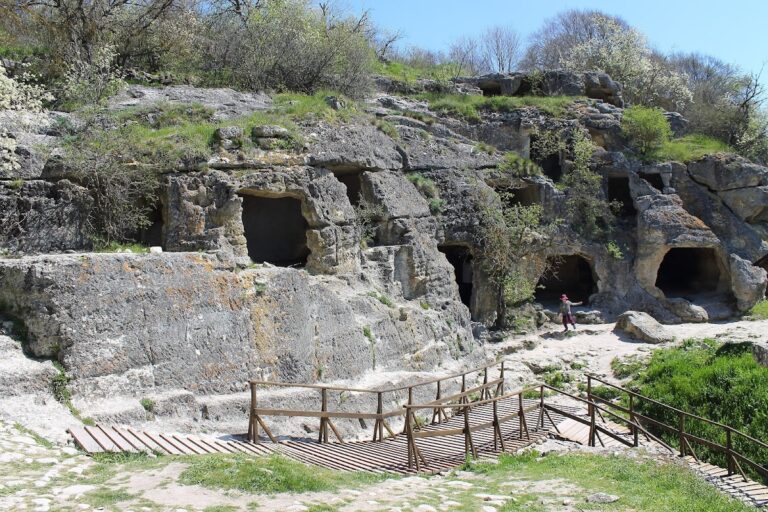
Kachi-Kalon occupies the right slope of the Kacha River valley beneath the cliffs of the Inner Mountain Range, above the Bakhchisaray-Sinapnoye road and between Predushchelne and Bashtanovka. Its caves lie on a rocky spur between approximately 450 and 510 metres above sea level. About 250 artificial caves of different periods and functions were cut mainly into the walls of five large natural grottoes. The complex includes domestic, productive, residential, ecclesiastical, and ritual spaces connected by terraces, crawlways, and stairways, some of which survive in partial form.
Grottoes and cave groups
First grotto
The first grotto contains the church of St Sophia and a wine-production complex. The church is among the religious spaces cut into the grottoes, whose rock walls carry crosses and Greek inscriptions. The nearby production area forms part of the settlement’s network of presses, cisterns, and associated buildings.
Second and third grottoes
The second grotto contains a monastic dormitory. The third grotto forms another major cave group within the complex. Between the large grottoes, groups of about thirty to fifty caves were cut into near-vertical rock faces and arranged on several levels. Terraces, crawlways, and stairways linked these groups.
Fourth and fifth grottoes
The fourth grotto is associated with the monastery of St Anastasia. The fifth is partly ruined. Together, the grottoes preserve the principal divisions of the settlement, while individual caves within them served different domestic, residential, productive, and religious purposes.
Rock formation and enclosure
The rocky spur resembles the bow of a large ship, and cracks across its upper surface form a cross. This appearance is associated with the name Kachi-Kalon, usually translated as “Cross Ship.” Large limestone blocks lie below the cliff and on the steep slope. Some are as large as a two-storey building and retain traces of quarrying.
A dressed-stone wall about one metre thick formerly enclosed the site on its northwestern side. Much of the Burun-Kaya promontory is occupied by an old cemetery. Gabled gravestones and stone boxes survive there, providing physical evidence of burial practices connected with the settlement.
Wine production and water management
Numerous rock-cut cisterns and wine presses point to a substantial wine-making economy. The presses could process as much as 250 tonnes of grapes at one time. Buildings associated with this activity date from the tenth and eleventh centuries. The mountain spring connected with the monastery had almost dried up by the beginning of the twenty-first century.
Churches and burial remains
Historic church of St Anastasia
The historic church of St Anastasia has been destroyed. Its former place belongs to the fourth grotto, the area associated with the monastery’s principal dedication. The church’s history is preserved through the wider cave complex and through the later church restored in 1888 in a separate fallen block.
Cave church restored in 1888
The cave church restored in 1888 was cut into a huge detached block that had fallen from the cliff. It stands on the mountain about 350 metres from the former church of St Anastasia. The small structure measures approximately 4 by 2.5 metres and is oriented southeast.
Two entrances open into the surviving church. Rainwater channels were cut above one entrance, while an equal-armed cross occupies a niche above it. Icon niches are set into the northern and southern walls. The walls were finished with oblique pick marks and plastered, and stone benches were carved for worshippers. A burial covered by stone slabs lay in the southern part of the floor, with ancient burials and ossuaries around the church. An ossuary is a place where human bones are stored after burial or reinterment.
Modern church of St Anastasia
The skete founded in 2005 contains a church dedicated to St Anastasia inside one of its caves. Its interior is decorated with beadwork. A spring on the skete grounds was consecrated to St Sophia, Divine Wisdom.
Archaeological investigation of Kachi-Kalon has not been comprehensive, but materials recovered in the immediate surroundings support the dating of the settlement’s principal flourishing to the eighth and ninth centuries.
Nearby sites