Kyburg Castle: A Medieval Noble Fortress and Castle Residence in Switzerland


Site at a Glance
- Rating
- 4.5
- Popularity
- Medium
- Country
- Switzerland
- Primary era
- Medieval
- External website
- Open
- Eras represented
- Medieval, Early Modern
- Civilizations
- Habsburg, Holy Roman Empire
- Site type
- Military
- Remains
- Castle
On this page13 sections
History
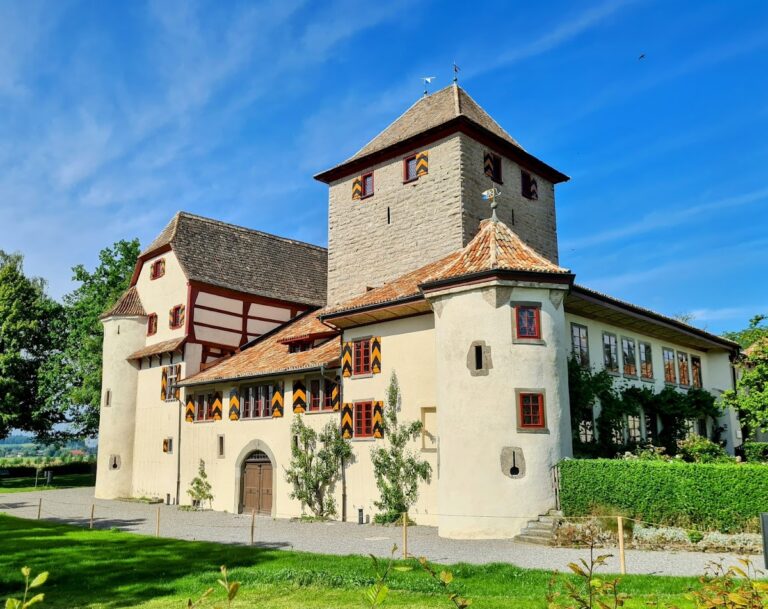
Kyburg Castle is a medieval noble fortress and later castle residence in Switzerland, standing above the Töss south of Winterthur near Kyburg. Its earliest phase was established by the eleventh century, probably by Liutfried II of Winterthur, and the complex later became the administrative center of the County of Kyburg. The substantially preserved buildings reflect successive medieval, early-modern, and modern changes.
Origins and the Counts of Kyburg
The site was first recorded in 1027 as Chuigeburg. Other early forms of the name include Chuoiburk, Chuoweburg, Chuoburg, Qwiburg, and Chiburg. The name probably derives from an Old High German term for a place or mountain where cattle stayed. A later, possibly deliberate change may have connected it with the Middle High German word kîp, meaning quarrel or defiance, which gave the name a more fortress-like association.
Liutfried II of Winterthur is regarded as the probable builder of the original castle. In 1025, it may have provided refuge for Count Werner of Winterthur after he joined Duke Ernest of Swabia in rebellion against his stepfather, Emperor Conrad II. Once the rebellion had been suppressed, Werner and Ernest fled to Kyburg. Imperial forces captured and destroyed the castle in 1027. Werner later died on 17 August 1030 near Falkenstein Castle in the Black Forest while fighting the forces of Warmann, Bishop of Constance.
After the Winterthur family died out in the middle of the eleventh century, its inheritance passed to the House of Dillingen through the marriage of Adelheid of Winterthur-Kyburg to Count Hartmann I of Dillingen. Hartmann fought with supporters of the papacy against the emperor-loyal abbot of St. Gall and lost Kyburg in 1079. His grandson Hartmann III of Dillingen later adopted the name Hartmann I of Kyburg and married Richenza of Lenzburg-Baden.
The extinction of the Lenzburg and Zähringer dynasties, in 1173 and 1218 respectively, transferred their lands and lordship rights to the House of Kyburg. Alongside the Habsburgs and Savoys, the Kyburgs became one of the important noble houses between the Rhine and the Alps. The Kyburg line ended in 1263. Through Anna of Kyburg, its inheritance passed to the Counts of Habsburg-Laufenburg, who sold most of it to Rudolf of Habsburg.
Habsburg administration and Zurich rule
Kyburg lost political importance after Rudolf of Habsburg was elected German king, although the imperial regalia, the ceremonial objects associated with medieval German kingship and the Holy Roman Empire, were kept there from 1273 to 1325. Under Habsburg administration, part of the former Kyburg inheritance was organized as the County of Kyburg, with the castle as its administrative center.
Zurich acquired the county in 1424. Its first bailiff, Johannes Schwend the Elder, ordered repairs to the dilapidated castle. Austria demanded its return in 1442 as compensation for its support during the Old Zurich War, a conflict between Zurich and the Habsburg-backed side. In 1452, Zurich raised 17,000 gulden and received the county as a pledge. King Maximilian I renounced his rights in 1499, leaving Kyburg to Zurich.
Until 1798, prominent citizens of Zurich served as territorial bailiffs, or landvogts, at Kyburg for six-year terms. They held court and collected taxes, and the office often served as a step toward Zurich’s mayoralty. Johann Heinrich Waser and Heinrich Escher were among those who followed this path. Ludwig Lavater, later archdeacon of the Grossmünster and senior clerical leader of Zurich’s Reformed Church, was born at Kyburg as the son of bailiff Hans Rudolf Lavater. Fifty-nine Zurich bailiffs lived at the castle in total.
From administrative center to museum
The bailiff administration ended in 1798 with the establishment of the Helvetic Republic. In March of that year, peasants occupied and plundered Kyburg but allowed the last bailiff, Hans Caspar Ulrich, who lived from 1741 to 1817, to leave freely.
Kyburg became the seat of an upper administrative office, or district authority, in 1815. This change helped prevent the buildings from falling into ruin. After the canton of Zurich was reorganized in 1831, the castle lost its administrative role. The canton auctioned it in 1832 to Franz Heinrich Hirzel, a Winterthur coffee-house owner, for 10,600 francs. He planned to demolish the complex and sell its stone as building material, but citizens of Winterthur stopped the scheme.
Hirzel sold Kyburg in 1835 for 12,000 gulden to Count Alexander Sobansky, a Polish refugee who had taken part in the 1830 uprising against Russia and fled after its suppression. Sobansky and his wife lived at Kyburg for nearly thirty years with their two sons. In 1864, the castle passed to Lieutenant Colonel Matthäus Pfau of Winterthur, who displayed his painting collection there. After his death, the buildings remained empty for nine years.
In 1889, the merchant Eduard Bodmer Thomann of Oetwil am See, assisted by the art historian Rudolf Rahn, restored the castle and opened it as a museum arranged in the spirit of medieval romanticism. Thomann personally guided visitors through the rooms. The Canton of Zurich repurchased the complex from his heirs in 1917 for 150,000 francs. Alterations made from 1925 to 1927 partly reversed earlier changes. The exhibition remained in place until 1999, when the Association Museum Schloss Kyburg assumed its operation and installed a new permanent exhibition under Dione Flühler-Kreis. Kyburg is classified as a cultural property of national importance in Switzerland.
Remains
Fortifications and principal buildings
Kyburg occupies a hill spur approximately 629 metres above sea level, high above the Töss. The earliest phase, probably present in 1027, consisted of wooden buildings protected by a palisade. The oldest archaeologically demonstrated structures date from about 1150 to 1250. They include the bergfried, the principal defensive tower of a medieval German-speaking castle, the palas, its main residential and representative building, a chapel, three stone houses, and a southwest corner tower.
Bergfried and defensive walls
A shield wall, a particularly strong defensive wall protecting a vulnerable side, was built between the bergfried and the palas in the thirteenth century. After the castle came under Habsburg control, the southwest corner tower was demolished, the complex was extended southward, and a northern perimeter wall with a castle gate was added. A major fire sometime between 1250 and 1370 was followed by extensive renewal. The upper part of the bergfried was later reconstructed in tuff, and after Zurich acquired Kyburg a high entrance was installed 11 metres above ground level.
Palas and Ritterhaus
By about 1370 at the latest, the palas had been built. Each floor provided 290 square metres of living space, making it one of the largest buildings of its type in the German-speaking world. Further rebuilding followed Zurich’s acquisition in 1424. In 1472, the south facade of the Ritterhaus was rebuilt because the ground beneath it had become unstable. The present appearance of the castle is substantially that of around 1500, although later alterations remain visible in the fabric.
The entrance area is reached by a bridge leading to the main portal. Other identified features include a ruling coat of arms, an imperial eagle, the courtyard, a wall-walk, Dragon’s Hole, the Halberd Room, a niche, and a hall.
Chapel and painted decoration
Romanesque chapel
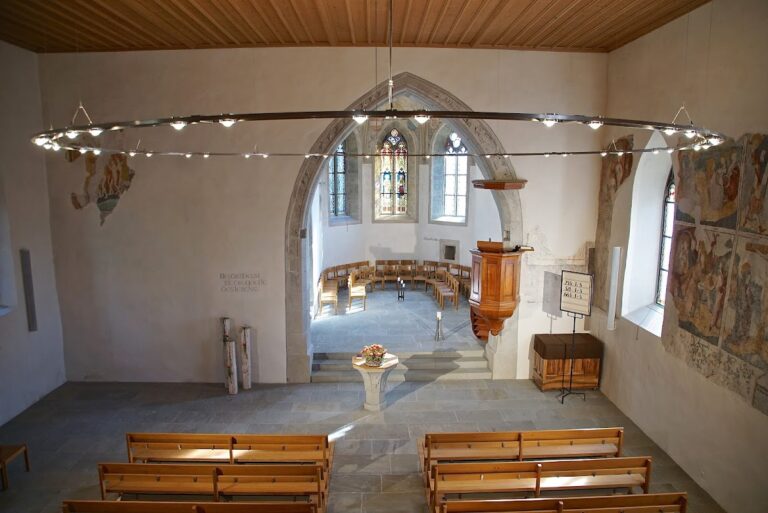
The chapel’s construction date is unknown, but it is estimated at around 1200. Its essentially preserved Romanesque plan, a medieval form associated with heavy masonry and rounded arches, consists of a nave, choir, and side choir. Changes supposedly made around 1308 by Agnes of Hungary can no longer be identified.
Medieval wall paintings
The nave and choir were painted in 1440 on the orders of Zurich’s first bailiffs. Around 1480, bailiff Felix Schwarzmurer commissioned a cycle showing the life of Regula, traditionally regarded as Zurich’s patron saint. The decoration also includes several saints, an Annunciation showing the angel Gabriel announcing to Mary that she would bear Jesus, and an Adoration of the Magi depicting the biblical visit of the Three Kings to the infant Jesus.
The style of the nave and choir paintings points to a workshop from the Lake Constance region, while the side choir was painted by a local artist from northeastern Switzerland. Matthäus Pfau rediscovered and uncovered the paintings in 1865. Eduard Bodmer later restored and partly supplemented them. Between 1992 and 1996, the paintings were investigated and conserved on behalf of the cantonal monument-preservation authority.
Later alterations and interior objects
After the Reformation, the sixteenth-century religious transformation that established Protestant churches in parts of Europe including Zurich, the chapel’s wall paintings were covered with plaster in 1515 and the building was converted into an artillery store. In 1624, it was divided into two levels. The chapel is also said to have housed the imperial regalia in the fifteenth century in an iron-bound chest.
The Iron Maiden
The Iron Maiden is a thin wooden construction covered with iron and measuring 2.37 metres in height. Matthäus Pfau acquired it from a castle in Carinthia in 1876 and installed it at Kyburg to attract visitors. It stood in the torture chamber until 1999 and is now displayed in the Knight’s House. The object was not a medieval torture instrument: contemporary records do not mention it, its material is not medieval, and its spikes are directed toward a person more than two metres tall.
Nearby sites