Wagenburg: Medieval Castle Ruin in Switzerland


Site at a Glance
- Rating
- 4.3
- Popularity
- Very Low
- Country
- Switzerland
- Primary era
- Medieval
- Eras represented
- Medieval
- Civilizations
- Habsburg, Holy Roman Empire
- Site type
- Military
- Remains
- Castle
On this page7 sections
History
Foundation and Medieval Lordship
Wagenburg, also known as Wagenberg, is a medieval castle ruin near Oberembrach in Switzerland. Established in the thirteenth century, it was a spur castle built on a projecting ridge and formed the center of a lordship created through land clearance. The castle controlled the high and low jurisdictions of Oberembrach and Lufingen. High jurisdiction concerned serious crimes, while low jurisdiction covered lesser offenses and local civil matters.
The castle was used by the Wagenbergers, a medieval noble service family serving higher-ranking lords, who were first recorded in 1263. The family held the castle under the Kyburg and later Habsburg ruling houses. The Wagenbergers remained there until about 1305. From 1320, Wandelberg near Benken in the Gaster was identified as their ancestral seat. Their arms, showing a half-gold lion on a black field, later provided the basis for Oberembrach’s coat of arms.
Changing Ownership
During the fourteenth century, Wagenburg passed by marriage to the Lords of Heidegg. They also held it as a Habsburg fief, and the castle remained in their possession until 1451. In that year, Hans and Peter Küfer gave the jurisdictions associated with Wagenburg to the city of Zurich.
The castle’s ownership at this point is less certain. Rudolf Meiss, a former mayor of Zurich, may have acquired it in 1451, although that transaction may instead have involved the Wagenburg estate near Seegräben. The more probable interpretation is that the Küfer family retained the castle and later in the fifteenth century sold it to the Bosshard family of Hörnen near Bauma.
Destruction
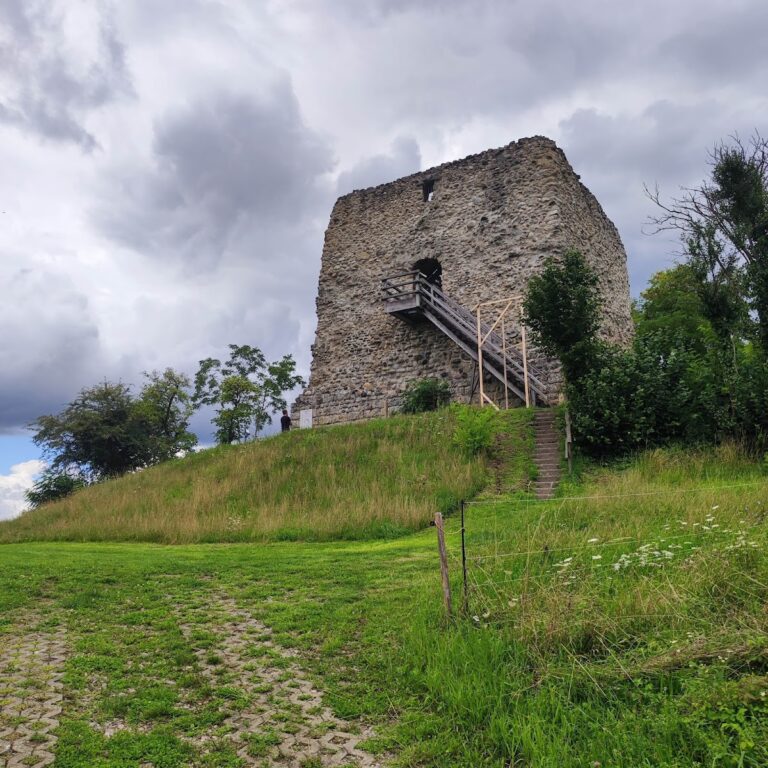
In 1556, the castle burned because of carelessness during the retting of hemp, a process used to prepare hemp fibers. The fire completely destroyed the occupied buildings. Wagenburg is now classified as a castle site or ruin rather than a standing castle, with only a few wall remains surviving.
Remains
Spur Setting and Defenses
The ruins stand at about 580 metres above sea level on Schlossbuck, approximately two kilometres east of Oberembrach. The castle occupied a projecting spur protected on three sides by steep slopes. To the south, the ground falls toward the Wildbach, while the northern slopes descend toward the Tobelbach; the two streams meet west of the ruins.
An eastward neck ditch, cut across the narrow connection between the spur and the surrounding terrain, protected the castle. Beyond it probably stood a zwinger, an outer defensive zone between fortifications. A shield wall, more than two metres thick, followed farther west and protected the most exposed side of the castle.
Inner Castle
Behind the shield wall lay the inner castle. Its several buildings were probably arranged around a courtyard enclosed by the surrounding wall. The former buildings have largely disappeared, and the surviving remains are in a ruinous condition.
Nearby sites