Cardigan Castle: A Medieval Fortress on the River Teifi



Site at a Glance
- Rating
- 4.3
- Popularity
- Medium
- Country
- United Kingdom
- Primary era
- Medieval
- External website
- Open
- Eras represented
- Medieval, Modern
- Civilizations
- British, English
- Site type
- Military
- Remains
- Castle
On this page16 sections
History
Cardigan Castle is a medieval Norman fortress in Cardigan, United Kingdom, whose history began around 1093 during the Norman conquest of Wales. The castle is historically important for its association with the Welsh prince Lord Rhys and for the elaborate gathering held there in 1176, traditionally regarded as the first recorded Welsh eisteddfod, a Welsh competition in poetry, music, and artistic performance.
Norman foundations and Welsh conquest
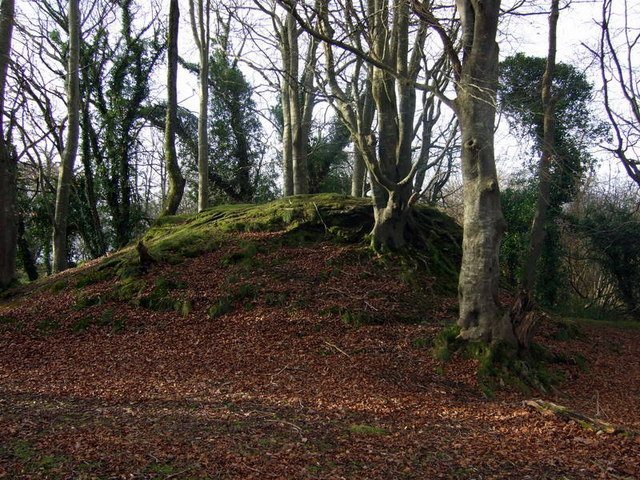
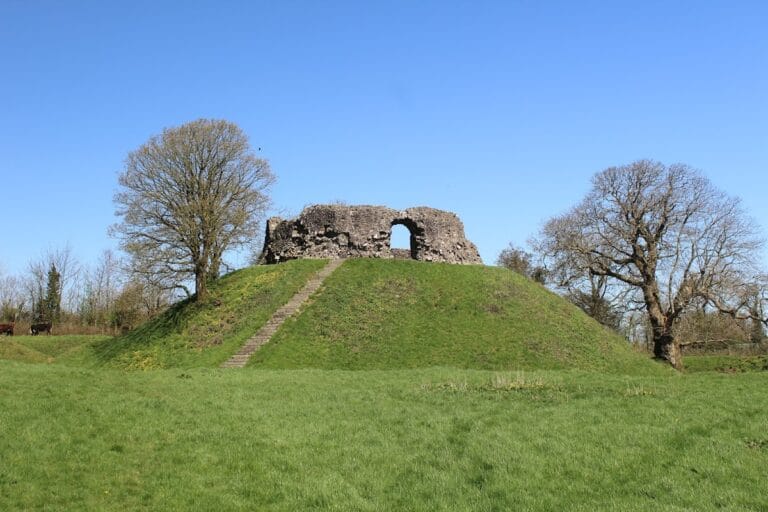
The earliest Cardigan fortress was a motte-and-bailey, a raised earth mound with a fortified residence beside an enclosed area for buildings and activity. Built around 1093 by the Norman baron Arnulf de Montgomery, it stood approximately one kilometre downstream from the present castle. Welsh forces attacked it in 1094, and Cadwgan ap Bleddyn of Powys destroyed it in 1096.
King Henry I took Cardigan from Prince Owain ap Cadwgan in 1110 as a punishment, then granted the lordship and castle to Gilbert Fitz Richard. Gilbert’s son, Gilbert de Clare, later built an Anglo-Norman fortress at the present location. Anglo-Norman describes the Norman-French ruling presence that developed in Britain after the conquest of England and extended into the Welsh borderlands.
Gilbert de Clare, 1st Earl of Pembroke, inherited the castle in 1136. In the same year, Owain Gwynedd defeated the Norman rulers of Cardigan at the Battle of Crug Mawr. The town was captured and burned, while the castle was successfully defended. Further Welsh attacks and sieges failed in the following decades, partly because supplies could reach the fortress by sea.
Lord Rhys and the Welsh principality
Rhys ap Gruffydd, ruler of Deheubarth, a medieval Welsh kingdom in southwestern Wales, captured Cardigan in the mid-1160s. Known in English as Lord Rhys, he rebuilt the earlier timber fortress in stone in 1171. In 1176 he hosted an elaborate Christmas celebration, inviting Welsh bards, poets, and musicians to compete. This gathering is traditionally treated as the first recorded Welsh eisteddfod.
After Lord Rhys died in 1197, his sons Maelgwn and Gruffydd disputed the inheritance. Maelgwn surrendered Gruffydd to the Normans and sold the castle to King John around 1200. The castle was later held for William Marshal, 1st Earl of Pembroke.
Thirteenth-century conflict and rebuilding
Llywelyn the Great, the leading ruler of Gwynedd and a major Welsh opponent of Norman and English power, captured Cardigan in 1215. At the council of Aberdyfi in 1216, he transferred the castle to the sons of Gruffydd ap Rhys of Deheubarth. William Marshal, 2nd Earl of Pembroke, recaptured it in 1223, but Rhys Gryg and his allies took it again for Llywelyn in 1231. It remained under Llywelyn’s control until his death in 1240.
Cardigan then returned to Norman or English control. The castle passed to the English Crown in 1241, and in 1244 Gilbert, Earl of Pembroke, rebuilt and enlarged it while adding town walls for greater protection. This work continued into the period from 1244 to 1254, and the principal surviving medieval fabric is generally attributed to this phase. Edward I visited Cardigan in 1284 and again in 1295.
Royal residence and later medieval use
From 1376, Cardigan Castle was the residence of Joan of Kent, widow of Edward, the Black Prince. Until her death in 1385, she was Princess of Wales and Lady of Cardiganshire. The castle was unsuccessfully besieged during the rebellion led by Owain Glyndŵr, the Welsh prince who directed a major revolt against English rule from 1400 to 1415. Substantial renovation followed between 1428 and 1432.
In 1501, the castle was given to Catherine of Aragon on the occasion of her marriage to Arthur Tudor, Prince of Wales. Its military usefulness declined, and the castle gradually deteriorated.
Civil War destruction and private ownership
Royalist troops occupied Cardigan Castle in June 1644 during the English Civil War. Parliamentary forces captured it after a three-week siege in December, bringing ship-mounted guns onto land for the attack. A Royalist attempt to retake the castle failed in 1645. Parliamentary troops then burned the castle and demolished parts of its walls to prevent its reuse as a military stronghold.
After the Civil War, the ruined castle passed into private ownership. In 1713 Thomas Brock levelled parts of the site and created a bowling green. John Bowen commissioned Castle Green House within the castle walls between 1805 and 1808, and its front range was added in 1827.
Decline, restoration, and renewed use
The castle and house were bought in 1940 by an unnamed shipping magnate. His daughter, Barbara Wood, and her mother lived in Castle Green House while the estate progressively deteriorated. Local authorities attempted to take over the property in 1971, and the house was declared unfit for habitation in 1984. Barbara Wood, the castle’s last occupant, left for nursing-home care in 1996 and placed the property on the private market in 2001.
Ceredigion County Council purchased the approximately 8,000-square-metre property in April 2003 as part of the regeneration of Cardigan. Restoration and stabilisation addressed the decaying house, unstable walls, and ruined castle fabric, with work associated with the Cadwgan Building Preservation Trust and Friends of Cardigan Castle. Castle Green House appeared in the second series of the BBC programme Restoration in 2004, and the restored site opened to the public on 15 April 2015.
Cardigan Castle is a Grade I listed building and a Scheduled Monument. Grade I listing denotes exceptional architectural or historic interest, while a Scheduled Monument is a legally protected archaeological or historic site of national importance. The grounds, including pleasure and kitchen gardens within the former ward, are listed Grade II on the Cadw/ICOMOS Register of Parks and Gardens of Special Historic Interest in Wales. The restored complex now combines heritage and education spaces, accommodation, a restaurant, rooms for classes and events, and facilities for open-air performances.
Remains
Site setting and medieval fabric
The castle occupies a strategic position on the north bank of the River Teifi, where the river was navigable to Cardigan. It stands beside the bridge built across the river in 1728 and overlooks the water from the town centre. The present remains are arranged within the former fortified area, with medieval walls and towers integrated into later buildings and landscaped grounds.
River wall and eastern towers
Southern curtain wall
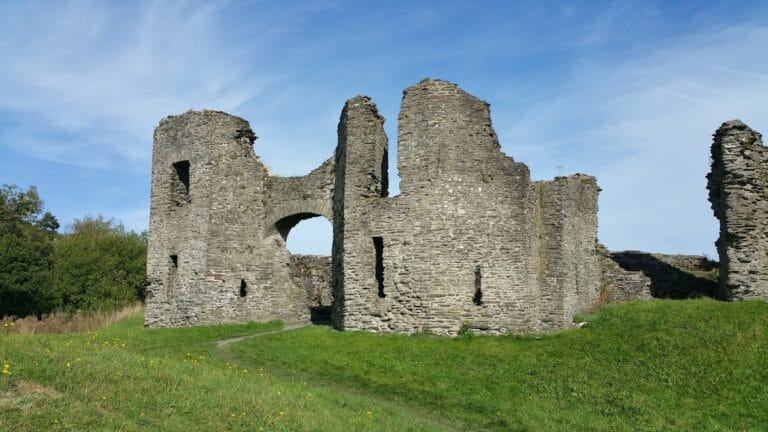
The principal surviving medieval fabric probably belongs to the English rebuilding and enlargement carried out after 1244. Sections of the southern curtain wall, a defensive wall enclosing the castle’s fortified area, survive beside the river. Parts of the wall became dangerously unstable during the late twentieth century, including a section that fell in 1984, and the surviving fabric was later stabilised and restored.
Eastern round towers
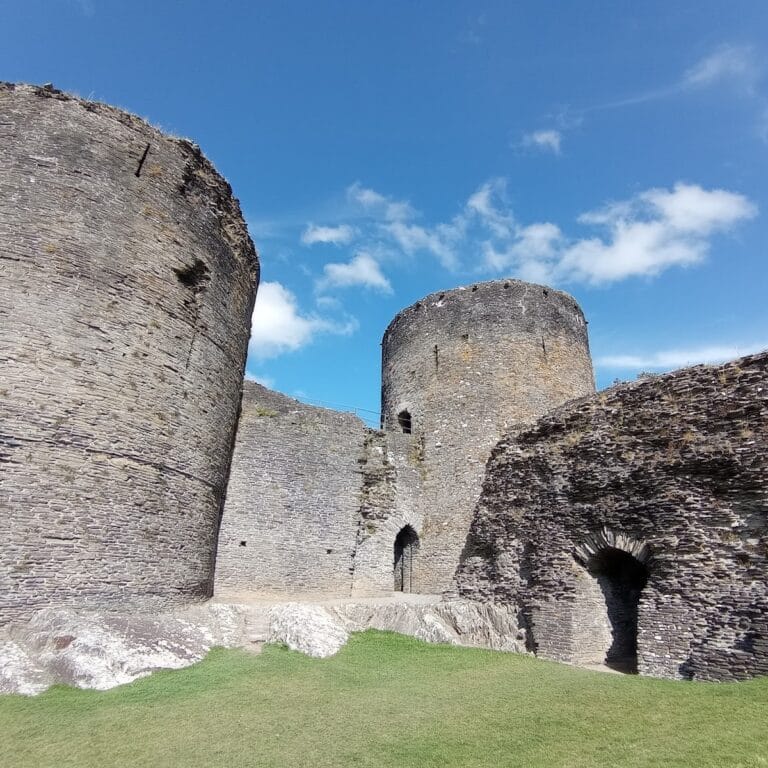
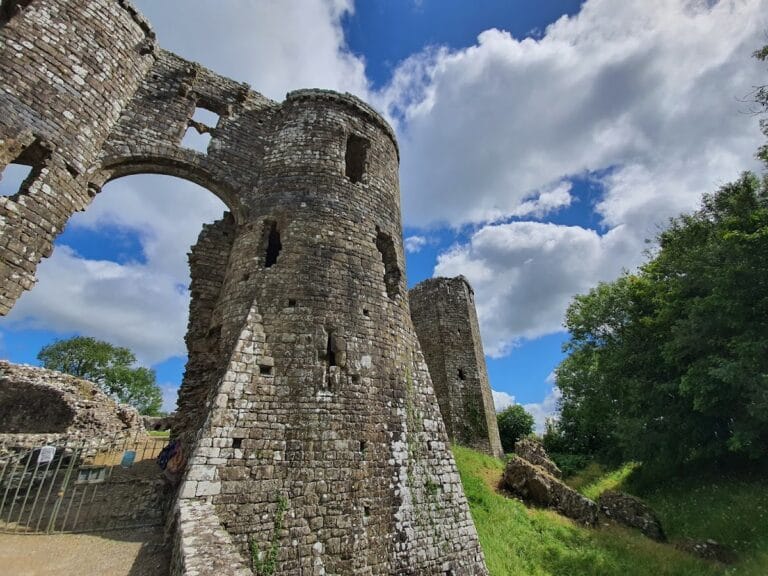
Two medieval round towers survive on the eastern side of the castle. The ruin of a medieval round North Tower was incorporated into the rear of Castle Green House, preserving a physical connection between the later country house and the earlier fortress.
Castle Green House and the landscaped ward
Georgian country house
Castle Green House is a substantial two-storey Georgian country house built inside the medieval walls between 1805 and 1808. Its front range dates from 1827. The building was later restored as part of the wider work that stabilised the castle walls and adapted the site for cultural use.
Pleasure and kitchen gardens
The former bailey was landscaped as a garden during the eighteenth and nineteenth centuries. Its grounds contain pleasure gardens and a kitchen garden. After the Second World War, the grounds became overgrown before being incorporated into the restored complex, which includes exhibition and education spaces, accommodation, the restaurant called “1176,” rooms for classes and events, and an outdoor performance area.
Twentieth-century defensive feature
A small pillbox, or observation bunker, was constructed on the curtain wall during the Second World War. It forms part of the later military history preserved within the medieval castle’s fabric.