Château d’Estaing: A Historic Seigneurial Residence in France


Site at a Glance
- Rating
- 4.3
- Popularity
- Medium
- Country
- France
- Primary era
- Medieval
- Eras represented
- Medieval, Early Modern, Modern
- Civilizations
- French
- Site type
- Domestic
- Remains
- Castle
On this page13 sections
History
Château d’Estaing is a former seigneurial residence in Estaing, France, built by the d’Estaing family from the eleventh century and substantially remodelled during the fifteenth, sixteenth, and seventeenth centuries. Standing above the village in the historic Rouergue region, it was connected to the counts of Rouergue and became the centre of a barony attested in 1028.
The d’Estaing family
The castle was associated with numerous military and religious figures who shaped the history of Rouergue and France. Cardinal Pierre d’Estaing and François, bishop of Rodez, were traditionally said to have been born there. The family’s long association with the residence continued into the seventeenth century, when Joachim d’Estaing, lord of Enval and Murol, became viscount of Estaing in 1657.
Joachim probably became the last member of the family to live at the castle. After serving in the king’s armies, he retired there around 1660, carried out genealogical research into his family, and made his will at the residence in 1673.
Succession and forged genealogies
Charles François d’Estaing, the last representative of the senior branch, died without children on 10 September 1729 at the age of 36. Seals were placed on the castle in 1732 in the presence of Abbé Joachim d’Estaing. Ownership of the castle and the viscounty then passed to Charles-François d’Estaing, Viscount of Ravel.
When the seals were removed in 1750, the family archives reportedly included a locked metal chest containing documents and genealogical objects intended to demonstrate the antiquity of the d’Estaing line. The collection included supposed twelfth- and thirteenth-century documents, a text allegedly issued by Philip Augustus after the Battle of Bouvines, and bronze plaques joined by silver rings that traced a genealogy from Roderic, the last Visigothic king, to 1222. These objects were later established to be forgeries without historical plausibility.
Charles Henri d’Estaing (1729–1794), the only son associated with the later senior line, used the forged material to advance his position. He became an admiral and fought in the American War of Independence. After the death of his infant son, he legitimised his half-sister Lucie Madeleine d’Estaing (1743–1826), Viscountess of Ravel, and named her his universal heir.
Revolutionary and institutional changes
The French Revolution led to the castle’s sale as national property, meaning property confiscated and sold by the revolutionary state. Lucie Madeleine d’Estaing regained possession in 1793. After her death, the castle was sold again, and by 1838 it had become a girls’ boarding school. The Sisters of Saint-Joseph bought it in 1836 to establish a convent and boarding school, an institution that continued until the property passed to the municipality of Estaing in 2000.
In February 2005, former French president Valéry Giscard d’Estaing, who held office from 1974 to 1981, bought the castle with his brother Olivier Giscard d’Estaing and their cousin Philippe. They presented the purchase as a patronage project supporting restoration and the opening of several rooms to the public. Proposed uses also included concerts, meetings, conferences, and a place for Valéry Giscard d’Estaing’s personal archives from the European Convention, the political body that prepared a proposed constitutional framework for the European Union in the early 2000s.
Both the 2000 and 2005 sales took place without competitive tender or public advertising and prompted criticism. The Sisters of Saint-Joseph had sold the castle to the municipality below market value so that it would remain public property rather than pass to a foreign buyer. The municipality stated that managing the monument had become burdensome and that new ownership might increase its renown. The Valéry Giscard d’Estaing Foundation has been based at the castle since 2012.
The castle entered the register of historic monuments in 1928. The castle, entrance pavilion, and terraces were classified in their entirety by a decree of 6 January 1945. The twentieth-century Saint-Joseph Chapel was separately registered in 2018. In 2013, a bust of Tristan Dieudonné d’Estaing was found in a house at Fijaguet. It was presented to the foundation on 5 July 2014 during the Saint Fleuret celebrations and is exhibited at the castle.
Remains
Castle buildings and terraces
Keep
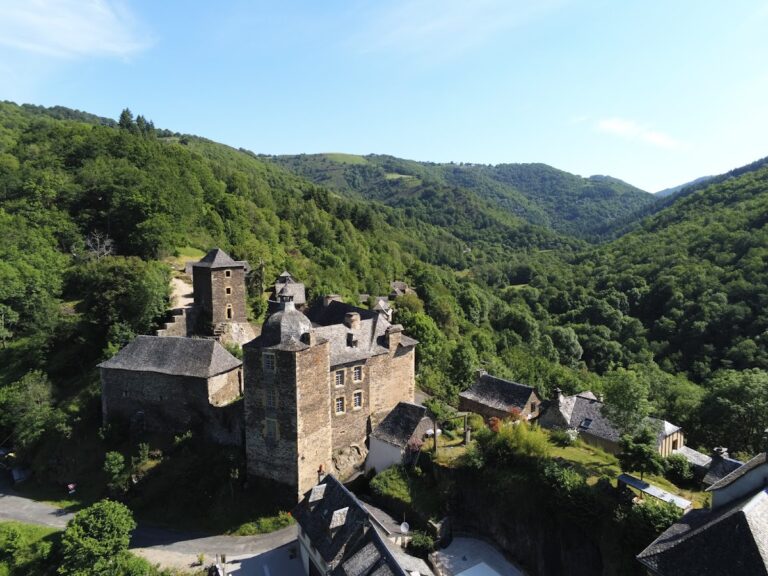
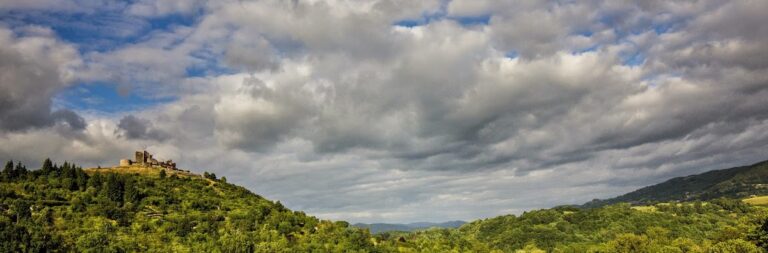
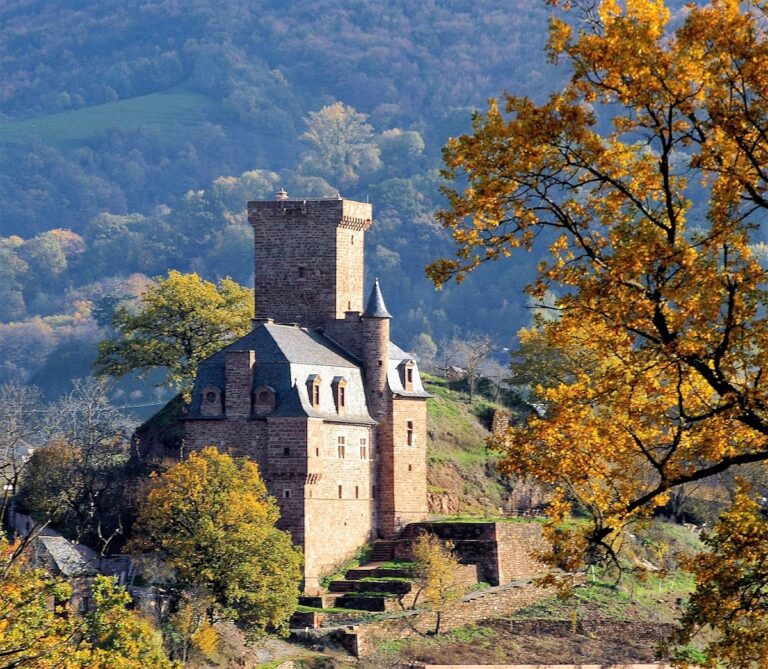
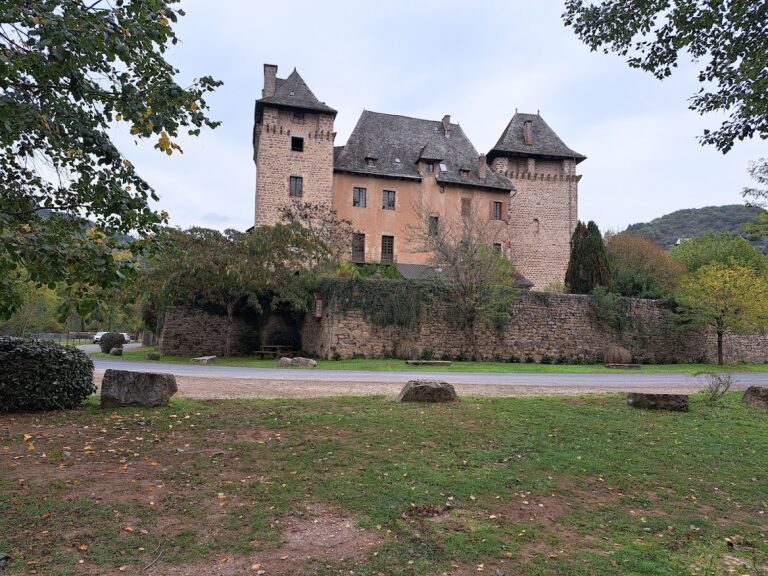
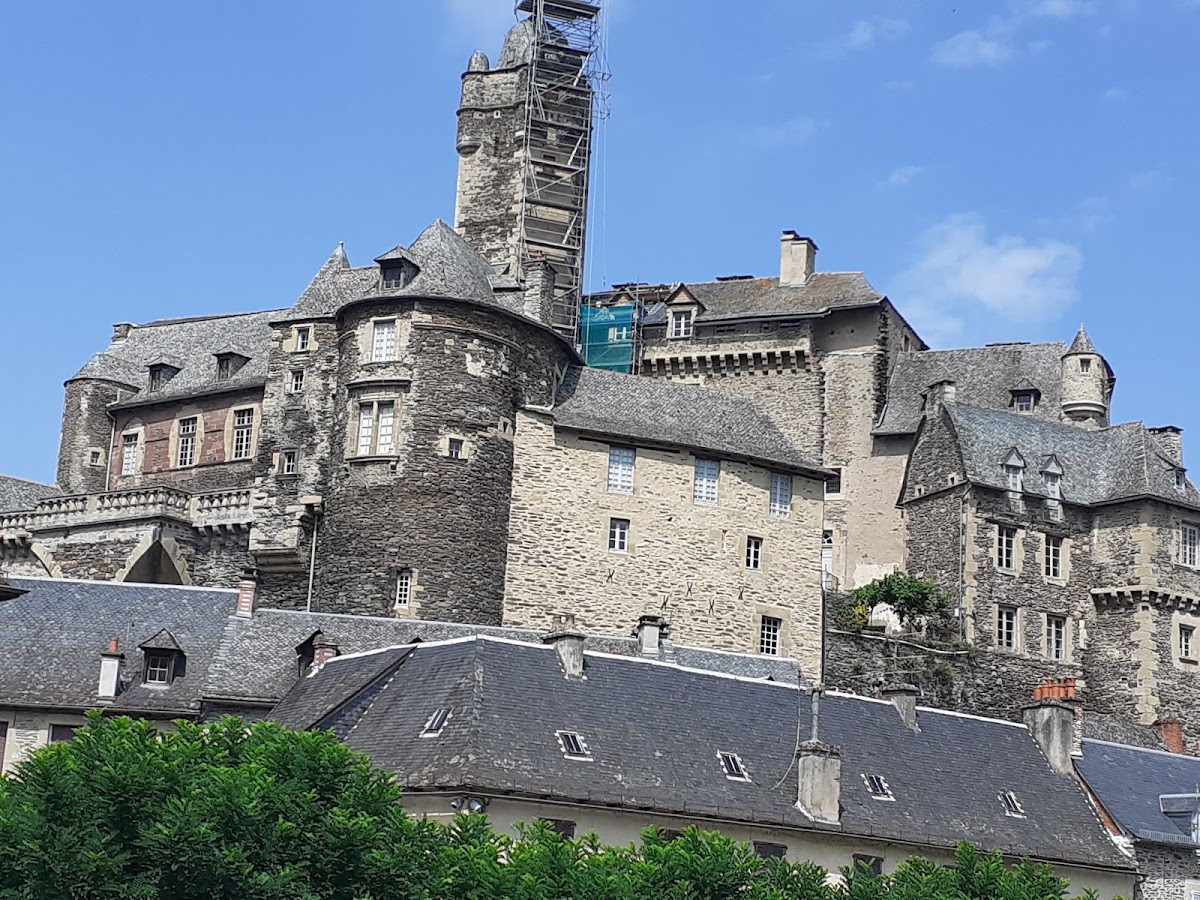
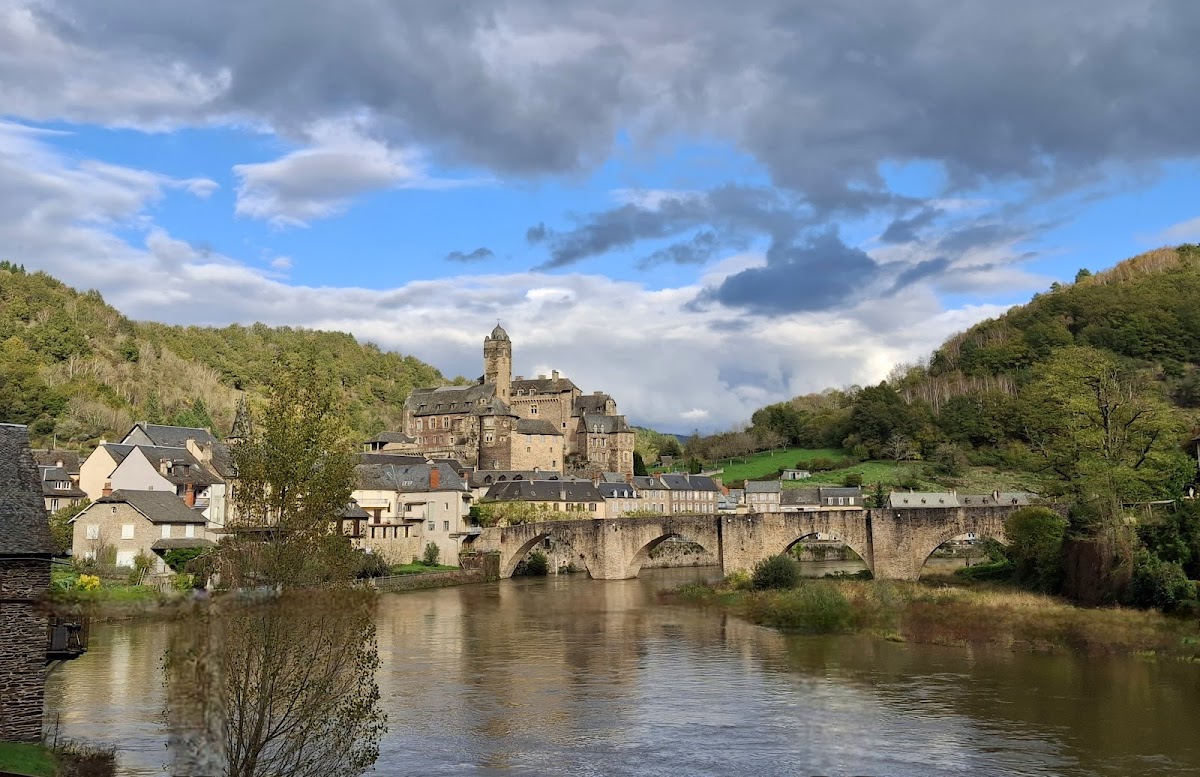
The castle occupies a promontory at the confluence of the Lot and Coussane rivers, overlooking the village of Estaing. Its terrace extends above the Lot. Buildings of different heights are arranged around this terrace, with fifteenth-, sixteenth-, and seventeenth-century structures built around an older square keep. The keep is a principal fortified tower of the medieval castle, crowned by five small turrets and a lantern-shaped roof.
Entrance pavilion and terraces
The entrance pavilion, the surrounding castle buildings, and the terraces form the documented architectural complex. Their arrangement combines the older keep with later building phases and places the principal structures around the terrace overlooking the river.
Chapels
Fifteenth-century chapel
A fifteenth-century chapel served the lords of Estaing. It belongs to the period when new buildings were added around the older keep and remains part of the castle’s religious architecture.
Saint-Joseph Chapel
A new Saint-Joseph Chapel was built beside the earlier chapel in the twentieth century. It was separately registered as a historic monument in 2018, under France’s legal heritage system, which protects buildings and sites through registration or the stronger classification procedure.
Portrait sculpture
Bust of Tristan Dieudonné d’Estaing
The castle displays a bust of Tristan Dieudonné d’Estaing made by Victor Causse (1842–1869), a pupil of the sculptor François Mahoux. The sculpture was discovered in a house at Fijaguet built in 1832, transferred to the Valéry Giscard d’Estaing Foundation in 2014, and then exhibited at the castle.
Nearby sites