Alt-Wülflingen Castle: A Medieval Hilltop Castle Ruin in Switzerland
Site at a Glance
- Rating
- 4.6
- Popularity
- Low
- Country
- Switzerland
- Primary era
- Medieval
- External website
- Open
- Eras represented
- Medieval
- Civilizations
- Habsburg, Holy Roman Empire
- Site type
- Military
- Remains
- Castle
On this page9 sections
History
Alt-Wülflingen Castle is a medieval hilltop castle ruin in Winterthur, Switzerland. The settlement of Wülflingen began as an Alemannic foundation, and the castle was already standing by the middle of the eleventh century. Classified as a Swiss cultural property of national significance, the ruin reflects the changing control of a lordship that passed among counts, noble vassals, the city of Zurich, and the city of Winterthur.
Early Wülflingen and the Medieval Castle
Wülflingen was first mentioned in 897 under the name “Wulfilinga.” By at least the tenth century, it appears to have been the seat of a counts’ family whose allodial and freehold lands extended through Wülflingen, Embrach, and Buch am Irchel. The date of the first fortified residence on the hill is uncertain. A refuge fortress apparently came before the medieval castle, which must have existed by the mid-eleventh century.
The castle entered the politics of the Empire in 1055 and 1056, when Count Kuno of Achalm held Bishop Gebhard III of Regensburg prisoner there for Emperor Henry III. The bishop was suspected of plotting against the emperor. Kuno lived at the castle and later adopted the name Kuno of Wülflingen, linking his identity to the lordship.
In 1089, Kuno and Count Liutold of Achalm founded Zwiefalten Abbey, a Benedictine monastery in present-day Baden-Württemberg. They endowed the abbey with Wülflingen Castle among other possessions. After Kuno’s death in 1092, the abbey returned Alt-Wülflingen to Liutold. When Liutold died without sons in 1098, the castle and lordship passed to the sons of his sister Mathilde of Horburg, the Counts of Horburg of Upper Alsace. They were later inherited by the Habsburgs, who took over the territories of the Counts of Kyburg in 1264.
Documents from 1155 and 1169 name Rudolf of Wülflingen and his son Hermann. They did not apparently hold comital titles, and their connection with the earlier Wülflingen family remains uncertain. By no later than 1239, the castle, lordship, and high jurisdiction were held by the Habsburg-Kyburg counts. High jurisdiction was the authority to hear serious criminal and capital cases. The Habsburg-Kyburg rulers built the surviving keep and expanded the surrounding residential and service buildings.
Habsburg Lordship and Noble Vassals
The Habsburgs granted Wülflingen as a fief to several noble families. Konrad of Wülflingen was one of these vassals and also served, among other offices, as chief magistrate of Sempach around 1257. The Lords of Hettlingen held the castle fief around 1290. From 1315, the Lords of Seen controlled it, renewed the complex, and performed important military service for their Habsburg overlords.
Financial difficulties led Duke Leopold III to pledge the lordship to Hartmann of Seen in 1376. He never redeemed the pledge. Hartmann died at the Battle of Sempach in 1386, when the Swiss Confederates defeated the Habsburgs. Hartmann’s son later died at the Battle of Stoss in 1405, another conflict involving Habsburg interests. The castle then passed to Hartmann’s son-in-law, Ulrich VIII of Landenberg-Greifensee, who made it his residence.
Rümlang Ownership and the End of the Residential Castle
Through marriage, the lordship came to Konrad of Rümlang toward the end of the fifteenth century. His son and successor, Hans Konrad of Rümlang, sold Wülflingen’s entire tithe to the city of Winterthur in 1515 and pledged the judicial lordship to the community of Wülflingen. Unable to settle his debts, he was beheaded for fraud in October 1529 on the order of the Zurich council.
Hans Steiner of Pfungen acquired the castle and lordship from the community of Wülflingen in 1528. In 1596, plague killed much of the castle’s population, including its lord, Sebastian Steiner. The Steiner family later attempted to sell the castle to Winterthur in 1634, but Zurich opposed the transaction. Later that year, the Zurich families Escher and Meiss acquired the complex.
The old hilltop castle had by then ceased to meet residential needs. In 1644, the Eschers built Wülflingen Castle in the village, using material from the older castle. Zurich assumed sovereign rights over the judicial lordship in 1760, while the castle and estate passed to the city of Winterthur. The keep continued to serve as a prison at least until 1764. The complex then deteriorated, with the estate farm demolished in 1834 and materials from the decaying ancillary buildings reused in nearby nineteenth-century construction.
Damage, Conservation, and Present Use
The keep received a sloping tile roof in 1895, but an earthquake in November 1911 caused further damage. Its wall crown was secured in 1936, when a later ground-level opening through the tower wall was also closed. The tower underwent another renovation in 1983 and 1984, restoring access through the old high entrance and an internal staircase.
Moisture and frost continued to threaten the masonry. At the end of 2013, the complex was closed and secured with tension straps beneath a temporary roof. A permanent protective roof was installed in July 2016, and extensive masonry conservation began in 2017. The work was completed in September 2018. Since then, the surviving keep has functioned as a viewing tower, with its platform reaching 15 metres above ground.
Remains
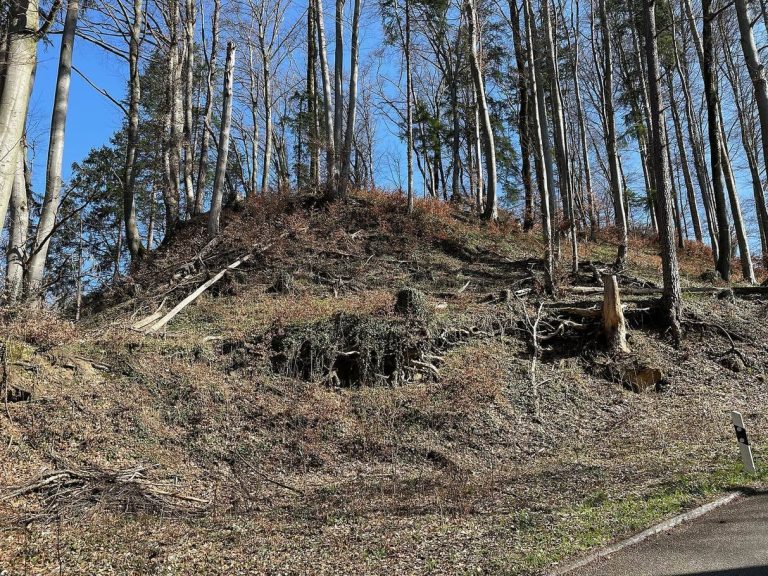
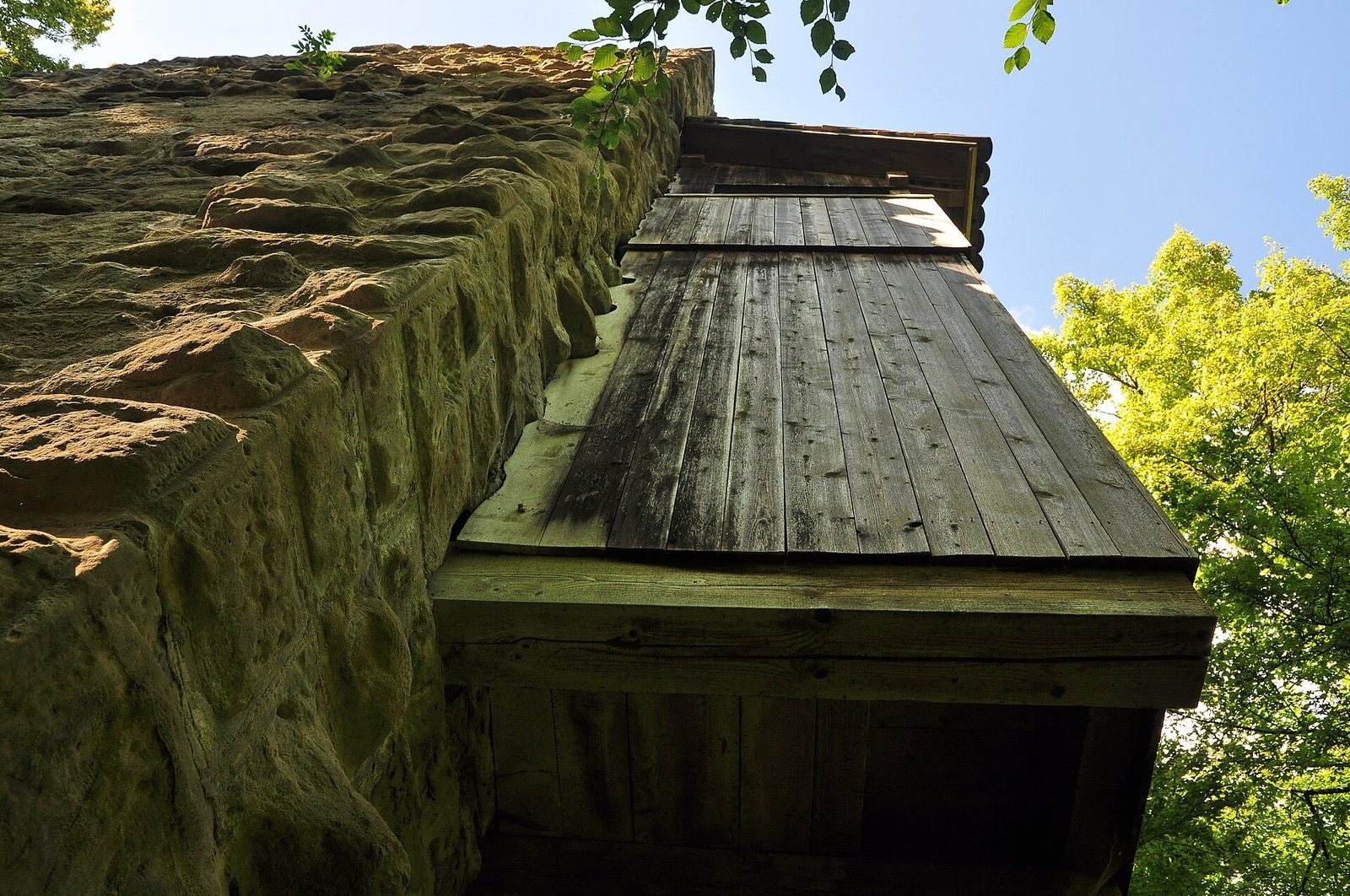
Alt-Wülflingen occupies a wooded rise above the Totentäli at approximately 540 metres above sea level, about 3 kilometres west of Winterthur’s old town. The hilltop complex was organized around a square keep, with a residential wing, an inner courtyard, and ancillary buildings grouped around it. The keep is built of sandstone bossed ashlar, masonry formed from squared stones whose outer faces project to create a strongly textured surface.
The Keep and Protective Roof
The surviving keep has a square ground plan measuring 7.3 by 7.3 metres. Its walls reach up to 2.25 metres in thickness, and the tower rises about 18 metres. A keep was the principal fortified tower of a medieval castle and could combine defensive, residential, and administrative functions. At Alt-Wülflingen, the interior is entered through the old high entrance and reached by two spiral staircases. Seventy-six steps lead to the viewing platform.
Conservation has adapted the structure to the continuing effects of moisture and frost. Temporary tension straps first reinforced the masonry, followed by a permanent flat protective roof made of spruce wood. The roof is covered with gravel and stands approximately 1 metre above the walling, shielding the surviving stonework while keeping the tower’s upper masonry exposed as a historic ruin.
Residential and Service Buildings
A residential wing, the inner castle courtyard, and other ancillary buildings once surrounded the keep. Their remains are now only weakly recognizable, while barns and stables stood at the foot of the hill beside the Töss. Material from the older complex was also used when Wülflingen Castle was built in the village in 1644, and materials from later-decaying ancillary buildings were reused in nearby nineteenth-century construction.
Setting and Outlook
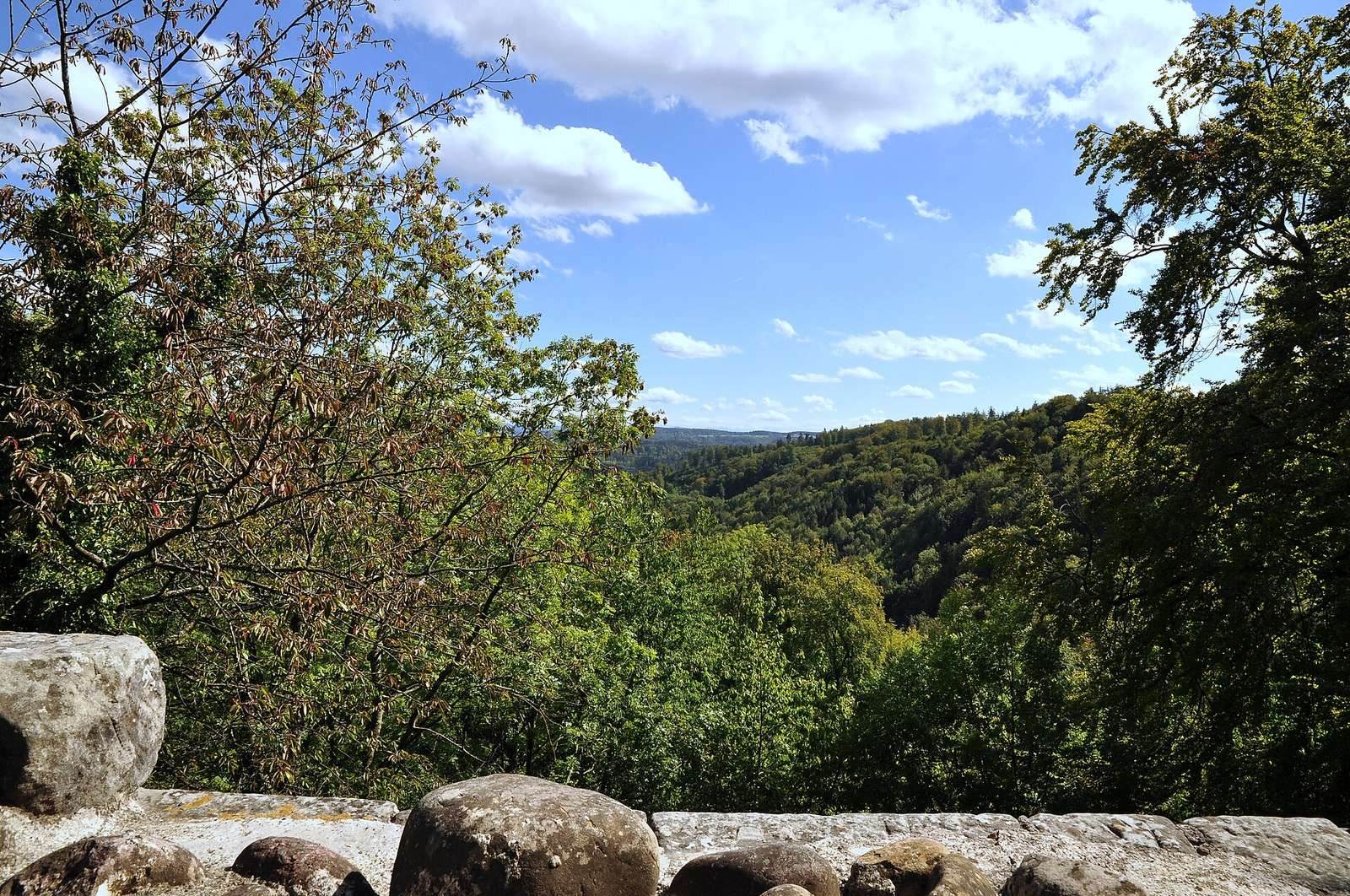
The ruin lies about 320 metres northeast of the former Hoh-Wülflingen castle site, with the two former castles separated by the Totentäli. From the keep, the viewing platform overlooks the Töss and Brüelberg, the ridge separating the Wülflingen and Töss districts. The view also extends across the Winterthur districts of Brühlberg, Tössfeld, Heiligberg, and Deutweg.