Kōzen-ji Temple: A Rinzai Zen Memorial Temple in Kiso, Japan


Site at a Glance
- Rating
- 4.1
- Popularity
- Very Low
- Country
- Japan
- Primary era
- Medieval
- External website
- Open
- Eras represented
- Medieval, Modern
- Civilizations
- Ashikaga shogunate, Japanese
- Site type
- Religious
- Remains
- Monastery
On this page18 sections
History
Kōzen-ji Temple is a Rinzai Zen temple in Kiso-Fukushima, Japan, traditionally founded in 1434 by Kiso Nobumichi as a memorial institution for his ancestor Kiso Yoshinaka, also known as Minamoto no Yoshinaka. Rinzai Zen is a Japanese Buddhist tradition that emphasizes disciplined meditation and kōan practice. The temple belongs to the Myoshinji branch, one of the principal branches of Rinzai Zen, and its principal image is Shaka Nyorai, the Japanese name for Shakyamuni Buddha.
Foundation and Medieval Development
The foundation tradition connects Kōzen-ji with Nobumichi’s move from Suhara in Ōkuwa to Kiso-Fukushima. He invited Enkaku Taika, the fifth abbot of Kenchō-ji in Kamakura, to establish the temple for rites commemorating Kiso Yoshinaka, a twelfth-century Minamoto warrior who played a major role in the Genpei War. Kōzen-ji became one of the three major temples of the Kiso area, together with Chōfuku-ji in Kiso and Jōshō-ji in Ōkuwa.
Kiso Ietoyo donated a temple bell in 1466. During the Meiō period (1492-1501), Jakuga Ryōen, the younger brother of Kiso Yoshimoto, became the second abbot. With the protection of Yoshimoto and Keishū, a member of the Kiso family, he rebuilt the temple, including a Buddha hall in 1496.
During the Genki period (1570-1573), Furuhata Jūemon Masatsura, the local lord of Yabuhara, invited the fourth abbot, Morin, to establish Gokuraku-ji. In the early Tenshō period (1573-1592), Kiso Yoshimasa became a devotee of Kōzen-ji and granted it formal protection. In 1582, the seventh abbot, Keigaku Soshō, is said to have revived Taihō-ji at Narai-juku, although Kōzen-ji was then under its fifth abbot, Tōgan.
Protection and Institutional Connections
In 1590, Kiso Yoshimasa left the Kiso Valley after Tokugawa Ieyasu transferred him to the Kantō region and granted him 10,000 koku in Achido, Shimōsa Province. Koku was a historical measure of agricultural production used to assess a lord’s income, so this grant represented a substantial feudal holding. Ishikawa Mitsuyoshi, a senior retainer of Toyotomi Hideyoshi who became administrator of Kiso, subsequently guaranteed the protection of Kōzen-ji, Chōfuku-ji, and Jōshō-ji. Kōzen-ji was also depicted in 1590 in Hosokawa Yūsai’s Tōkoku Jin-dōki.
The temple appears to have declined before the sixth abbot, Nanshuku, brought it into the Myoshinji branch and restored its fortunes with the support of Kiso Yoshimasa. Nanshuku died in January 1631, after which Keigaku Soshō became the seventh abbot. Kōzen-ji’s influence extended beyond its own precinct. In 1624, Horio Sakuzāemon Kazunari, a retainer of Yamamura Yoshikatsu and administrator of the Nakatsugawa office, founded Shōgen-ji in Tegano Village, Mino Province, and invited Keigaku from Kōzen-ji to serve as its founding abbot.
Edo-Period Patronage and Fire
During the Edo period, Kōzen-ji was protected by Yamamura Yoshikatsu, a senior retainer of the Owari domain and administrator of Kiso. The Owari domain was a major feudal domain governed by a branch of the Tokugawa family. Kōzen-ji became the family temple of the Yamamura Jinbei household. After Yamamura Yoshikatsu died in 1634, his son Yoshitoyo, who had succeeded him as Kiso administrator in 1629, helped transfer the family head’s funerary affiliation from Chōfuku-ji to Kōzen-ji. Chōfuku-ji thereafter served as the family temple for the household’s wives.
Keigaku Soshō founded Kyūshō-in in April 1653. In March 1660, he is said to have founded Zuishō-ji, formerly called Zuishō-an, at Kaida Village. Keigaku reportedly did not reside there, and the later abbots Shūkoku, Daisen, Rinsan, Nankai, Saidō, and Tōrin are likewise said not to have lived there.
A fire on April 20, 1641, destroyed the Buddha hall and Kannon hall rebuilt in 1496, together with other structures. Kannon is a Buddhist bodhisattva associated with compassion. With assistance from Yamamura Yoshitoyo, the temple was restored in 1645. A new bell was cast in 1653, followed by construction of the temple gate. In 1714, images of the Niō guardians were installed at the gate, while sixteen arhats, enlightened disciples in Buddhist tradition, were placed on the gate tower’s upper floor.
Teaching, Destruction, and Conservation
In the summer of 1757, at the request of the Kiso administrator Yamamura Yoshihiro, the eleventh abbot, Saidō, gathered more than 180 monks and laypeople at Kōzen-ji. They heard Hakuin Ekaku lecture on the Lotus Sutra for 24 days, adding a major episode of Buddhist teaching to the temple’s history.
Fires in 1906 and 1927 destroyed much of the older temple fabric, leaving little of the original appearance. The Imperial Envoy Gate was reconstructed in its original form in 1953. Kōzen-ji is designated as a local cultural-tourism conservation area, and Kanuntei Garden was registered as a national Registered Monument in 2019.
The temple is also associated with a monument identifying Kōzen-ji as the birthplace of the Kiso Dance. The plaza before the monument is the starting point for the Kiso Yoshinaka Torch Festival procession, held on the night of August 13.
Remains
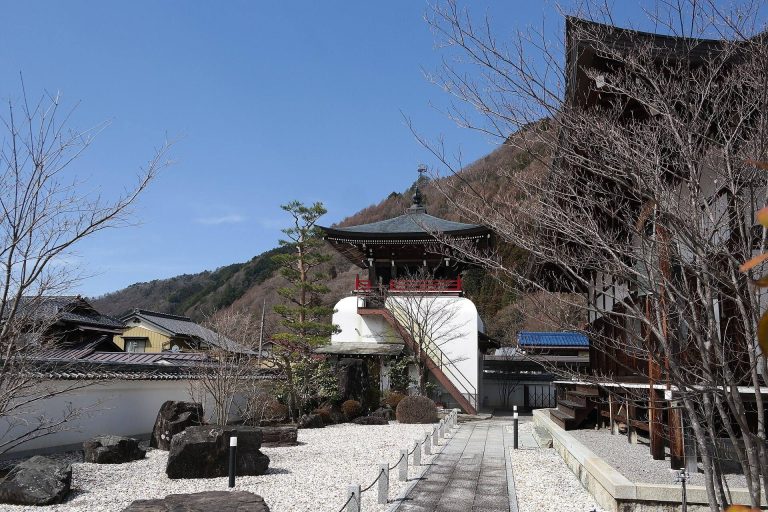
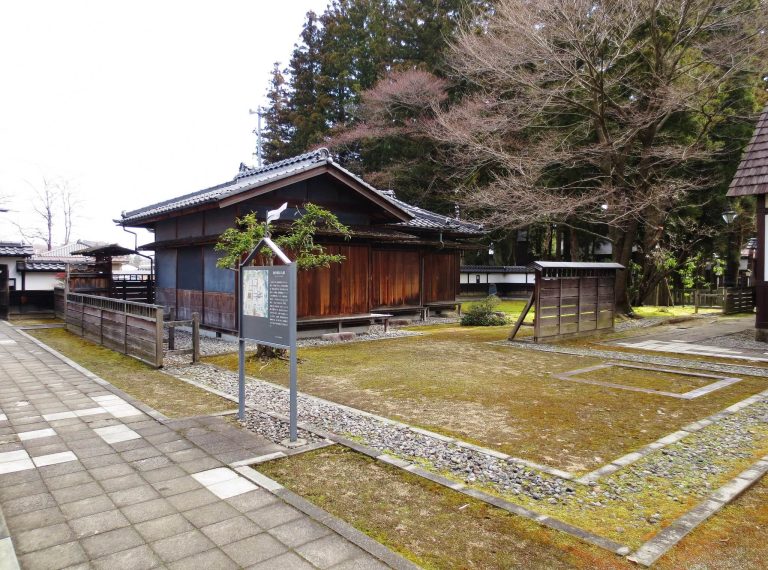
The Kōzen-ji precinct covers approximately 5,300 square metres and includes buildings, gardens, a cemetery, and woodland. Large hinoki cypress trees, old cedars, and mature pines enclose the grounds. The woodland is also known as a migratory arrival site for the Oriental dollarbird. The main entrance leads directly to the Kannon Hall. Behind it, the tile-roofed main hall stands on the right, while the priest’s quarters occupy the left side.
Temple Buildings
Kannon Hall
The Kannon Hall is reached directly from the main entrance. It was rebuilt in 1496 and destroyed by the fire of 1641, which also consumed other temple buildings. Its history reflects the repeated reconstruction of Kōzen-ji during periods of fire and renewal.
Main Hall and Priest’s Quarters
The large main hall has an irimoya roof, a traditional form combining a central gable with slopes on all four sides. The main hall and the priest’s quarters were reconstructed after the 1927 fire. Both are imposing buildings constructed entirely from hinoki cypress.
Imperial Envoy Gate
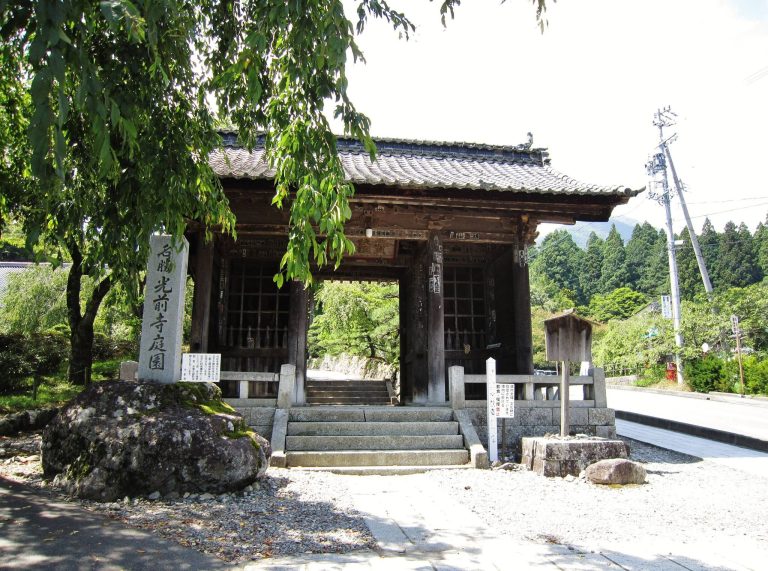
The Imperial Envoy Gate was reconstructed in 1953 according to its original form. The gate also recalls the earlier arrangement in which Niō guardian images were installed in 1714 and sixteen arhats were placed on its upper floor.
Gardens
Manshō Garden
Manshō Garden lies west of the abbot’s quarters. It has existed in that area since an earlier period and was laid out in the middle of the Edo period. Its design includes a pond and waterfalls.
Shōryū and Shumisen Gardens
Shōryū Garden represents the legend of the Dragon’s birth. Shumisen Garden presents nine mountains and eight seas as an image of the universe. The name Shumisen refers to Mount Sumeru, the cosmic mountain at the centre of Buddhist cosmology.
Kanuntei Garden
Kanuntei Garden is a dry landscape garden created in 1963 by garden designer Mirei Shigemori. A dry landscape garden uses stones, gravel, and sand rather than flowing water to evoke natural or cosmological landscapes. Kanuntei expresses a sea of clouds among high mountains: its white sand lines represent clouds, while its rocks represent mountains. The sand patterns change daily, like the clouds of Kiso.
Cemetery and Memorial Stones
Historical Graves
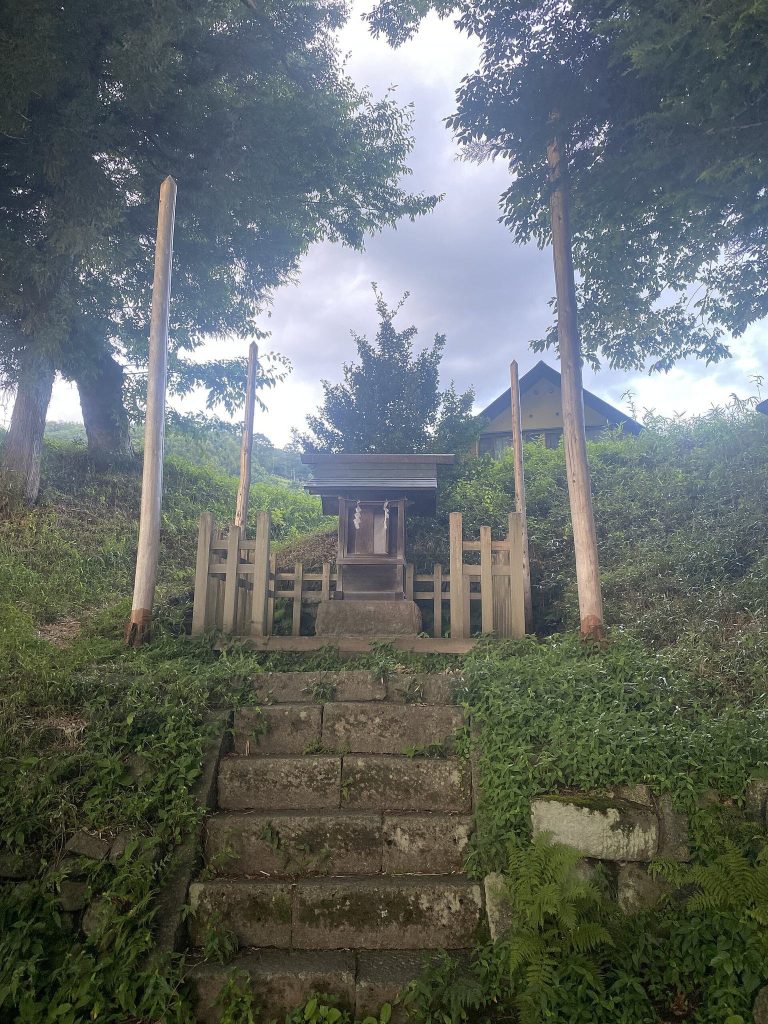
A cemetery behind the main hall contains grave markers associated with Kiso Yoshinaka, Kiso Nobumichi, Kiso Yoshiyasu, Kiso Yoshimasa, and successive heads of the Yamamura Jinbei family, hereditary administrators of Kiso for the Owari domain. The hillside behind the temple continues this memorial landscape with successive Yamamura family graves, a memorial stone tower associated with Minamoto no Yoshinaka, and gravestones associated with Kiso Nobumichi and Kiso Yoshimasa.
Yamamura Ryōyū’s Marker
The grave marker of the ninth-generation Yamamura Ryōyū is especially notable for an epitaph composed by Kabashima Sekiryō. Ryōyū, also known as Yamamura Somon, became a senior councillor of the Owari domain and was a scholar and poet. He appears in Shimazaki Tōson’s novel Before the Dawn.
Other Memorials
The cemetery includes graves associated with Takei Yōsetsu, a pioneer of the Freedom and People’s Rights Movement in Shinano, and Endō Oto, an architect known as a pioneer of modern architecture. Eleven additional stone monuments shaped like shogi pieces are traditionally identified as graves of successive members of the Kiso family. Their inscriptions are now illegible, and their precise identities are unknown.
Kiso Yoshimasa died at Achido in Shimōsa and was given a water burial by his son, Kiso Yoshitoshi. A grave associated with Yoshimasa also exists in present-day Asahi, Chiba Prefecture.