Ōtori Shrine: A Shinto Shrine in Koka, Japan


Site at a Glance
- Rating
- 4.2
- Popularity
- Low
- Country
- Japan
- Primary era
- Early Modern
- External website
- Open
- Eras represented
- Early Modern
- Civilizations
- Tokugawa
- Site type
- Religious
- Remains
- Sanctuary
On this page12 sections
History
Ōtori Shrine is a Shinto shrine in Koka, Shiga Prefecture, Japan, established in 882 during the Heian period. Its principal deity is Susanoo-no-Mikoto, a major Shinto deity associated with storms, the sea, and the expulsion of harmful forces. The shrine’s main sanctuary follows the three-bay nagare-zukuri style, whose roof extends in a flowing projection over the entrance. Formerly ranked as a gōsha, a historical shrine rank, it is also popularly known as Tennosan.
Foundation and medieval development
The shrine was founded after its deity was invited from Mount Shinoyama in Ahai District, Iga Province, and enshrined at Ohara-naka. It was later moved to its present location in Torino. A Tendai Buddhist temple, Ohara-san Kawaidera, was established as the shrine’s jingūji, a Buddhist temple serving an associated Shinto shrine. Under shinbutsu shūgō, the historical combination of Shinto and Buddhism in Japan, the shrine and temple operated as one religious institution.
Kawaidera grew into a substantial religious complex with 36 subsidiary temples. These included Ryusen-in, Zenju-in, Ganjo-in, Yuzen-in, and Kakuju-in. From the Kamakura through the Muromachi periods, Ōtori Shrine received strong patronage from the Rokkaku, a warrior family that held the office of military governor in Omi Province. During this period it was known by several names, including Kawai Shrine, Kawai Gion Shrine, Ohara Gion Shrine, Gozu Daimyojin, and Gozu Tenno Shrine.
Early-modern patronage
In 1595, Toyotomi Hideyoshi, the late-sixteenth-century military ruler who unified most of Japan, granted official authorization for the flower-snatching ritual and donated land to the shrine. In 1689, Keishoin, the mother of the shogun Tokugawa Tsunayoshi, provided a perpetual mountain land tax of 5 koku and 8 to for repairs. These were historical Japanese units used in rice and land-tax assessments, with one to equal to one-tenth of a koku.
Separation, rebuilding, and modern status
The 1868 order separating Shinto and Buddhism sought to establish the two religions as distinct systems. At Ōtori, this divided the shrine from Kawaidera, which was abolished. Its seated image of Maitreya Tathagata, a Buddhist figure regarded in Mahayana Buddhism as the Buddha of the future, and other Buddhist objects were transferred to Ichino-ji.
Following the administrative changes, the shrine was renamed Ōtori Shrine by combining the first character of the former Ohara estate with the first character of Torino. This name therefore does not connect the shrine with the separate tradition of Ōtori worship. The shrine was designated a village shrine in October 1876 and raised to the rank of gōsha in February 1885. In April 1908, it became eligible to receive offerings of ritual food and cloth. In 1912, deities formerly enshrined in nine districts of the former Ohara village were combined into subsidiary shrines within the precincts.
A fire in the mid-1910s destroyed part of the worship hall, the two-story gate, the cloister, the kagura hall, the shrine office, and the former Kawaidera buildings. The main sanctuary remained, while the destroyed shrine buildings were rebuilt in 1919 and the complex was restored by 1920. The main sanctuary and stone arched bridge have municipal heritage designations, and several rebuilt buildings have national registration as tangible cultural properties.
Annual festival traditions
The Ohara Gion festival takes place on July 23 and 24. Its eve festival includes lantern events, a shrine-shaped lantern dance, and the fire-taking ritual. The main festival includes the flower-snatching ritual and the chimaki ritual. The festival’s Gion flower event is described as the largest of its kind in Koka, and shrine tradition traces its origin to 1415.
Remains
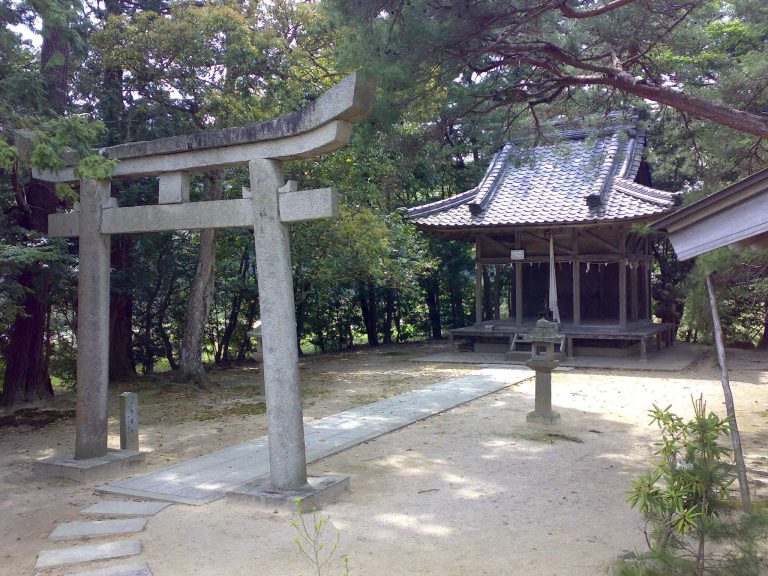
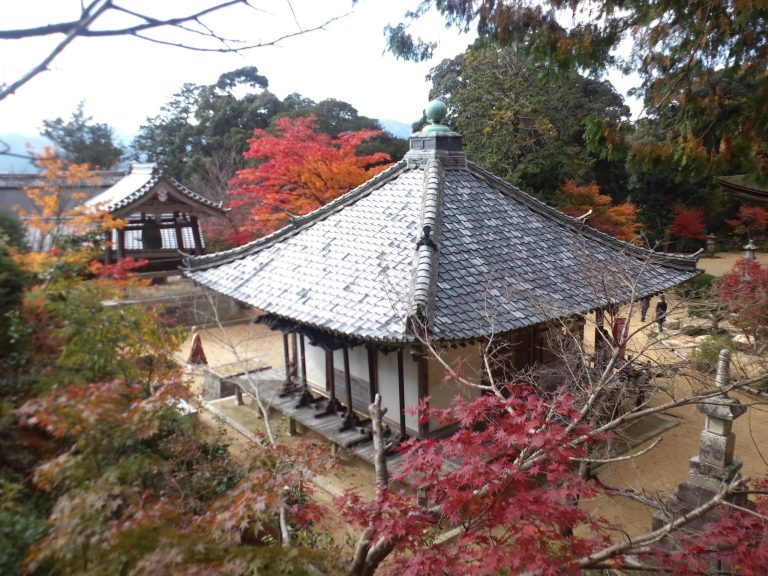
The precinct combines the main sanctuary with rebuilt halls, ritual buildings, storage structures, an assembly hall, and the stone bridge leading through the complex. The principal sanctuary uses three-bay nagare-zukuri, identified by a roof ridge running parallel to the entrance facade and a projecting front eave. The present arrangement also preserves the relationship between the sanctuary, the central gate, and the buildings used for worship and shrine administration.
Sanctuary and ritual buildings
Main sanctuary
The main sanctuary is the surviving principal structure associated with the shrine’s central worship. Its three-bay nagare-zukuri form gives the building a roof with a flowing extension over the front. It remained after the fire in the mid-1910s and has a municipal heritage designation.
Norito Hall and worship buildings
The Norito Hall, also called the middle gate, was rebuilt in 1919. The worship hall, kagura hall, food-offering hall, mikoshi storehouse, and shrine office were rebuilt during the same campaign. The kagura hall was used for sacred dance and music, while the mikoshi storehouse serves the portable shrine used in festivals. An assembly hall also stands within the precincts.
Gate and bridge
Two-story gate
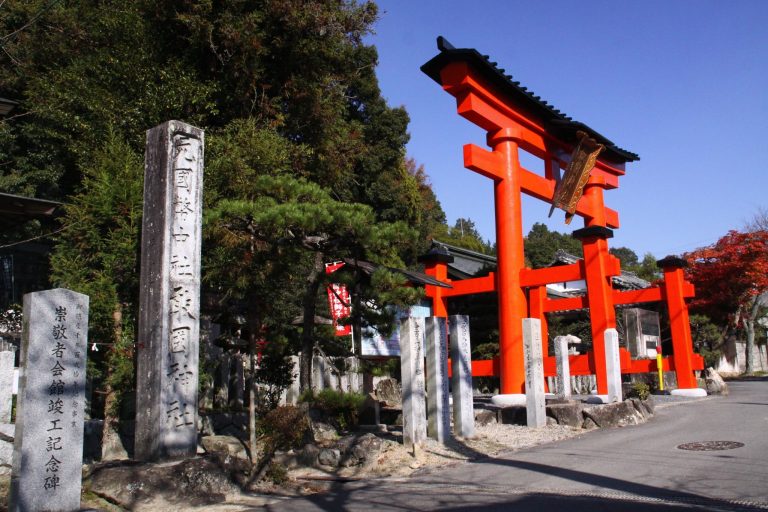
The two-story gate was rebuilt in 1919 to designs by Suekichi Kameoka, an engineer of Kyoto Prefecture. Its resemblance to the west gate of Yasaka Shrine in Kyoto contributes to the shrine’s alternative association with the name Ohara Gion Shrine. The gate is a three-bay, single-entrance, two-story structure with a gabled roof covered in cypress bark.
Its lower level has three-tier bracket complexes, while the upper level uses brackets with projecting arms. Frog-leg struts and intercolumnar struts form the intermediate supports, and the gable ends use a double rainbow-beam and frog-leg composition. The corner pillars project slightly, while the greater curvature of the rafters and girders follows medieval construction techniques.
Stone arched bridge
The stone arched bridge, also called the drum bridge, was made in 1744 by Sugimoto Bun’emon, a stonemason from Kyoto. The bridge is municipally designated as heritage and forms part of the shrine’s historic built fabric.