Tō-ji Temple: Kyoto’s Shingon Buddhist State Temple


Site at a Glance
- Rating
- 4.5
- Popularity
- High
- Country
- Japan
- Primary era
- Early Modern
- External website
- Open
- Eras represented
- Classical, Medieval, Early Modern, Modern
- Civilizations
- Ashikaga shogunate, Tokugawa, Toyotomi regime
- Site type
- Religious
- Remains
- Temple
On this page18 sections
History
Tō-ji Temple is a Japanese Buddhist temple in Kyoto, Japan, founded in 796 during the early Heian period as the eastern state temple protecting the new capital of Heian-kyō. Planned beside Rashomon, the capital’s southern gate, it formed a pair with Sai-ji, the Western Temple. Emperor Kanmu, who ordered the establishment of Heian-kyō, is identified as Tō-ji’s founder.
Foundation and the rise of Shingon
The two state temples were intended to protect the capital and the government through Buddhism. A temple tradition attributes Tō-ji’s construction to Fujiwara no Iseto, although his historical existence is uncertain. In 823, Emperor Saga granted the still-incomplete temple to Kūkai, the monk who founded the Shingon school in Japan. With the permission of Emperor Junna, Kūkai installed 50 monks of his school at Tō-ji. This was the first recorded exclusive occupation of a Japanese temple by one Buddhist school and marked the government’s formal recognition of Shingon, a form of esoteric Buddhism using ritual initiation, sacred texts, mandalas, and images of many Buddhas and protective deities.
Kūkai made Tō-ji the principal center of Shingon practice and began building its Lecture Hall in 825. Completed in 839, the hall became the center of the temple’s esoteric teachings. Tō-ji was also known as Kyō-ō-gokoku-ji, a name meaning a temple for protecting the nation through the “king of doctrines.” Historical documents from the Heian period through the early modern period generally use Tō-ji as the temple’s ordinary official name, while Kyō-ō-gokoku-ji first appears in an official document in 1240.
In 828, Kūkai founded the Shugeishuchi-in at Tō-ji. Regarded as the first publicly accessible school in Japan, it taught Buddhist, Confucian, and Daoist studies. The experiment ended in 847, but the temple continued to develop as an intellectual and religious institution.
Institutional change and medieval devotion
During the ninth and tenth centuries, Tō-ji became involved in disputes within Shingon Buddhism. These conflicts concerned government-appointed priestly positions and control of Kūkai’s secret writings. The writings were returned to Tō-ji in 919, allowing the temple temporarily to reassert authority over several Shingon centers.
Tō-ji declined toward the end of the Heian period, but its fortunes improved during the Kamakura period as devotion to Kōbō Daishi, the posthumous title of Kūkai, spread widely. The temple became known as the “temple of the Great Teacher” and attracted worshippers from the imperial family to ordinary people. Princess Sen’yōmon’in, a daughter of Retired Emperor Go-Shirakawa and a devoted follower of Kūkai, donated extensive estates after receiving what she regarded as a revelation in a dream. She is associated with the establishment of the daily offering to Kūkai and the monthly memorial service held on the twenty-first day.
Emperor Go-Uda was ordained at Tō-ji in 1308 and helped restore the deteriorated temple. Tō-ji did not recover its earlier political prominence after the decline of the aristocracy that had supported it, but Shingon scholarship flourished there. Raihō, Gōhō, and Genpō became known as the “Three Jewels of Tō-ji.”
Rulers, war, and reconstruction
Tō-ji received support from Retired Emperor Go-Uda, Emperor Go-Daigo, and Ashikaga Takauji, the founder of the Muromachi shogunate. A tradition holds that Takauji took refuge inside the temple during a battle with Nitta Yoshisada. The Eastern Gate was closed during the episode, leading to its later name, the “Gate That Is Not Opened.”
In 1486, a peasant uprising led to a fire that destroyed the Golden Hall, Lecture Hall, Southern Great Gate, and most of the principal buildings. The Lecture Hall was rebuilt in 1491, while the Golden Hall remained unreconstructed for nearly a century. An earthquake seriously damaged Tō-ji in 1586, adding to the challenges of preserving the complex.
In 1591, Toyotomi Hideyoshi granted Tō-ji an income of 2,030 koku. His son, Toyotomi Hideyori, sponsored the rebuilding of the Golden Hall, completed in 1603 under the supervision of Katagiri Katsumoto. The hall is traditionally said to have been modeled on Hideyoshi’s Great Buddha Hall at Hōkō-ji. The five-storied pagoda was destroyed by lightning and other fires four times before its present form was rebuilt in 1644 through a donation from Tokugawa Iemitsu, the third Tokugawa shogun.
The Southern Great Gate burned accidentally on October 21, 1868. In 1895, the western gate of Sanjūsangen-dō, built under Toyotomi Hideyori in 1601, was transferred to Tō-ji and reused as the temple’s Southern Great Gate. Tō-ji’s Golden Hall and Lecture Hall opened to the general public for the first time in 1965.
Religious and archival continuity
Tō-ji is the head temple of the Tō-ji branch of the Shingon school and is associated with Tōmitsu, the form of esoteric Buddhism practiced in that branch. It remains a center of devotion to Kūkai. The daily offering ritual continues at 6:00 a.m. in the Miei Hall, and the monthly Kōbō-san market takes place on the twenty-first day, associated with Kūkai’s death.
The temple’s main image is Yakushi Nyorai, the Medicine Buddha, associated with healing and protection from illness. Tō-ji also belongs to several Buddhist pilgrimage networks, including the twenty-third station of the Luoyang Thirty-Three Kannon Pilgrimage, the ninth of the Eighteen Main Shingon Temples, the eighth of the Western Japan Seventeen Aizen Sites, and the twelfth of the Kyoto Thirteen Buddhist Sites.
Tō-ji was designated a national historic site in 1934. In 1994, it became part of the UNESCO World Heritage property Historic Monuments of Ancient Kyoto. Its archive, the Tōji Hyakugō Monjo, entered the UNESCO Memory of the World Register in 2015. The archive contains 24,147 records concerning religious and political activity and estate administration from 763 to 1711.
Remains
The surviving complex follows the traditional Shichidō garan, or seven-building temple compound, derived from Nara-period planning. Its principal buildings are arranged along a north-south axis, with the Southern Great Gate, Golden Hall, Lecture Hall, and refectory placed successively from south to north. The arrangement and scale of the main complex retain the pattern of the Heian-period temple, while the surviving buildings represent several later periods of rebuilding.
Gates and principal halls
Southern Great Gate
The Southern Great Gate is a Momoyama-period structure transferred from Sanjūsangen-dō in 1895. Its gabled roof is covered with traditional tiles. The gate is designated an Important Cultural Property and forms the southern entrance to the principal north-south sequence.
Golden Hall
The Golden Hall is Tō-ji’s principal hall and a National Treasure. Reconstructed in 1603 after the fire of 1486, it has an irimoya roof, a roof form combining a gable with sloping sides, covered in traditional tiles. A lower pent roof called a mokoshi is attached beneath the main roof, giving the exterior the appearance of two stories.
The hall combines Japanese construction with features of the Daibutsuyō, or “Great Buddha,” style. These include powerful tie beams that pass through the structure and inserted bracket arms supporting the high ceiling. A ridge plaque records Toyotomi Hideyori’s sponsorship and Katagiri Katsumoto’s supervision of the rebuilding.
Inside, a seated Yakushi Nyorai is accompanied by Nikkō and Gakkō Bodhisattvas. Kōshō and his associates made the three images between 1602 and 1604 using joined blocks, lacquer-and-gold finishing, and crystal eyes. The Yakushi image is 288 centimeters high, while Nikkō and Gakkō measure 290 and 289 centimeters. Twelve guardian-generals stand around the waist of the central figure’s draped pedestal.
A viewing window was designed to make the principal image visible from outside. Its height does not align with the Yakushi image, so it reveals the halo rather than the face, while also admitting light into the hall.
Lecture Hall
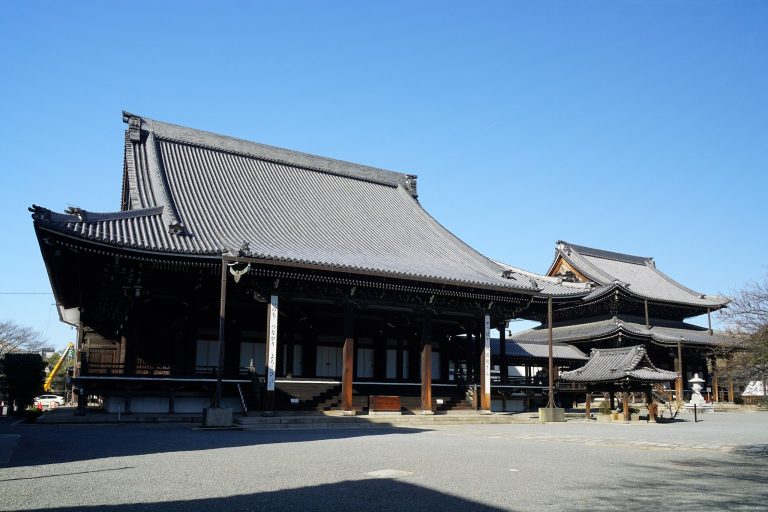
The Lecture Hall stands north of the Golden Hall and is an Important Cultural Property. Rebuilt in 1491 after the 1486 fire, it is a single-story building with a hipped-gable roof in a pure Japanese style. Its central feature is a three-dimensional mandala formed by 21 sculptures, a sculptural expression of a Buddhist cosmos and system of teachings.
Five Buddhas occupy the middle, centered on Dainichi Nyorai, the universal body of Buddhist truth. Five bodhisattvas, centered on Kongō Haramitsu, stand to the east, and five Wisdom Kings, centered on Fudō Myōō, stand to the west. Brahma and Taishakuten mark the eastern and western ends of the altar, while the Four Heavenly Kings occupy its four corners.
The images received their consecration in 839 and are regarded as Japan’s earliest fully developed group of esoteric Buddhist sculptures. Fifteen are original ninth-century works. All five Buddhas and the central bodhisattva were replaced or supplemented between the Muromachi and Edo periods. The arrangement is traditionally called the Karma Mandala, or three-dimensional mandala, although its interpretation remains debated. Older Shingon tradition connects it with the Mandala of the Benevolent Kings Sutra, while later interpretations relate it to the Diamond Realm teachings and the Benevolent Kings ritual.
Lecture Hall sculptures
The five Buddhas are centered on Dainichi Nyorai and accompanied by Hōshō, Amida, Fukūjōjū, and Ashuku. The central Dainichi was made by Kōchin between 1493 and 1497. It is 285 centimeters high, built from joined blocks, finished with lacquer and gold, and fitted with crystal eyes. Its halo contains 37 small Buddha figures, including one dating from the ninth century.
The five bodhisattvas are centered on Kongō Haramitsu. The central image is an Edo-period work, while the other four are original images with extensive later repairs. They use single-block construction combined with dry lacquer and show strong Nara-period stylistic and technical characteristics.
The five Wisdom Kings, centered on Fudō Myōō and accompanied by Gōzanze, Gundari, Daiitoku, and Kongōyasha, are National Treasures. Together with the Fudō image in the Miei Hall, they form the oldest surviving examples of Wisdom King sculpture in Japan.
The National Treasure images of Brahma and Taishakuten show two contrasting esoteric figures. Brahma is four-faced and four-armed, seated on a lotus supported by four geese. Taishakuten wears armor, rides a white elephant, and lowers his left leg. Parts of both pedestals and Taishakuten’s head are later replacements.
The Four Heavenly Kings are also National Treasures. Jikokuten has an angry expression and vigorous movement, while Zōchōten, Kōmokuten, and Tamonten are more restrained. Tamonten includes many later repairs, and restoration revealed well-preserved original areas of the face and other parts beneath later paint.
Pagoda, memorial hall, and refectory
Five-storied pagoda
The five-storied pagoda is a National Treasure and one of Kyoto’s principal symbols. Rebuilt in 1644 after four earlier destructions, it rises 54.8 meters and is the tallest wooden tower in Japan. Its first story contains paintings of the Two Realms Mandala and the eight patriarchs of Shingon on its walls and pillars. Four Buddhas and eight bodhisattvas surround a central pillar, which is treated as an embodiment of Dainichi Nyorai rather than containing a separate statue of that Buddha.
The pagoda stands beside the Hyōtan Pond, which forms part of a stroll garden. Paintings, sculpture, and the central pillar connect the tower’s structure with the ritual teachings of esoteric Buddhism.
Miei Hall
The Miei Hall, also called the Daishi Hall or Saiin Miei Hall, is a National Treasure associated with Kūkai. It stands on the site identified as his former residence and has a Muromachi-period appearance. Its roof is covered with cedar shingles. A seated Fudō Myōō from the Heian period is kept in the rear room.
Refectory
The refectory, or Shikidō, lies north of the Lecture Hall. Its former principal image was a standing Thousand-Armed Kannon accompanied by Jizō and Monju. These Heian-period sculptures are Important Cultural Properties. Restoration of the Kannon in 1961 revealed an inscribed plaque dated 877 inside the image.
Kanchiin and movable heritage
Kanchiin precinct
The Kanchiin precinct occupies the southwestern part of the grounds within an enclosing wall. It was used for secret Shingon initiation rites and is administered as a subtemple of Tō-ji. Its Edo-period guest hall was rebuilt in 1605 and is a National Treasure.
Paintings, manuscripts, and ritual objects
The Treasure Museum preserves a Tang-period standing Tobatsu Bishamonten measuring 189.4 centimeters high. Tradition holds that it once stood on the upper story of Rashomon and was recovered from the gate’s rubble after its collapse in 980. Carved from Chinese Wei cherry wood, the figure holds a halberd and a small pagoda and is accompanied by two small demons. The original pagoda was stolen in 1968; a replica was made during repairs in 2015 and displayed in 2016.
Tō-ji also preserves seven portraits of Shingon patriarchs, including five that Kūkai brought from Tang China, a ninth-century pair of paintings of the Two Realms Mandala, Heian-period paintings of the Five Honored Ones, and Kamakura-period images of the Twelve Heavenly Kings. Ritual objects include Tang-period esoteric Buddhist implements, a robe brought from Tang China and traditionally associated with Kūkai, and a lacquered, inlaid reliquary vehicle used in the annual ceremony honoring Buddhist relics.
The temple’s written collections include Kūkai’s three handwritten letters known as the Fūshinjō, a catalogue of objects he brought from Tang China, imperial documents concerning Tō-ji’s development, the medieval temple record Tōhōki, and extensive sutra and administrative collections. Sculptures, paintings, manuscripts, masks, and implements connected with the relic ceremony include masks representing the Eight Classes of Buddhist Protectors.
The grounds also include a garden and pond containing turtles and carp, as well as the Rakunan private school. Together, the buildings, images, ritual objects, and written archives preserve the religious, institutional, and artistic history of Tō-ji across more than a millennium.