Kok Gumbaz Mosque in Shahrisabz: A Timurid Main Mosque


Site at a Glance
- Rating
- 4.6
- Popularity
- Low
- Country
- Uzbekistan
- Primary era
- Medieval
- Eras represented
- Medieval
- Civilizations
- Timurid
- Site type
- Religious
- Remains
- Mosque
On this page7 sections
History
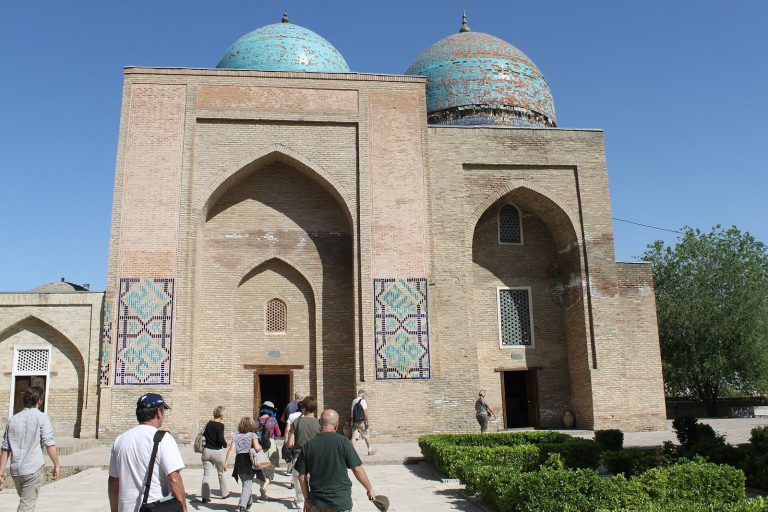
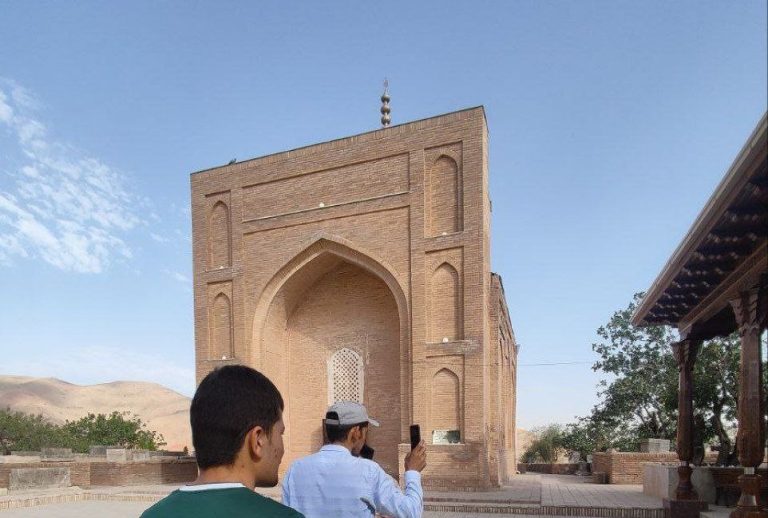
Kok Gumbaz Mosque in Shahrisabz, Uzbekistan, is a Timurid mosque built in 1434–1435 by Ulug Beg Mirzo for his father, Shah Rukh Mirzo. The Timurids were the dynasty founded by Amir Temur, who established a major empire in Central Asia and Iran during the late fourteenth century. The mosque became the main mosque and principal monument of the Dorut Tilavat ensemble, a religious and memorial complex associated with the recitation of Quranic passages.
The Timurid foundation
The mosque stands in southern Shahrisabz near the Chorsu shopping complex, opposite the Gumbazi Sayidon Mausoleum and the Shamsuddin Kulol Mausoleum. Its foundation reflects the patronage of Ulug Beg Mirzo, a Timurid ruler known for supporting science, architecture, and scholarship, and the authority of his father, Shah Rukh Mirzo, a major Timurid ruler.
Historical inscriptions in the mosque’s porch preserve the names of members of the Timurid family together with the construction date. These texts connect the building’s architectural form with the dynasty that commissioned and used it.
Renovation and damage
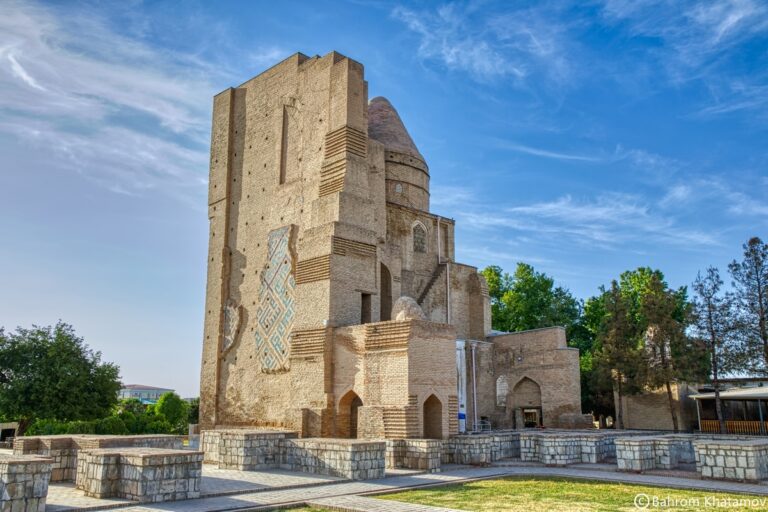
Kok Gumbaz Mosque underwent several renovations, including work during the 1970s and further restoration in 1995–1996. The later campaign was associated with the 660th anniversary of Amir Temur. Poor-quality repairs in 1975 and during 1992–1999 damaged some inscriptions and contributed to the loss of part of the mosque’s original appearance. The facade inscriptions were restored in 1995.
Remains
Plan, galleries, and entrance
The mosque has a nearly square plan, measuring approximately 12.6 by 12.61 metres, while the interior measures about 12.7 by 12.7 metres. Deep, tunnel-like passageways or arched galleries run along all four sides of the building. Entry is from the east through a porch about 10 metres wide. Broad arched openings once connected the porch’s side walls, but those openings are now closed.
Dome and calligraphic decoration
The large dome is covered with blue tiles, giving the mosque its name, Kok Gumbaz, meaning “Blue Dome.” Its outer surface carries blue and white decoration, with Quranic verses placed between the ornamental elements. Mosaic brick tiles line the dome and bear Kufic inscriptions. Kufic is a historic Arabic calligraphic style used in Islamic architectural decoration. In the middle of the border, verses 1–3 of the Quran’s Surah al-Fath appear in large white letters on a yellow background. Below the dome, small blue-background lettering gives the text of Surah al-Jumu’ah, a chapter associated with communal Friday worship; this section was repaired later.
Facade and interior structure
The facade pediments contain extensive geometric ornament, while single-layer tilework covers the exterior facade and interior. Arabic inscriptions are combined with traditional patterns, and floral ceramic decoration appears on the columns and arches. The pediments repeat the phrase “Allah is great” in Kufic Bannai script, another historic Arabic calligraphic style. Verses 127–128 of Surah al-Baqarah, the Quran’s second chapter, appear in Thuluth script on a blue background. The facade columns and upper galleries were damaged.
Inside the hall, eight small arches are linked by rhombus-shaped, shield-like arches and supported by sixteen arches. Four spiral staircases are built into the corners of the brick walls, integrating circulation into the building’s structural fabric.