Dorut Tilavat: A Timurid Memorial Complex in Uzbekistan
Site at a Glance
- Rating
- 4.4
- Popularity
- Very Low
- Country
- Uzbekistan
- Primary era
- Medieval
- Eras represented
- Medieval
- Civilizations
- Timurid
- Site type
- Religious
- Remains
- Tomb
On this page12 sections
History
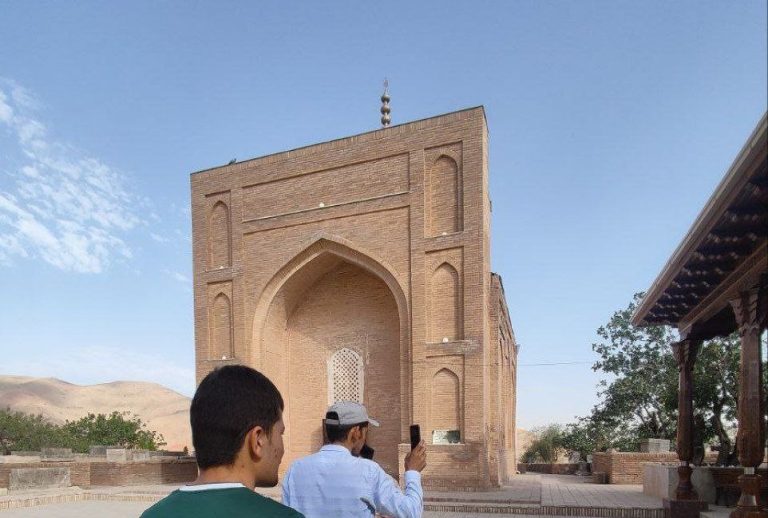
Dorut Tilavat is a Timurid memorial complex in Shahrisabz, Uzbekistan, dating mainly from the fourteenth and fifteenth centuries. Built under the Timurid dynasty, it developed as a religious and dynastic ensemble around the grave of Shaykh Shamsiddin Kulol. The name means “the place where the Qur’an is read and recited,” reflecting the complex’s devotional character. It stands in the southeastern part of the city, west of the Darussiodat complex.
Origins and the Shamsiddin Kulol Memorial
Before Dorut Tilavat was established, the site contained an old cemetery associated with Sayyids, Muslims traditionally regarded as descendants of the Prophet Muhammad. Amir Timur initiated the complex in memory of Shaykh Shamsiddin Kulol, a revered religious leader who died in 1370. Shamsiddin Kulol had been the spiritual mentor of both Amir Taragay, Timur’s father, and Amir Timur. His grave quickly became a place of pilgrimage.
Amir Taragay was later buried at Shamsiddin Kulol’s feet, and his remains were transferred to the site in 1373. The complex consequently became connected with the Timurid ruling family as well as with the religious memory of Shamsiddin Kulol. The construction of the mausoleum devoted to Shamsiddin Kulol began on Amir Timur’s order in 1373 and was completed in 1374.
Dynastic Burials and Timurid Development
In 1376, Amir Timur’s eldest son, Mirzo Jahangir, was buried at Dorut Tilavat. A grave attributed to Amirzoda Umarshaykh Mirzon was also placed on the qibla side, the side oriented toward Mecca, of the mausoleums of Shamsiddin Kulol and Amir Taragay. When Amir Timur visited Shahrisabz, he and his family visited the graves of Shamsiddin Kulol, Taragay, Jahangir, and other relatives.
The Dorut Tilavat madrasa, an Islamic institution traditionally devoted to religious learning, was attached to the north of Shamsiddin Kulol’s mausoleum. During the fourteenth and fifteenth centuries, its enclosed courtyard became the center of a unified memorial complex. This ensemble brought together the mausoleum, the madrasa with Taragay’s burial chamber, a mosque, and a dynastic mausoleum.
During the reign of Mirzo Ulugh Beg, a Timurid ruler and patron of architecture, a domed mausoleum was erected over Shamsiddin Kulol’s burial place. Ulugh Beg also began the final design of the complex in 1438 by constructing a mausoleum for his relatives and descendants beside the earlier memorial. An inscription beneath the dome identifies this dynastic purpose.
The Kok Gumbaz Mosque
In 1435–1436, Ulugh Beg built the Kok Gumbaz Jami Mosque on behalf of his father, Shahruh, according to the inscription on its portal. Shahruh was Amir Timur’s son and Ulugh Beg’s father. The mosque served as Shahrisabz’s Friday congregational mosque, giving the memorial complex an important public religious function.
Excavation and Preservation
Excavations carried out from 1994 to 1996 revealed remains of the earlier madrasa, a gatehouse, decayed wall sections on both sides of the congregational mosque, and sections of walls surrounding the minaret. Later restoration addressed the mosque façades, part of the madrasa, the minaret, the Kok Gumbaz Mosque, and the Gumbazi Sayidon Mausoleum. These interventions aimed to preserve and recover the complex’s historical appearance. Dorut Tilavat is protected as a historical complex and is identified as a Timurid memorial and dynastic burial ensemble.
Remains
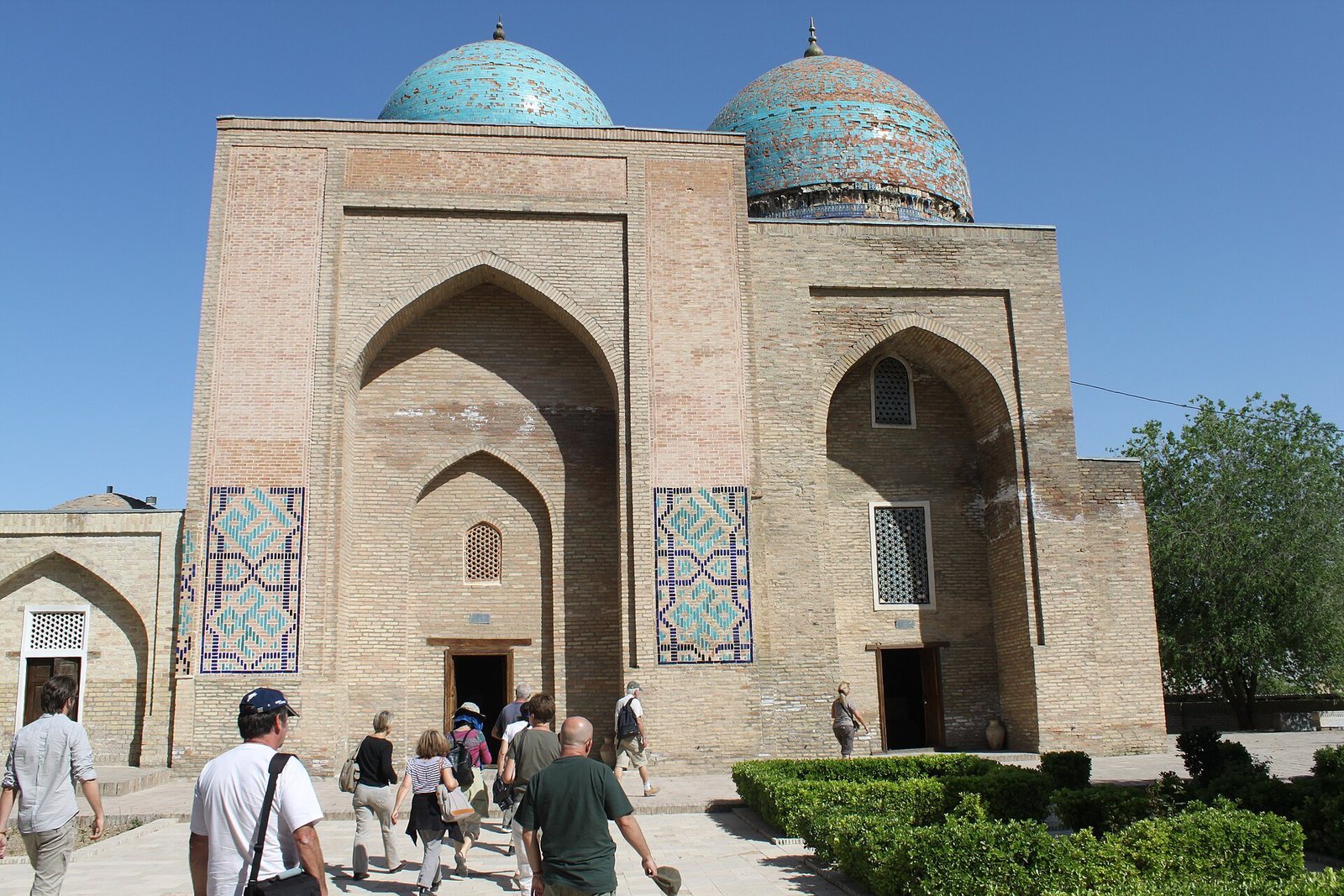
The present complex has a generally square plan covering about 500 square metres. Its platform rises approximately 2.25 metres above the surrounding city surface. Fired brick and marble tiles are among its stated construction materials, and some architectural elements resemble those of Shah-i-Zinda. The surviving ensemble consists of the Shamsiddin Kulol Mausoleum, the Gumbazi Sayidon Mausoleum, the Dorut Tilavat madrasa, and the Kok Gumbaz Jami Mosque.
Mausoleums and Burial Spaces
Shamsiddin Kulol Mausoleum
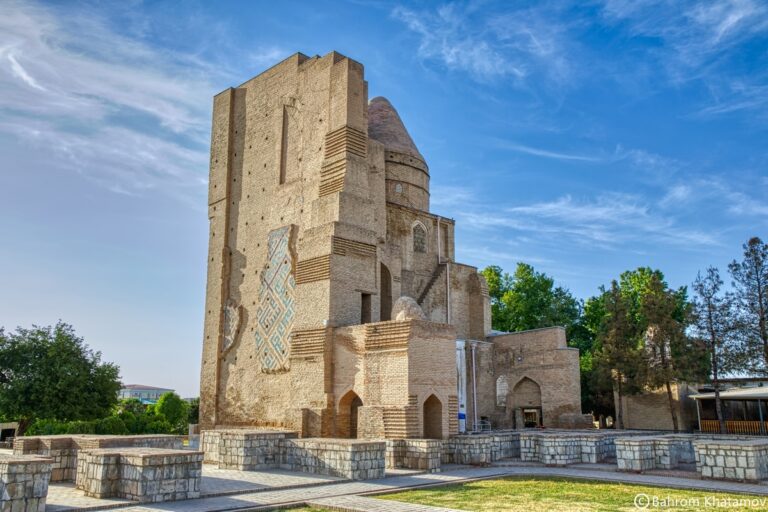
The Shamsiddin Kulol Mausoleum is regarded as the oldest structure in the complex. Its initial construction took place in 1373–1374, while a later domed mausoleum was raised over the burial place during Ulugh Beg’s reign. Excavations uncovered double walls around the building, supporting the interpretation that it was based on an earlier mosque dating from the tenth to twelfth centuries.
The mausoleum contains Shamsiddin Kulol’s burial place and the burial chamber associated with Amir Taragay. Several stone grave markers were transferred into the building from an additional cemetery during the fifteenth and eighteenth centuries. Some carry the names of virtuous Sayyids, and older marble inscriptions remain on the tombstones. Inscriptions preserved inside the mausoleum praise Ulugh Beg for justice, knowledge, religion, and faith.
Gumbazi Sayidon Mausoleum
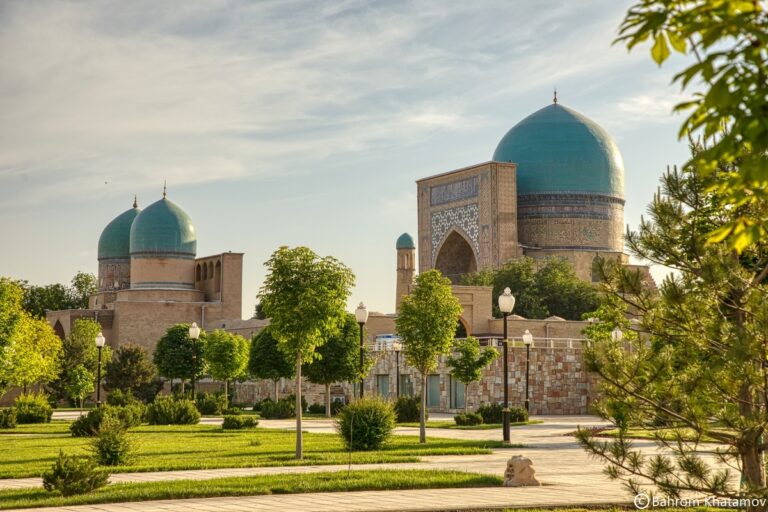
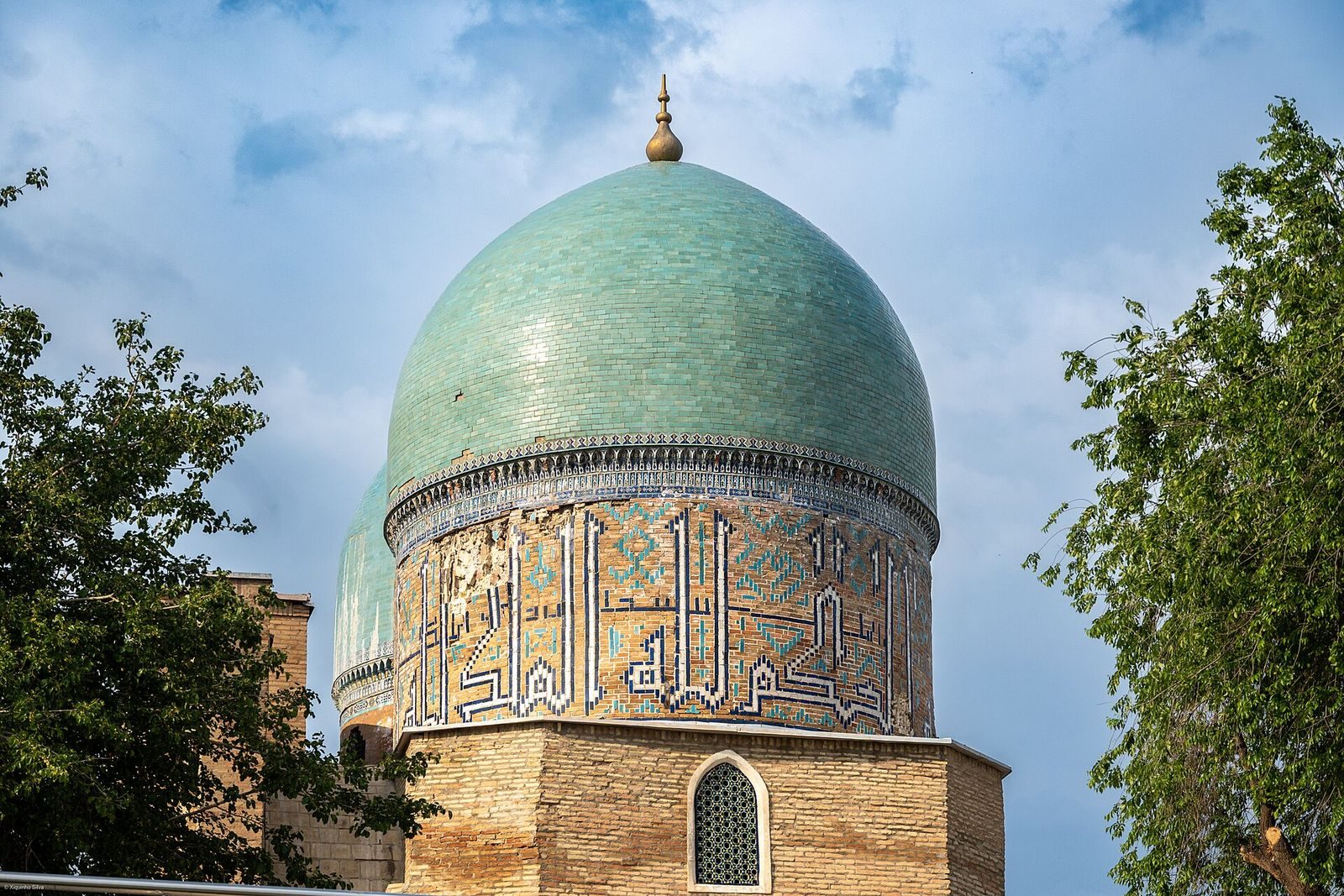
The Gumbazi Sayidon Mausoleum occupies the southern part of Dorut Tilavat. Its walls were completed between 1437 and 1438 under Ulugh Beg’s orders. The structure is slender and has a tall drum, the cylindrical section supporting a dome. Its outer dome was originally pointed.
The name Gumbazi Sayidon means “Dome of the Sayyids.” It derives from marble tombstone inscriptions inside the mausoleum that preserve the names of Sayyids. The building forms part of the later Timurid dynastic arrangement created beside Shamsiddin Kulol’s memorial.
Congregational Mosque and Madrasa
Kok Gumbaz Jami Mosque
The Kok Gumbaz Jami Mosque stands opposite the two mausoleums in a paired composition known as a kosh arrangement, in which major buildings face one another across an open space. Its spacious square prayer hall is covered by a large dome faced with blue tiles, giving the mosque its name, “Blue Dome.”
Canopied wings supported by pillars extend from both sides of the main room and could accommodate many worshippers. The monumental entrance façade, or peshtak, faces east, and a small minaret was built in the courtyard. The mosque’s decoration is comparatively restrained. Its inscriptions include the words “Rule belongs to Allah; wealth belongs to Allah,” together with texts written in Suls and Kufic, two calligraphic scripts used in Islamic architecture.
Dorut Tilavat Madrasa and Archaeological Walls
The madrasa occupied the northern side of Shamsiddin Kulol’s mausoleum and helped organize the complex around an enclosed inner courtyard. Archaeological excavations brought parts of the madrasa to light, along with a gatehouse and decayed wall sections on both sides of the congregational mosque.
Additional surviving remains include sections of walls surrounding the minaret. Together with the restored mosque, parts of the madrasa, and the two mausoleums, these fragments reveal the physical extent of a complex that combined religious education, congregational worship, pilgrimage, and Timurid dynastic burial.