Dorous Siadat Complex: A Timurid Funerary and Religious Ensemble in Shahrisabz


Site at a Glance
- Rating
- 4.4
- Popularity
- Low
- Country
- Uzbekistan
- Primary era
- Medieval
- Eras represented
- Medieval
- Civilizations
- Timurid
- Site type
- Religious
- Remains
- Tomb
On this page11 sections
History
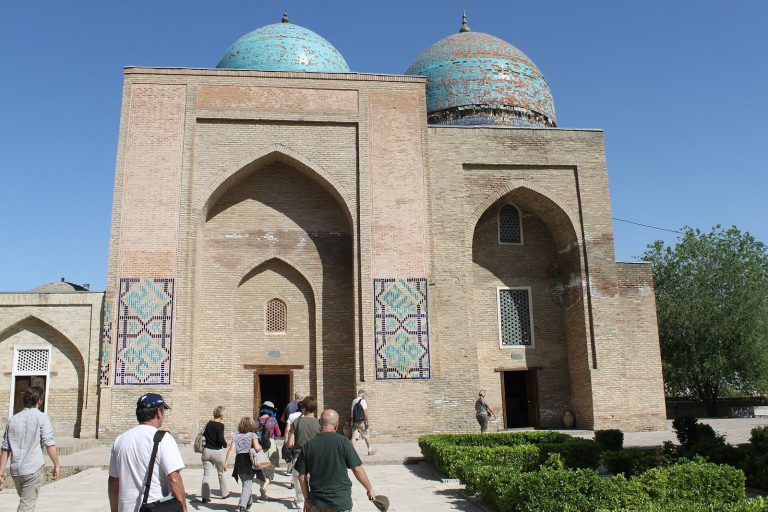
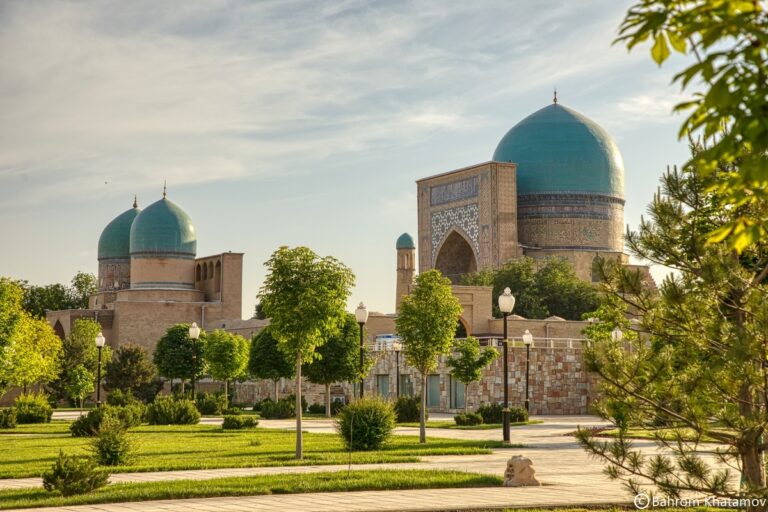
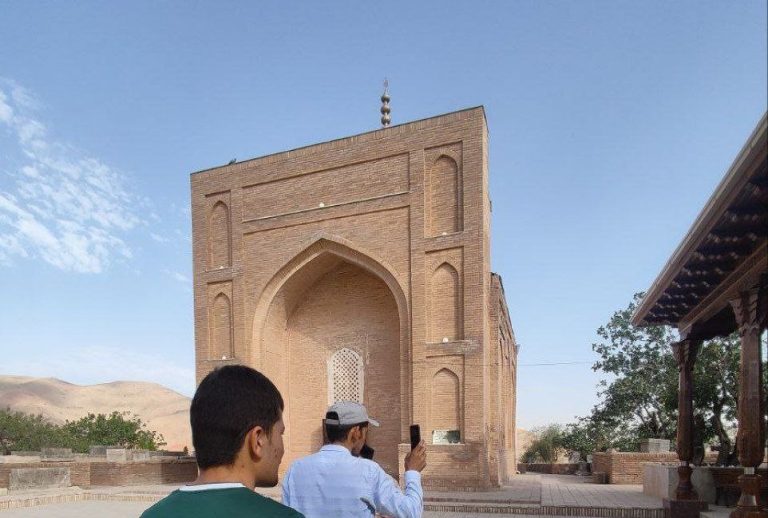
Dorous Siadat complex is a ruined funerary and religious ensemble in Uzbekistan, located in Shahrisabz and built under Amir Timur during the late fourteenth century. Construction began in 1379 and was completed by the end of that century. Known as the “House of the Sayyids,” it became one of the principal religious and burial complexes associated with Amir Timur, the Central Asian ruler who established the Timurid dynasty and made Shahrisabz a major political and architectural centre.
A dynastic and religious centre
The complex’s principal monument was created for Jahangir, Amir Timur’s eldest son, who died at the age of 22. The site also formed part of a route toward the nearby Dor ut-Tilavat complex. Together, the two ensembles served as a cemetery for members of the political and religious elite.
Dorous Siadat may have functioned as a dynastic cemetery for Amir Timur and members of the Barlas, the Central Asian Turco-Mongol tribal group from which Timur emerged. Umarshaykh Mirza’s burial is traditionally or tentatively connected with the complex. This association rests on the discovery nearby of a stone sarcophagus belonging to his son, Said Ahmad Mirza.
Sharaf al-Din Ali Yazdi’s Zafarnama records that a funerary building was commissioned at Shahrisabz for the burial monuments of Jahangir, other officials, and their descendants. The complex was also visited by Ruy González de Clavijo, who recorded observations about it.
Archaeological investigation and heritage status
Investigations during the 1970s and 1980s revealed numerous architectural remains across the complex. Excavations in 2002 identified the remains of a building belonging to its southern pillar. Dorous Siadat forms part of the Historic Centre of Shakhrisabz, which entered the UNESCO World Heritage List in 2000 under criteria (iii) and (iv). In 2016, the historic centre was placed on the List of World Heritage in Danger, the UNESCO category for inscribed sites facing serious conservation threats.
Remains
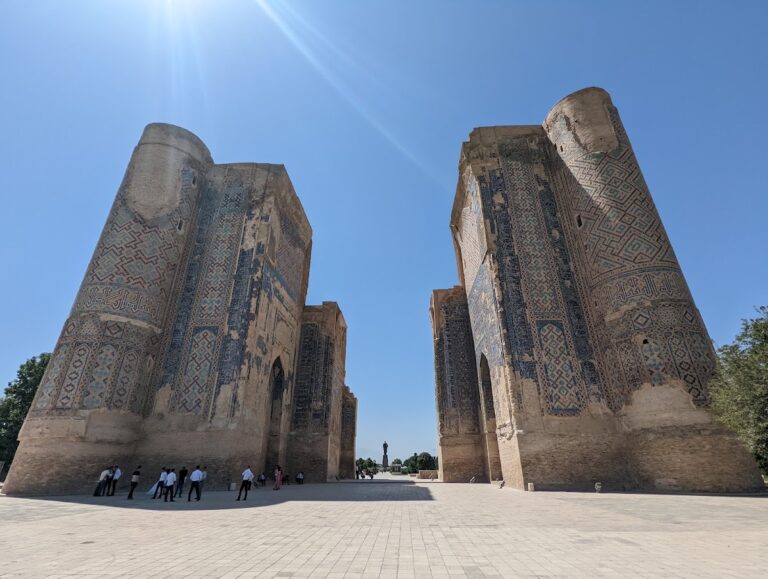
The surviving complex covers approximately 3,500 square metres and preserves the remains of a large mausoleum and religious ensemble. Its layout closely resembles that of the Yasawi complex. On the principal western side, a monumental arched or vaulted entrance was approximately 20 metres wide. From this entrance, the route led toward a building used for charitable meals, or possibly a palace, and then to a central structure containing an underground burial chamber intended for Amir Timur.
Principal funerary buildings
Jahangir Mausoleum
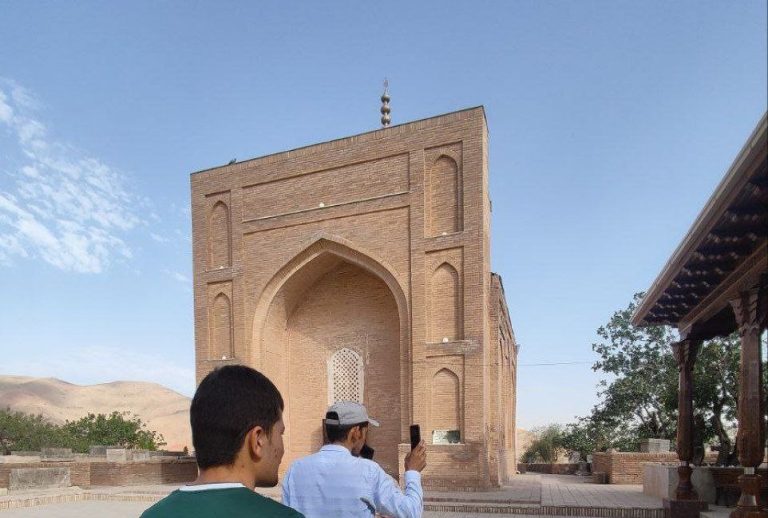
The Jahangir Mausoleum is the chief monument of Dorous Siadat and contains the remains of Jahangir. Its role as a monumental tomb placed the burial of Amir Timur’s eldest son at the centre of the complex’s funerary purpose.
Amir Timur’s crypt
A crypt, or underground burial chamber, survives within the complex. It contains a sarcophagus, a stone funerary container, with inscriptions indicating that it was intended to hold Amir Timur’s remains. Timur was ultimately buried in Samarkand, leaving the chamber as a physical expression of the burial plan associated with the complex rather than his final tomb.
Entrances and service spaces
Monumental western entrance
The western entrance formed a substantial arched or vaulted passage into the ensemble. Another arch stood 10.15 metres from the Jahangir Mausoleum. It was only 1.7 metres shorter than the arch of the Aq Saray and incorporated two proportionally arranged pishtaqs, monumental framed portals, built strongly from white marble blocks. Its scale places it among the largest arches of its period.
Central building and lateral rooms
A long corridor at the corner of the central building gave access to lateral rooms. These spaces are tentatively interpreted as a kitchen, mosque, library, and cells for guests. The complex also included the Hazrat-i Imam Mosque, adding a formal religious function to its funerary role.
Associated burial evidence
Nearby, archaeologists found the burial sarcophagus of Said Ahmad Mirza, the son of Umarshaykh Mirza. This find provides the basis for the tentative identification of Umarshaykh’s burial at Dorous Siadat and links the surviving remains with the wider dynastic burial traditions of Amir Timur’s ruling milieu.