Langarota Mosque: An Islamic Architectural Monument in Uzbekistan
Site at a Glance
- Rating
- 4.9
- Popularity
- Very Low
- Country
- Uzbekistan
- Primary era
- Medieval
- Eras represented
- Medieval, Early Modern
- Civilizations
- Timurid
- Site type
- Religious
- Remains
- Mosque
On this page9 sections
History
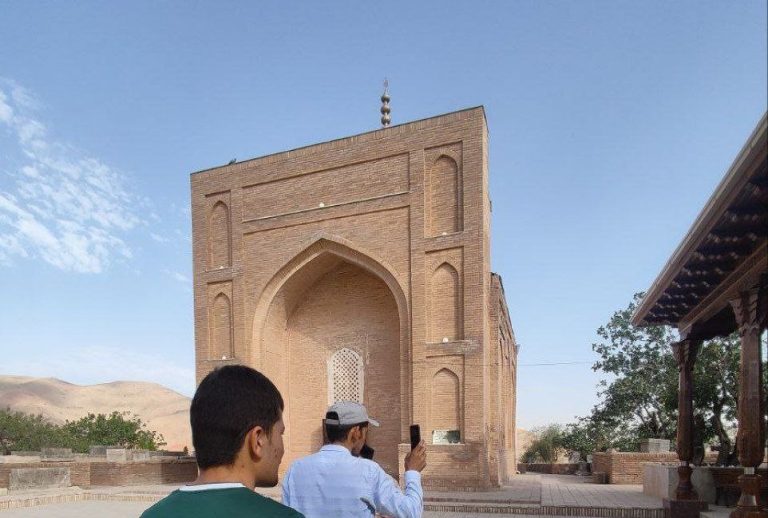
Langarota Mosque is an Islamic architectural monument in Katta Langar village, Uzbekistan, in the mountainous Qashqadaryo Region. Known popularly as Khazrat Langar Ota, the mosque is associated with the fifteenth century and the first half of the sixteenth century, although its exact construction date remains uncertain. It belongs to the architectural traditions of Central Asia’s mountain regions and developed as a religious center connected with the Langarota sheikhs.
Origins and successive construction
The mosque is traditionally attributed to Sheikh Abul Hasan. According to local tradition, he began the project after receiving a letter from an elder in Bukhara. Its construction depended on charitable organizations, individual patrons, and collective labor by local people. Contributors brought materials and other resources according to what they could provide, giving the building a communal foundation.
The mosque grew in stages rather than as a single unified project. The smaller prayer room is considered the earlier part, while the larger prayer room was added later beside it and given a shared veranda. One hall was begun during the rule of Mirzo Ulugbek, a Timurid ruler and astronomer of fifteenth-century Central Asia, and was completed under the Ashtarkhanid dynasty, which ruled parts of Central Asia after the Timurids.
Decorative inscriptions preserve evidence of later building work or reconstruction in 1519–1520, 1562–1563, 1748, and 1807–1808. A further inscription on a column states that the mosque was reconstructed in 1905 by the master Muhammadiyar. These successive interventions shaped the complex over several centuries.
The Langarota religious complex
The mosque stands within a wider sacred landscape associated with the Langarota Mausoleum. Monuments at the mausoleum were built from the late fifteenth to the mid-sixteenth century. Local traditions preserve the memory of influential Langarota sheikhs, including Muhammad Sadiq (1465–1545) and Abul Hasan (1491–1592), as well as Timurid princesses.
Soviet-era survival and present status
During the Soviet period, reconstruction work was carried out in the surrounding area, and authorities at one point intended to destroy the mosque. Local residents collected money and bought the building from the state, helping it survive. Part of the wider complex, including a madrasa, an Islamic educational institution, was destroyed during the 1950s.
Langarota Mosque remains an active place of worship. In 2023, Ismoil Sarmonov served as its imam-khatib, the mosque official responsible for leading communal prayers and delivering sermons. The mosque is included in Uzbekistan’s list of tangible cultural heritage of republican significance.
Remains
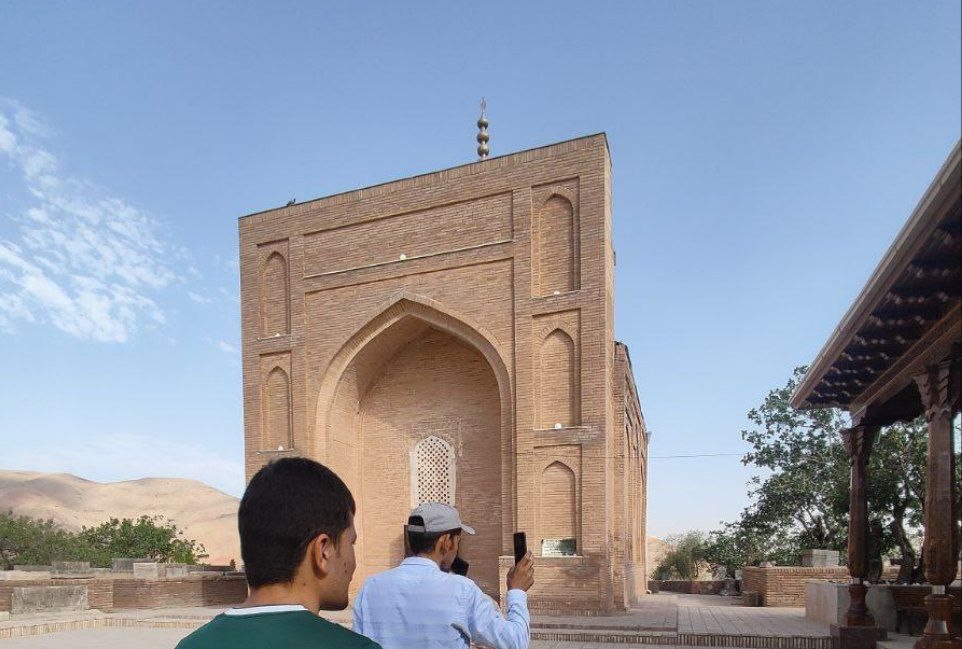
Langarota Mosque occupies a hill near a cemetery at an elevation of about 1,000 meters in the mountainous area around Langar, within the Hissar mountain range. The village lies approximately 25–30 kilometers from Kyzyltepa. The square building measures 32 by 32 meters and rises about 11 meters. Its plan brings together two prayer rooms, a roofed entrance veranda known as an iwan, four mihrabs, seven doors, and nineteen columns.
Architectural complex
Langarota Mosque
The iwan contains two rows of tall, carved wooden columns, with nineteen columns recorded as surviving there. Several have distinctive carved patterns and ornaments. The smaller prayer room has four columns supporting its roof and thick walls, while the larger room has five roof-supporting columns and was built alongside it. Small, dark rooms for sheikhs, an honorific for respected Islamic religious leaders, are located inside the mosque.
The roof and ceiling display traditional Fergana-style decoration. Beams and other timber elements carry intricate floral and vine motifs, while the building also contains carved plaster window latticework, marble columns, decorated capitals, and elaborately ornamented woodwork. The lower wall zone is divided from the main floor by smooth gray and gilded marble borders.
Langarota Mausoleum
The Langarota Mausoleum measures approximately 140 by 12.5 meters and includes a single chamber measuring 5.2 by 5.2 meters. The chamber has a vaulted roof resting on a four-sided dome. Its architectural details include latticed, shield-shaped arches, shelves decorated with carved-capital motifs, and two-layered polychrome carving on the arches. Bricks on the upper surface were laid in the “bandak” and “mavdj” styles.
Decoration and religious objects
The mosque’s mihrab, a recessed feature indicating the direction of prayer, is decorated with Thuluth inscriptions and polychrome ornament. Thuluth is a monumental cursive Arabic script often used for architectural inscriptions. Mosaic tile panels run along the walls. Some contain Arabic writing and writing in an unidentified language, while yellow and orange fragments bordered in blue, orange, and white stand against black panel lines.
The decorative surfaces include three types of star pattern, dark eight-shaped motifs, and central elements painted in gold. The altar and wall decoration are well preserved. A facsimile of the Katta Langar Quran is also preserved at the mosque. It reproduces a Quran written in Kufic, an older angular Arabic script associated with early Quranic manuscripts and formal religious decoration.