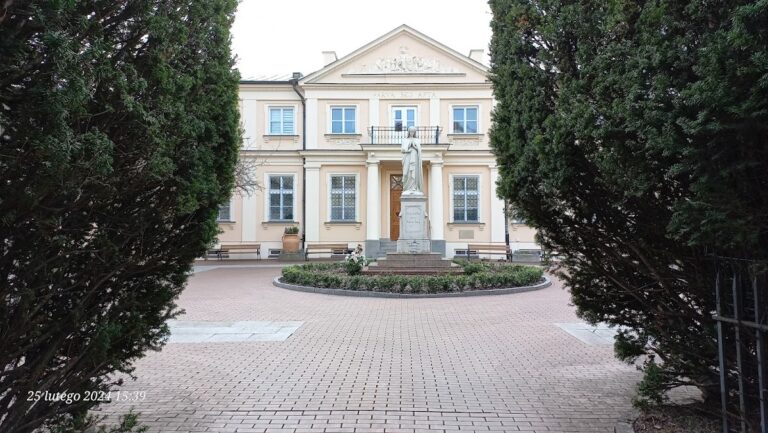
Koelichen Palace in Warsaw: A Historic Palace and Public Library


Site at a Glance
- Rating
- 4.6
- Popularity
- Very Low
- Country
- Poland
- Primary era
- Modern
- External website
- Open
- Eras represented
- Modern
- Civilizations
- Russian
- Site type
- Domestic
- Remains
- Elite Residence
On this page10 sections
History
Koelichen Palace in Warsaw is a historic palace in Poland, located in the Włochy district. Its origins lie in a seventeenth-century estate, while the present residence took shape through nineteenth-century redevelopment in the neoclassical period. The palace and its grounds later became part of Włochy’s garden-city district and now serve a public cultural purpose.
Seventeenth-century estate
Andrzej Leszczyński, Grand Chancellor of the Crown and primate of Poland, acquired the Włochy estate during the first half of the seventeenth century. Around 1650, he established a manor or summer residence there. The manor and the village of Witki were burned by the Swedish army in 1656 during the Second Northern War, the mid-seventeenth-century conflict involving Sweden and several northern and central European powers. The area later became part of Włochy, while the nearby settlement of Stojarty was last recorded in the seventeenth century.
In 1671, the estate provided refuge for Ulrich von Werdum, who organized opposition to the election of Michał Korybut Wiśniowiecki as king of Poland and grand duke of Lithuania. During the siege of Warsaw in 1794, the Prussian king Frederick William II used the area as his headquarters.
Mostowski and nineteenth-century redevelopment
Count Tadeusz Antoni Mostowski, a politician and statesman, acquired the Włochy estate in 1795 and established his residence there around 1800. He developed the surrounding park, which was later designed by A. Szubert. In 1842, the residence was redeveloped as a neoclassical palace and the grounds as an English landscape garden, a naturalistic park design based on lawns, curving paths, varied planting, and irregular composition. The English gardener F. James redesigned the park. The facade may also have been altered in a Neo-Renaissance style at about this time.
Entrepreneur Andrzej Koelichen acquired the estate in 1844. Around 1859, Edward and Karol Emil Koelichen rebuilt or remodeled the palace to a design by architect Aleksander Zabierzowski. The palace and garden remained in the Koelichen family until 1939.
Włochy garden-city district
In 1928, the palace and park became part of the developing garden-city district of Włochy. Part of the park was parceled out for the surrounding residential neighborhood, while the remaining grounds became a public recreational space known as Combatants Park. The development took place on the instructions of Warsaw mayor Zygmunt Słomiński.
From 1933, the palace housed a chapel serving the local community of the Evangelical Church of the Augsburg Confession, the Lutheran tradition associated with that foundational statement of doctrine. The community had approximately 1,000 members in 1931. The chapel ceased to be needed after the opening of the Church of the Epiphany. A library established by the Property Owners Association opened in the palace in 1936, and the building was also used as a medical station during the Second World War.
Wartime deportation and postwar use
On 16 September 1944, during the German occupation and the suppression of the Warsaw Uprising, the 1944 Polish resistance uprising against German rule, German units assembled more than 4,000 male residents of Włochy in Combatants Park. The men were approximately 16 to 60 years old and were transported to Transit Camp 121 in Pruszków. Transit camps were temporary detention and sorting facilities from which deportees were sent onward to forced-labor sites or concentration camps.
About 3,500 men were transported by train and the remainder were forced to walk. Approximately 2,072 were later murdered, while the overall deaths among those deported have also been estimated at up to half of the group. Włochy and Okęcie were liberated from the occupation by the Polish People’s Army on 17 January 1945. After the war, the palace was renovated and restored, and the library reopened there in 1947 under municipal administration.
The palace received protected cultural-property status in 1965. Since 1996, its silhouette has appeared on the coat of arms of the Włochy district. Two memorial stones in Combatants Park commemorate the September 1944 deportation.
Remains
Koelichen Palace and its surrounding grounds form a palace-and-park complex in Combatants Park at 2 Chrościckiego Street. The three-storey building has an irregular plan and irregular massing with eclectic features, while the palace grounds retain an English landscape garden. The park also contains a railway line associated with the 1944 deportations.
Palace and landscape garden
Palace building
The palace combines its neoclassical nineteenth-century redevelopment with later eclectic features. The building’s form reflects the rebuilding or remodeling carried out around 1859 for Edward and Karol Emil Koelichen. It currently houses a public library, continuing the building’s long connection with local cultural use.
Park and plantings
The surviving park includes the English landscape garden developed during the nineteenth century. Recorded trees include plane trees, American tulip trees, maples, and limes, several of which are designated natural monuments. The park’s railway line is associated with the wartime transportation of Włochy residents to Transit Camp 121.
Commemorative features
Two memorial stones stand in Combatants Park in remembrance of the men deported from Włochy in September 1944. They form part of the commemorative landscape surrounding the palace and preserve the connection between the site and the wartime history of the district.
Nearby sites