Redoubt 54 in Warsaw: A November Uprising Field Fortification


Site at a Glance
- Rating
- 4.5
- Popularity
- Low
- Country
- Poland
- Primary era
- Modern
- External website
- Open
- Eras represented
- Modern
- Civilizations
- Kingdom of Poland, Russian
- Site type
- Military
- Remains
- Fort
On this page11 sections
History
Redoubt 54 in Warsaw, Poland, was a Polish field fortification from the November Uprising, the insurrection against Russian rule that began in 1830 and continued through 1831. Built as part of Warsaw’s defensive belt in 1831, it stood on the southern edge of the city’s western forefield and protected the larger Wolskie Redoubt 56 from the left, at a distance of approximately 2 kilometres.
The attack of 6 September 1831
Russian forces commanded by General Jafimov attacked Redoubt 54 on 6 September 1831. Major Ignacy Dobrzelewski commanded the position, while Second Lieutenant Julian Konstanty Ordon led its artillery. Ordon did not command the redoubt itself, despite the name by which it later became widely known.
The garrison was made up of two companies from the 1st Regiment of Foot Rifles of the Kingdom of Poland, six guns, one wall gun, and 43 artillerymen. A wall gun was a heavy firearm used from a fortification rather than an ordinary infantry rifle. The position held only about one-third of its planned complement, leaving it severely undermanned when the assault began.
Russian artillery shelled the redoubt for about two hours. The bombardment badly unsettled the defenders. During the assault, they used no grenades and fired ineffectively with rifles from behind the rampart. Once Russian troops entered the position, it collapsed rapidly, and the Polish soldiers could not withdraw.
One of the two ammunition magazines exploded after the Russian troops had entered. The cause remains uncertain. It may have been an accidental fire started by retreating Polish soldiers, the deliberate destruction of the magazines on Ordon’s order, or a Russian shot fired at a Polish artillery officer who was sheltering in a magazine and refusing to surrender.
Approximately 100 Russian soldiers were reportedly killed in the explosion, and Russian losses in the battle reached about 600 men. Two Russian colonels died, General Jafimov was killed, and General Geismar was wounded. The fall of the redoubt therefore formed part of the wider defeat of Warsaw’s western defenses during the final phase of the uprising.
Memory and changing identifications
The defense and explosion became the subject of Adam Mickiewicz’s poem Ordon’s Redoubt. Mickiewicz was a major Polish Romantic poet, and his poem became the principal literary representation of the episode. Drawing on the eyewitness account of Stefan Garczyński, it portrayed Ordon as dying in the explosion. In reality, Ordon survived with burns, later emigrated, and died by suicide at the age of 77. His tomb is in Lychakiv Cemetery in Lviv.
For many years, tradition placed Ordon’s Redoubt near Mszczonowska Street. This location resulted from confusion with nearby Redoubt 55, which was unoccupied. An 1831 plan of Warsaw’s fortifications indicated the position of Redoubt 54 near Na Bateryjce Street, and archaeological research in 2011 supported that identification.
The mistaken location nevertheless became an important place of public memory. A Russian obelisk commemorating the victorious assault on Warsaw was erected there during the 1840s. It was replaced by a memorial stone unveiled beside a cross on 28 November 1937, shortly before the anniversary of the November Uprising. The stone commemorates the explosion of Ordon’s Redoubt on 6 September 1831 and honors the defenders of the homeland. Both the memorial and the name Ordon’s Redoubt remain associated with the former site of Redoubt 55, near the junction of Włochowska and Mszczonowska Streets.
Twentieth-century defense and archaeological research
During the September 1939 campaign, the area served as a defensive position for the 8th Company of the 40th Infantry Regiment during the defense of Warsaw. On 9 September, a German column of tanks and infantry vehicles was destroyed near Wolska Street and Ordon’s Redoubt.
Archaeological investigations at Na Bateryjce Street began on 28 October 2010 to establish the location and form of Redoubt 54. Research in 2013 uncovered soldiers’ burials and recovered buttons identifying men from the 1st Regiment of Foot Rifles of the Kingdom of Poland and several Russian units. These included the 11th Jaeger Regiment, the Belozersk, Olonets, 22nd Vologda, and Aleksopol Infantry Regiments, and the Siberian Grenadier Regiment. A jaeger regiment was a Russian light-infantry formation, while grenadiers were historically associated with specially selected assault troops. The site entered the register of historic monuments in 2016.
The area was associated with an initial, improvised burial of soldiers, chiefly Russians, by local inhabitants. Kurhan Street probably derives its name from that burial place. The construction of a mosque belonging to the Muslim League of the Republic of Poland near the probable redoubt site later provoked controversy, because of demands that the neglected ground be treated as a soldiers’ resting place.
Remains
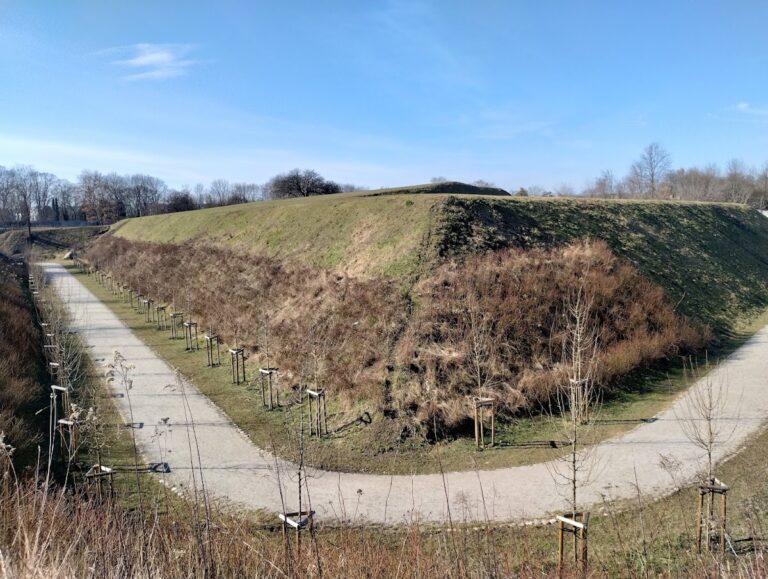
Redoubt 54 probably occupied a raised area beside Na Bateryjce Street, between Bohaterów Września Street, Aleje Jerozolimskie, the Blue City shopping center, and the Zesłańców Syberyjskich roundabout. It was likely a six-sided field fortification surrounded by a ditch, with an enclosed earthwork designed for defense in every direction. Its overall size was approximately 200 metres, although its exact shape and orientation remain unknown.
Earthwork and armament
Raised defensive position
The surviving raised ground is especially visible southwest of the Zesłańców Syberyjskich roundabout. The northern section of the redoubt has been irreversibly lost beneath the corridor of Aleje Jerozolimskie, which runs several metres below the former ground level. The northern edge of the fortification extended approximately halfway across the roadway. This altered landscape preserves part of the position while also cutting through its former extent.
Ammunition magazines and guns
Two ammunition magazines stood within the redoubt. Its six guns were old Austrian and Prussian rampart guns of limited effectiveness, supplemented by one wall gun. These weapons formed the artillery that defended the earthwork during the Russian assault and were connected to the explosion that destroyed one of the magazines.
Burials and commemorative remains
Soldiers’ graves
Archaeological investigations in 2013 revealed soldiers’ graves within the redoubt area. Buttons associated the buried men with Polish defenders from the 1st Regiment of Foot Rifles of the Kingdom of Poland and with Russian troops from the 11th Jaeger Regiment, the Belozersk Infantry Regiment, the Olonets Infantry Regiment, the 22nd Vologda Infantry Regiment, the Aleksopol Infantry Regiment, and the Siberian Grenadier Regiment. The burials connect the physical remains of the site with the opposing forces involved in the battle.
Memorial at the mistaken site
The Russian victory obelisk and the later 1937 memorial stone stand at the traditional location near Włochowska and Mszczonowska Streets, which was the site of Redoubt 55 rather than Redoubt 54. The modern shopping-center name Atrium Reduta and the Warsaw Redoubt Ordon station name also preserve this mistaken association. The memorial landscape therefore records the long afterlife of the redoubt’s name as well as the distinction between the remembered location and the position identified near Na Bateryjce Street.
Nearby sites