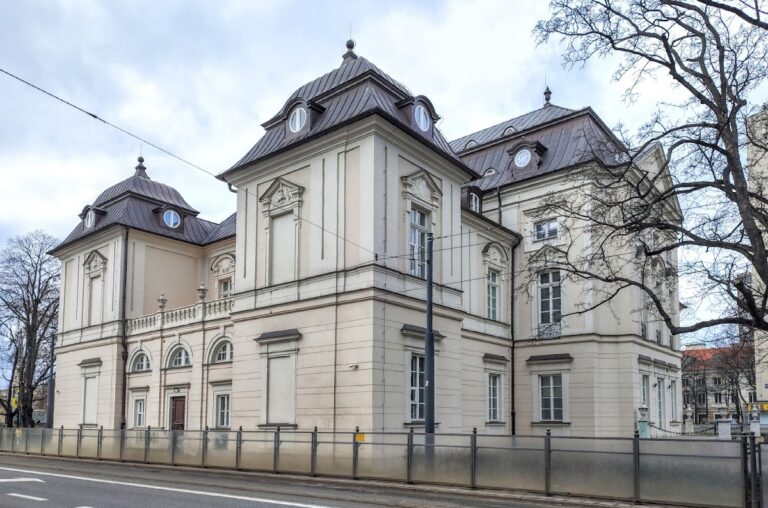
Bogusławski Palace: Historic Palace and Religious House in Warsaw


Site at a Glance
- Rating
- 5
- Popularity
- Very Low
- Country
- Poland
- Primary era
- Modern
- Eras represented
- Modern
- Civilizations
- Kingdom of Poland, Russian
- Site type
- Domestic
- Remains
- Elite Residence
On this page12 sections
History
Bogusławski Palace in Warsaw, Poland, was completed in 1807 when Wojciech Bogusławski, a Polish actor, playwright, and theatre director associated with the development of Polish national theatre, thoroughly rebuilt an older palace at 97 Żelazna Street. Its later history connected the building with Catholic education, care for children, wartime rescue, and the Franciscan Sisters of the Family of Mary.
Earlier palace and the 1807 rebuilding
The earlier palace was said to have housed the Masonic Temple of Isis in 1780. A local tradition also links the building with Alessandro di Cagliostro, an eighteenth-century Italian occultist and self-styled count associated with Freemasonry and esoteric practices. During his stay in Warsaw that year, he was believed to have performed at the palace and founded an Egyptian Masonic lodge.
Bogusławski’s rebuilding brought the palace to completion in 1807. In 1825, the architect Karol Henryk Gall purchased the property and rebuilt it again, creating another important phase in the building’s development.
The Feliński family and the Family of Mary
From 1862, the palace belonged to Father Julian Feliński, a Catholic priest. Together with his brother, Archbishop Zygmunt Szczęsny Feliński, he established a school and orphanage there. The orphanage was supervised by the Franciscan Sisters of the Family of Mary, a Catholic women’s congregation founded by Zygmunt Szczęsny Feliński.
Wartime destruction and rescue work
During the German occupation from 1940 to 1943, the palace stood immediately beside the walls of the Warsaw Ghetto. The ghetto was the enclosed district created by the German authorities in occupied Warsaw to forcibly concentrate the city’s Jewish population. The sisters cared for approximately 11 Jewish children and helped smuggle children to the “Aryan” side, meaning the area outside the ghetto in the Nazi occupation system. From there, the children were taken to orphanages or to families in the countryside.
German forces heavily damaged the palace during the Warsaw Uprising, the 1944 armed revolt by the Polish underground against German occupation forces in Warsaw. Fires severely affected the building, and the sisters who ran the orphanage were deported to Ravensbrück concentration camp.
Postwar reconstruction and present use
After 1945, the palace was rebuilt in a Classicist style under the direction of Beata Trylińska. Its present form differs from the original, and the two formerly separate outbuildings were joined to the main body. The building is now the general house of the Congregation of the Franciscan Sisters of the Family of Mary. The Museum of Saint Zygmunt Feliński opened in the right outbuilding in 2017.
Bogusławski Palace is entered in the heritage register as number 636, with the entry dated 1 July 1965.
Remains
Building and elevations
Main palace
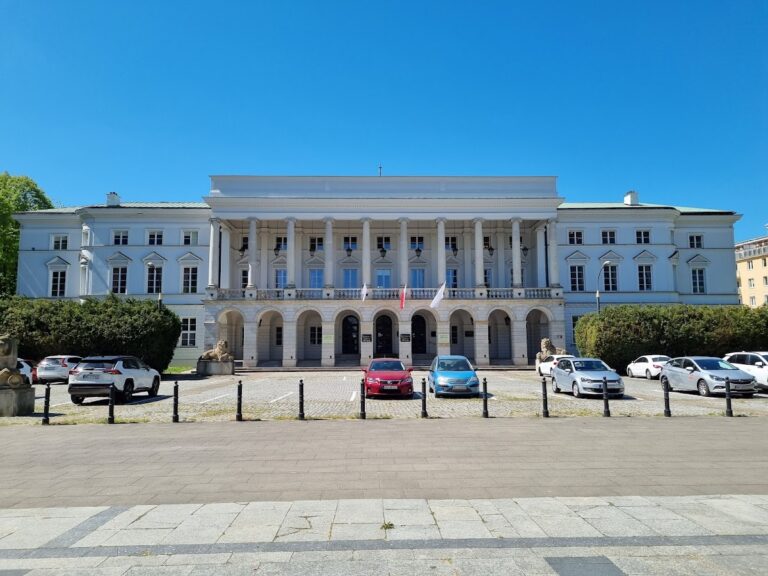
The palace was originally positioned between two single-storey outbuildings. One provided living quarters, while the other contained coach houses and stables. The front elevation has a two-column portico, a roofed entrance structure supported by columns, and the garden elevation has a four-column portico. These two porticos are the principal elements specifically stated to have survived unchanged from the earlier form.
The facade carries the Latin inscription Parva sed apta, meaning “Small but convenient.” The postwar reconstruction in Classicist style altered the building’s overall form, including the joining of the two outbuildings to the main body.
Courtyard sculpture
A statue of the Virgin Mary made by Andrzej Pruszyński was installed in the courtyard in 1863 and remains there. Pruszyński also created the relief of Christ set in the tympanum, the field enclosed by the framing elements of a Classical pediment.
Memorial features
Commemorative plaques
A plaque on the Żelazna Street facade commemorates Janusz Tarnowski. Another records the 1862 purchase of the property for the Family of Mary by Zygmunt Szczęsny Feliński from Count Pusłowski.
Monument to Zygmunt Szczęsny Feliński
A monument showing Zygmunt Szczęsny Feliński with two children was unveiled in front of the building in 2007.