Fort M “Mokotów”: An Inner-Ring Artillery Fort in Warsaw


Site at a Glance
- Rating
- 4.7
- Popularity
- Medium
- Country
- Poland
- Primary era
- Modern
- External website
- Open
- Eras represented
- Modern
- Civilizations
- Russian
- Site type
- Military
- Remains
- Fort
On this page8 sections
History
Fort M “Mokotów” is a nineteenth-century artillery fort in Warsaw, Poland, built by the Russian Empire during the 1880s near the former village of Mokotów. It formed part of the Warsaw Fortress, a system of fortifications surrounding the city, and belonged to its inner defensive ring, a chain of forts placed relatively close to the urban centre.
Construction and conversion to storage
The fort was a typical element of the inner defensive ring. Its military role changed after the Warsaw Fortress was modernized between 1889 and 1892 in response to high-explosive shells, artillery projectiles designed to cause powerful explosive and fragmentation effects. Fort M was converted to storage use, and additional protected storage buildings were added.
In 1909, the formal decision to liquidate the Warsaw Fortress was approved. Part of Fort M’s ramparts was demolished, but its shelters, barracks, and other buildings remained. The fort therefore continued to retain elements of its military fabric even as the wider fortress system was dismantled.
Radio installations and the defence of Warsaw
During the interwar period, Fort M became a site for Polish Radio transmitting stations. The 12-kilowatt Warszawa II transmitter was installed there in December 1926, giving the fort an important communications function.
Because of these radio installations, German forces heavily bombarded the fort during the defence of Warsaw in September 1939, causing substantial damage. Fighting around the position intensified on 24 September. On the following day, the German 10th Infantry Division attacked the fort, which was defended by a company of the 21st Infantry Regiment “Children of Warsaw.” German troops reached the ramparts, while the remaining Polish defenders continued fighting inside until the morning of 26 September, when German forces captured the position.
Occupation, industrial use, and protection
During the German occupation, the German Airport Command Warsaw, with approximately 500 personnel, was stationed at Fort M. In the Warsaw Uprising, German forces held the fort and used it as a base for attacks against positions of the Polish Home Army, the principal underground Polish military resistance organization during the Second World War, in Mokotów.
From 1961 until the late 1980s, the ZARAT Radio and Television Works operated at the fort and manufactured television and radio transmitting equipment. In 1935, about 6 hectares of the outer area had been transferred free of charge by the Polish Ministry of Finance to the Municipality of Mokotów, while another 6 hectares were sold for 2.5 złotys per square metre. Fort M is protected as the monument “Fort Mokotów I” at 99 Racławicka Street. The register gives the date 1883 and registration number 808, with entry made on 12 March 1975.
Remains
Fortification layout
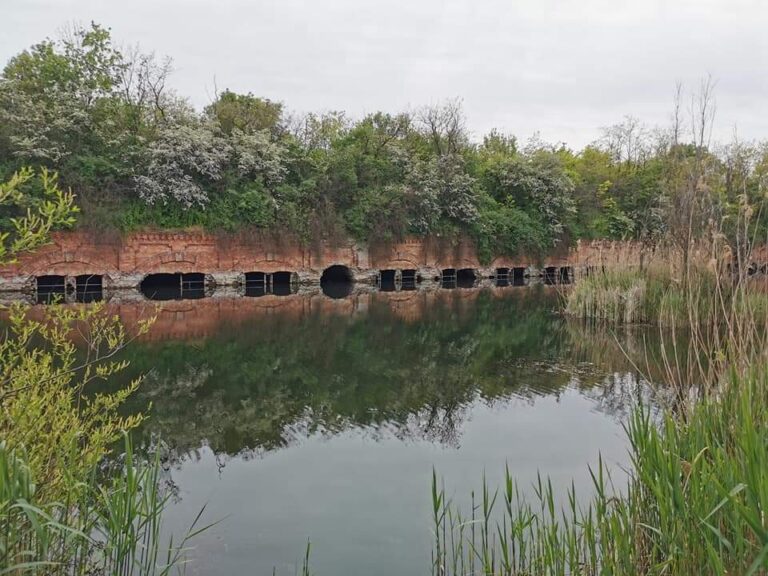
The fort lies directly south of present-day Racławicka Street at number 99 in Warsaw’s Mokotów district. Its regular pentagonal plan was formed by an earth rampart, a dry moat, and brick-built casemates, protected vaulted chambers used for shelter, storage, or weapons. The complete fortification occupied approximately 33.6 hectares.
Caponiers, fortified structures projecting into the moat so defenders could fire along or across it, were built at the front and shoulders of the rampart. Half-caponiers, which performed a similar defensive function from the flanks, strengthened the sides. Together, these elements formed the fort’s close defence of the dry moat.
Casemates and surviving buildings
The storage shelters added after the 1889–1892 modernization, together with the barracks and other buildings retained after the 1909 dismantling, remain part of the complex’s built fabric. A casemate survives in the former rampart in an unrestored condition. Other buildings from before the First World War and from the postwar period can still be identified within the site.
Buildings from both before and after the Second World War are used for storage and offices, while workshops and clubs occupy other parts of the fort. Casemates within the rampart are being renovated for office use, giving some of the original protected chambers a later function.
Outer areas and present setting
Residential development occupies former outer areas of the fort. Semi-detached houses and villas were built along Balonowa, Olimpijska, and Płatowcowa streets after the fortress was dismantled, and the fort is now surrounded by this residential development. The smaller connecting forts Fort Tscha-M “Rakowiec” to the west and Fort M-Tsche “Odyńca” to the east no longer exist.
Nearby sites