Kendal Castle: A Medieval Fortification in Cumbria


Site at a Glance
- Rating
- 4.5
- Popularity
- Low
- Country
- United Kingdom
- Primary era
- Medieval
- Eras represented
- Medieval
- Civilizations
- English
- Site type
- Military
- Remains
- Castle
On this page7 sections
History
Kendal Castle is a medieval fortification in the United Kingdom, situated east of Kendal in Cumbria and established in the late twelfth century as a seat of the Lancaster family, the Barons of Kendal. The castle is also associated with the Fitz Reinfred family and became the principal seat of the Barony of Kendal by the thirteenth century.
Early Fortification
The earliest reference to a castle at Kendal dates from 1216, although it may refer either to the stone castle that survives today or to the earlier Castle Howe across the river. Gilbert Fitz Reinfred is said to have begun the fortification with a motte, a raised mound for a fortified structure, and an earthwork enclosure. William de Lancaster later enclosed the site with a curtain wall, an enclosing defensive wall, in the early thirteenth century.
The Lancaster and Parr Families
The castle served as the caput baroniae, or principal seat and administrative centre of a barony, during the thirteenth century. By the fifteenth century, ownership had passed to the Parr family. Sir William Parr, an ancestor of Catherine Parr, strengthened the family’s connection with Kendal when he married the Kendal heiress Elizabeth Ros in the late fourteenth century. Sir William Parr, who lived from 1434 to 1483, appears to have been the last member of the family to reside at the castle.
By the time Catherine Parr was born, the Parrs had abandoned Kendal Castle and it was already deteriorating. Her father, Sir Thomas Parr, preferred the royal court in London. Catherine, later an English queen and the sixth wife of Henry VIII, was once believed to have been born at the castle, but later research concluded that its poor condition in the sixteenth century made Blackfriars in London a more likely birthplace.
Ruin and Later History
The castle had become a ruin by the Tudor period. During the sixteenth century, the Crown transferred or confiscated the Parr family’s properties, including Kendal Castle. Poet John Keats visited the ruins during his walking tour of the Lakes in the summer of 1818, accompanied by Charles Brown. They had spent the preceding night at Endmoor before continuing towards Windermere.
The Kendal Corporation purchased the castle in 1897 during Queen Victoria’s Diamond Jubilee, the sixtieth anniversary of her accession, with the intention of securing it for public enjoyment. Westmorland and Furness Council now maintains and manages the site, following local-government reorganization on 1 April 2023. Archaeological work has included a 1951 excavation of the gatehouse area led by J. E. Spence with pupils from Heversham Grammar School, excavations directed by Barbara Harbottle in 1967 to 1969 and in 1971, and a 2001 geophysical survey that identified a possible ditch.
Remains
Defensive Circuit
Kendal Castle occupies the summit of a glacial drumlin, a streamlined hill formed beneath glacial ice. The roughly circular fortification developed around an interior court enclosed by a broad ditch approximately 26 metres wide. An earthwork bank and the collapsed remains of a curtain wall formed the outer defences. The wall followed a generally circular course and incorporated three unevenly spaced mural towers, meaning towers built into or projecting from the surrounding wall. These towers included both square and round forms.
Entrance and Interior Buildings
A gatehouse stood on the northern side of the castle, with its remains associated with an earthwork barbican, an outer defensive work protecting an entrance. East of the entrance was a hall, with another tower beyond it to the east. The hall, which an assessment by the Royal Commission on Historical Monuments of England attributed to the fourteenth century, was built over two vaulted cellars.
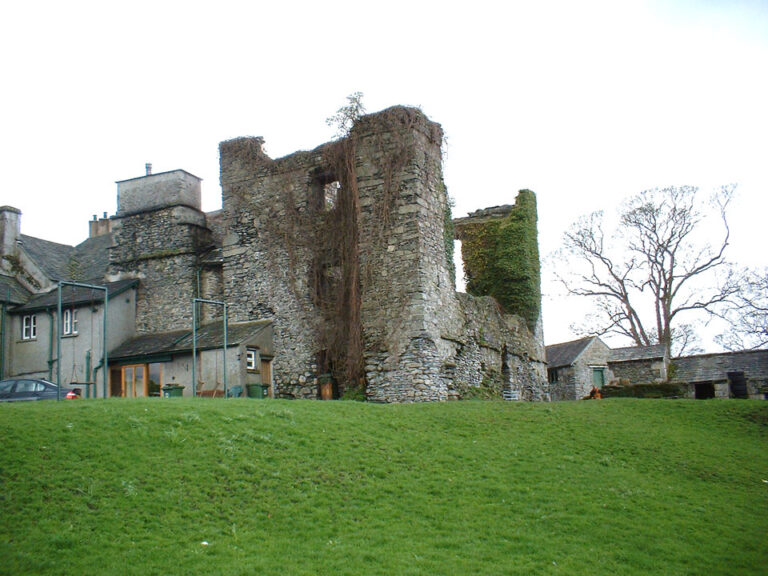
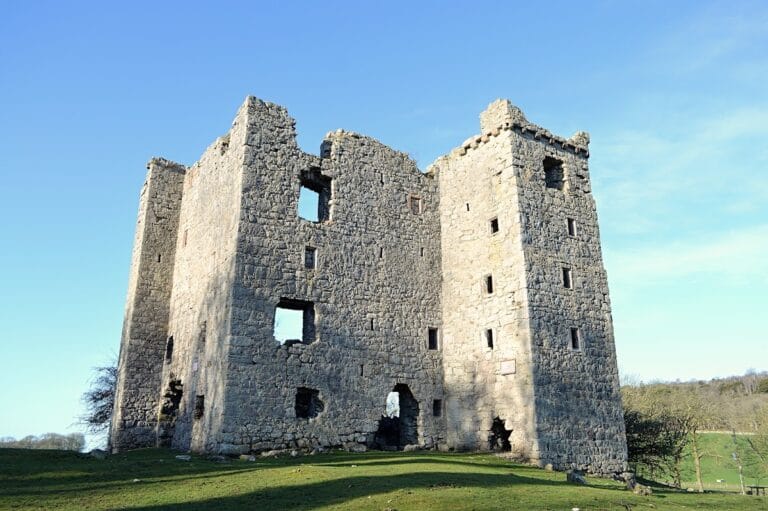
On the southern side stood a rectangular donjon, the principal fortified tower of a castle and often its strongest residence, also dated to the fourteenth century. Kendal Castle is now a limestone ruin. Surviving masonry and collapsed wall remains provide the principal visible evidence of the medieval fortification.
Nearby sites