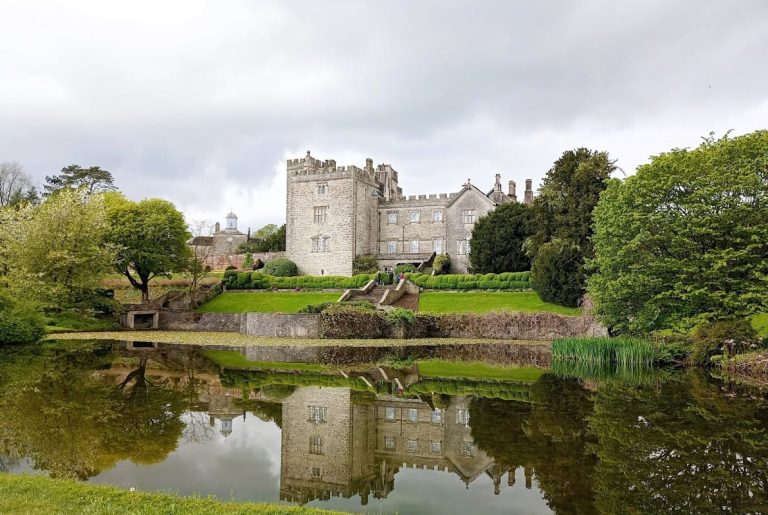
Wray Castle: A Victorian Neo-Gothic House and National Trust Estate

Site at a Glance
- Rating
- 4.6
- Popularity
- Very Low
- Country
- United Kingdom
- Primary era
- Modern
- Eras represented
- Modern
- Civilizations
- British
- Site type
- Domestic
- Remains
- Castle
On this page8 sections
History
Wray Castle is a Victorian neo-Gothic house in the United Kingdom, built in 1840 for James Dawson, a retired surgeon from Liverpool. Dawson financed the castle and the neighbouring Wray Church with his wife’s fortune, creating a family estate on the shore of Windermere.
The Dawson estate
After Dawson died in 1875, the estate passed to his fifteen-year-old nephew, Edward Preston Rawnsley. Two years later, Edward’s cousin Hardwicke Rawnsley became vicar of Wray Church. Rawnsley was an Anglican clergyman and conservationist who wanted to protect the countryside from harmful development.
Influenced by an idea advanced by the art critic and social thinker John Ruskin, Rawnsley developed the concept of a National Trust. The organisation would acquire and preserve places of natural beauty and historic interest for the nation. This idea later became the basis of the National Trust, a British conservation organisation established to protect historic and natural places for public benefit.
Beatrix Potter and the Lake District
Beatrix Potter spent a summer holiday at Wray Castle in 1882, when she was sixteen. She later became an important landowner in the area, buying Hill Top farm in 1905 with royalties from The Tale of Peter Rabbit and acquiring substantial surrounding land. She never owned Wray Castle, but after her death in 1943 she left 4,000 acres and fourteen farms to the care of the National Trust.
National Trust ownership and changing uses
In 1929, Sir Noton and Lady Barclay gave Wray Castle and 64 acres, about 25.9 hectares, to the National Trust. The property was briefly used as a youth hostel from that year. From 1931, it housed the offices of the Freshwater Biological Association for twenty years.
Between 1958 and 1998, the castle operated as a training college for Merchant Navy radio officers under the name RMS Wray Castle. As many as 150 cadets lived there while learning maritime radio procedures and regulations concerned with safety of life at sea.
The introduction of the Global Maritime Distress and Safety System in 1988 changed the profession. This international emergency-communications system became compulsory on all ships by 1999, bringing the radio-officer position to an end. The last radio officer left Wray Castle in 1995. The college then expanded into training for remotely operated vehicles, which are unmanned machines controlled from a distance, and general telecommunications, while retaining the name Wray Castle Limited. The company moved away from the castle in 2004 and continues to issue maritime safety-system licences through the national administration centre operated for the Association of Marine Electronic and Radio Colleges.
Two ships built for the Lancashire Shipping Company, also known as the Castle Line, carried the name Wray Castle. The first was a steel, ocean-going, three-masted sailing ship launched in March 1889. It survived a serious hold fire in 1906 but was wrecked on islands off Coronel, Chile, in 1924. The second, a 4,253-gross-registered-ton steamship built by William Hamilton of Glasgow in 1938, was torpedoed and sunk off Freetown, West Africa, on 3 May 1941.
In 2011, after the largely unfurnished property had been considered for use as a hotel, the National Trust opened it to the public during the visitor season. High visitor numbers led to a retrospective application in 2014 to change the listed building’s use to that of a visitor attraction. The castle and grounds have remained in National Trust ownership since 1929. They lie within the Lake District National Park, which forms part of the UNESCO World Heritage Site. Wray Castle is listed at Grade II* on the National Heritage List for England, while associated features have Grade II listings.
Remains
Wray Castle is a Victorian neo-Gothic building set within grounds that include part of Windermere’s shoreline. Its Gothic character is expressed through features such as deliberately false arrowslits. The estate also contains specimen trees, including conifers and Wellingtonia, as well as Ginkgo biloba, weeping lime, and several varieties of beech. These plantings reflect the nineteenth-century Picturesque approach to landscape design, which favoured varied and irregular scenery.
Castle grounds and associated structures
Retaining walls and boathouse
The grounds contain retaining walls and a boathouse, both protected as Grade II listed associated features. Together with the shoreline and planted grounds, they form part of the physical setting of the castle estate.
Wray Church
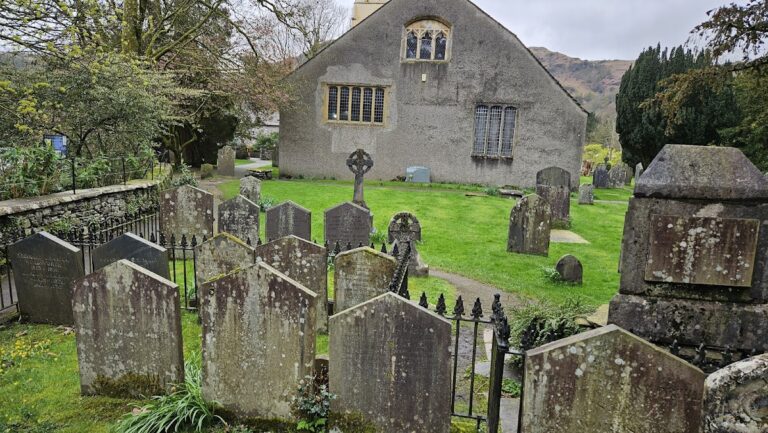
Wray Church, also known as the Church of Saint Margaret, stands beside the castle. The Dawsons built it approximately a decade after the house to serve the spiritual needs of the family and their employees. Its Gothic Revival appearance includes a tower resembling the castle, creating a visual connection between the two buildings. The church is normally closed, although it is occasionally opened for Heritage Open Days.
Nearby sites