Monkstown Castle: A Medieval Cistercian Fortification in Ireland


Site at a Glance
- Rating
- 4.4
- Popularity
- Low
- Country
- Ireland
- Primary era
- Medieval
- Eras represented
- Medieval
- Civilizations
- English
- Site type
- Military
- Remains
- Castle
On this page9 sections
History
Monkstown Castle, also known as Carrickbrennan Castle, is a ruined fortification in Ireland, near Dublin, associated with the Cistercian monks of St Mary’s Abbey. The first castle on the site was built in either the thirteenth or fourteenth century, possibly replacing an earlier fortified monastery. Its surviving fabric belongs chiefly to a substantial rebuilding and strengthening carried out in 1450, when the castle stood in a frontier landscape where defence was important.
Early monastic origins
Catholic monks had occupied the surrounding land from the ninth century. The Tallaght Martyrology states that Saint Mohonna founded the Holmpatrick monastery on an island among the skerries, but Vikings raided and plundered it in 798. The monks then established a monastery at Carrickbrennan, about 6 kilometres south of Dublin. Protected by the MacGillamocholmog clan, they built a church dedicated to Saint Mohonna and worked land granted by the clan. Farming and fishing in Bullock Harbour formed part of this religious community’s activities.
After the Norman conquest of Ireland in the late twelfth century, the monastery and its lands became the property of the Cistercians, a Catholic monastic order that emphasized communal religious life, manual work, and agricultural self-sufficiency. The estate lay along the boundary of the Pale, the area under effective English administration around Dublin, and territories controlled by the O’Toole and O’Byrne clans. Raids from these Gaelic Irish territories contributed to the castle’s defensive importance.
Rebuilding and changing ownership
Monkstown Castle was substantially rebuilt and fortified in 1450. The castle remained connected with the Cistercian estate until Henry VIII’s Protestant religious policies led to the dissolution of Catholic monasteries in territories under his authority. In 1539, the property passed to Sir John Travers, who held the senior judicial and administrative office of Master of the Rolls in Ireland. Travers died in 1562 and was buried in Carrickbrennan cemetery.
Through the marriage of Travers’s granddaughter, Mary Travers, the castle passed to James Eustace, 3rd Viscount Baltinglass. A viscount was an aristocratic rank below an earl and above a baron. Rebels used the castle during the 1580 uprising for Irish independence. It later came into the possession of Henry Wallop, vice-treasurer of Ireland, before returning to the widowed Lady Mary Baltinglass.
Lady Mary later married Gerald Alimer. After her death, the castle passed through the marriage of her sister Catherine Travers to Sir John Chivers, a Norman-descended aristocrat. Following their deaths, the estate was inherited by their second son, Henry Chivers, whose marriage to Catherine, daughter of Sir Richard FitzWilliam, connected the family to another prominent Irish lineage. Their children were Walter, Thomas, Patrick, and Margaret Chivers.
Cromwellian confiscation and restoration
Henry Chivers’s son Walter inherited the castle but lost it in 1653, when Oliver Cromwell confiscated the property because the Chivers family had supported the royalists during the civil wars in the British Isles. Cromwell, the English Parliamentarian leader who directed the conquest of Ireland during the campaigns of the 1640s and 1650s, relocated the family to Killian in County Galway and granted Monkstown Castle to General Edmund Ludlow, commander of the English cavalry in Ireland.
After the monarchy was restored in 1660, Walter Chivers regained Monkstown Castle. He lived there until his death on 20 December 1678 and was buried two days later in Mounttown cemetery. Michael Boyle, Archbishop of Armagh and Lord Chancellor of Ireland, later purchased the castle. An archbishop was a senior bishop responsible for an archdiocese, while the lord chancellor was a senior officer of state connected with justice and the custody of the Great Seal. Boyle’s son, Murrough Boyle, 1st Viscount Blessington, enlarged and improved the property. These seventeenth-century works made the castle and its estate one of Ireland’s finest aristocratic residences.
Storm disaster and national protection
On 18 November 1807, a severe storm wrecked the sailing ships Prince of Wales and Rochdale near the castle. Four hundred people died, and bodies carried ashore were buried near Monkstown Castle. The castle is designated a National Monument of Ireland.
Remains
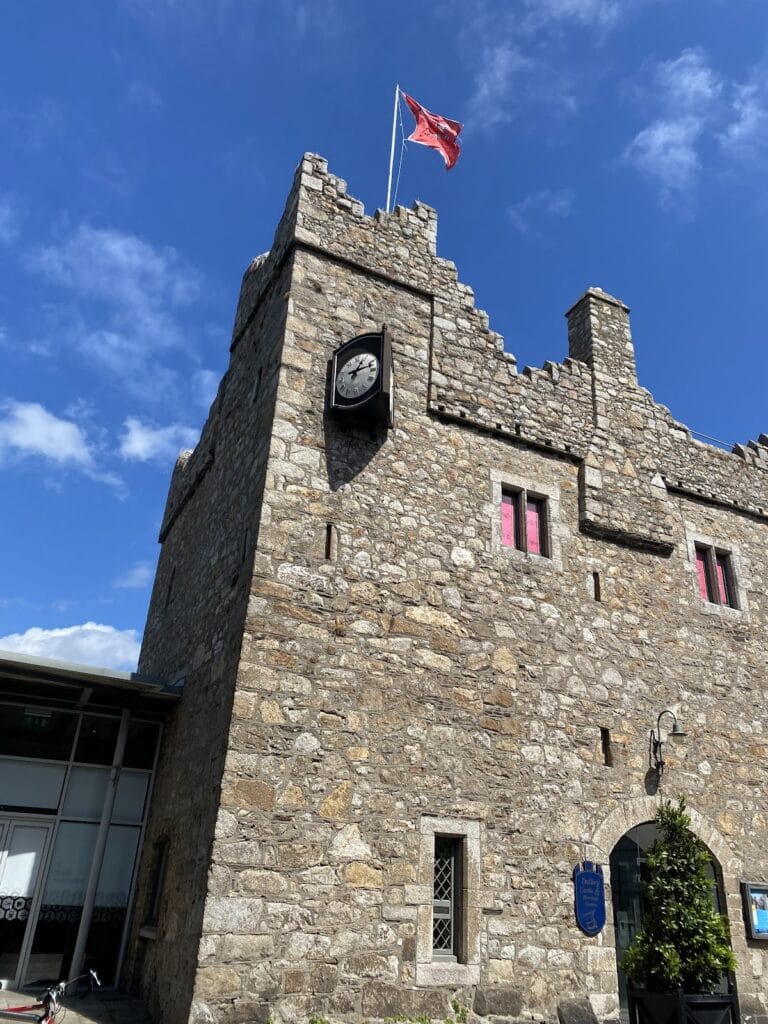
Monkstown Castle survives as a ruin comprising the remains of a garrison building and a three-storey tower. The tower formerly stood at the corner of a large hall, while the surviving masonry is associated with the rebuilding and fortification of 1450. Rivers, a lake with an island, rock formations, and quarries lie near the castle and form part of its physical setting.
Surviving castle fabric
Garrison building
The ruined garrison building represents the castle’s defensive function. Its surviving fabric belongs to the substantial fifteenth-century rebuilding, when the site’s position near the boundary of the Pale and neighbouring Gaelic territories gave the fortification practical military importance.
Three-storey tower and hall
The ruined three-storey tower is the most clearly defined surviving structure. It formerly occupied the corner of a large hall, establishing the relationship between the tower and the principal hall building. Together, these remains preserve part of the castle’s fifteenth-century arrangement and its later history as an aristocratic residence.