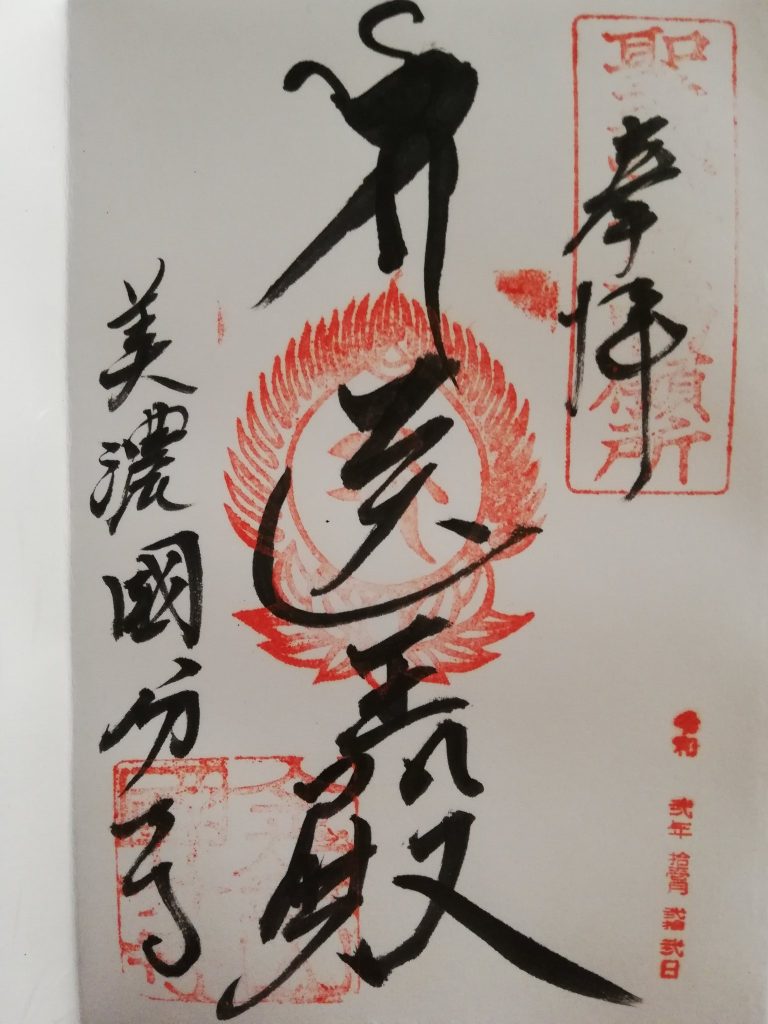
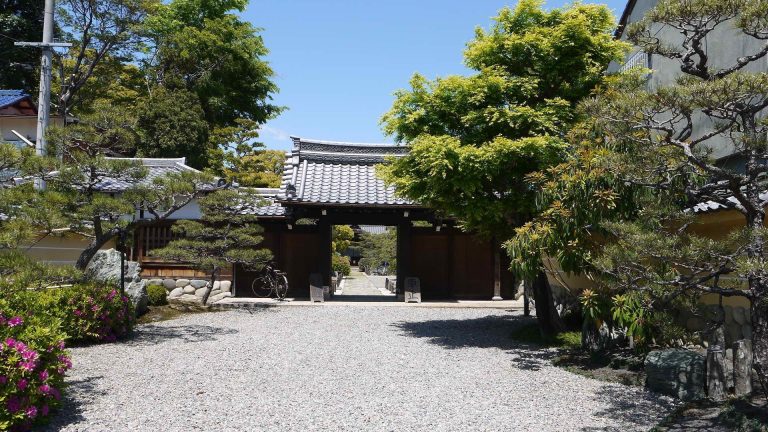
Kegon-ji Temple: Final Temple of the Saigoku Kannon Pilgrimage


Site at a Glance
- Rating
- 4.2
- Popularity
- Medium
- Country
- Japan
- Primary era
- Medieval
- External website
- Open
- Eras represented
- Medieval
- Civilizations
- Ashikaga shogunate
- Site type
- Religious
- Remains
- Sanctuary
On this page21 sections
History
Kegon-ji Temple is a Tendai Buddhist temple in Ibigawa, Japan, traditionally founded in 798 and associated with more than 1,200 years of religious history. Tendai is a major Japanese Buddhist tradition derived from the Chinese Tiantai school. The temple’s formal name is Tanigumi-san Kegon-ji, and its principal deity is Juichimen Kannon, the eleven-faced form of Kannon, the Buddhist bodhisattva of compassion.
Traditional foundation
The temple’s foundation tradition is preserved in the 1560 Tanigumi-san Root Origins Record. It tells of Oguchi Dairyō, the county governor of Aizu in Mutsu Province, who came from Kurokawa-go in present-day Aizuwakamatsu. After obtaining sacred wood through an encounter connected with Monju Daishi, he commissioned a Buddhist sculptor in the capital to carve an image of Juichimen Kannon.
According to the same tradition, the completed image began moving toward Aizu but stopped at Akasaka in Mino. It declared that it would remain five ri to the north, in a place of enlightenment. At the present site, Oguchi Dairyō and Hozen, a monk who had lived in a mountain hermitage, built a temple and enshrined the image. The name Tanigumi-san is traditionally linked to oil that emerged from a nearby valley and supposedly continued flowing when used in lamps before the Buddha.
Heian-period recognition
In 917, Emperor Daigo is said to have granted the mountain the name Tanigumi-san and bestowed a plaque bearing the name Kegon-ji. In 944, Emperor Suzaku designated the temple as an imperial prayer institution for the protection of the state. He also granted it an endowment of 15,000 koku for Buddhist implements and rice-producing land.
Kegon-ji is traditionally regarded as the easternmost and final, thirty-third temple of the Saigoku Kannon Pilgrimage, a circuit of thirty-three temples in western Japan dedicated to Kannon. Reaching its final temple represents completion of the circuit. This association is attributed to Cloistered Emperor Kazan, who is also said to have visited the pilgrimage sites on foot and deposited a pilgrim garment, staff, and three devotional poems at Kegon-ji.
Early pilgrimage records qualify this traditional attribution. The Jimon Koso-ki names Mimuroto-ji rather than Kegon-ji as the thirty-third site, and Kegon-ji was not included among the pilgrimage temples when Kakuchu made the pilgrimage in 1161. One of the three poems associated with Kegon-ji is known to have been written by Kakuchu rather than Kazan.
War, destruction, and rebuilding
During the Kamakura period, which lasted from 1185 to 1333, Emperor Go-Shirakawa is said to have visited Kegon-ji with more than 1,000 companions, following what he regarded as Kazan’s example. In the Jokyu War of 1221, a conflict between the imperial court and the Kamakura shogunate, the temple sided with the Imperial Court and consequently lost its temple lands.
From 1334, conflicts between the Ashikaga and Nitta clans, including disturbances involving Horiguchi Sadamitsu, repeatedly destroyed the temple buildings. The principal and attendant images were moved into the mountains and survived the destruction. Kegon-ji later declined, but in 1479 its Main Hall and other buildings were traditionally said to have been rebuilt by Doha Jikkoku, head priest of Jigen-ji in Kagoshima, Satsuma Province, after he received a dream message from Kannon.
Modern continuities
The present Main Hall was rebuilt in 1879. Until the Meiji era, the principal image was opened to the public every thirty-three years. From the Taisho era until 1955, the interval was seven years. Kegon-ji continues to be identified as the thirty-third and final station of the Saigoku Kannon Pilgrimage, as well as the thirty-third station of the Tokai Hundred-Year Kannon and Tokai Thirty-Six Fudo pilgrimages. Its wooden standing Bishamonten and the Silk Painting of the Thirty-Three Kannon Mandala are individually designated National Important Cultural Properties.
Remains
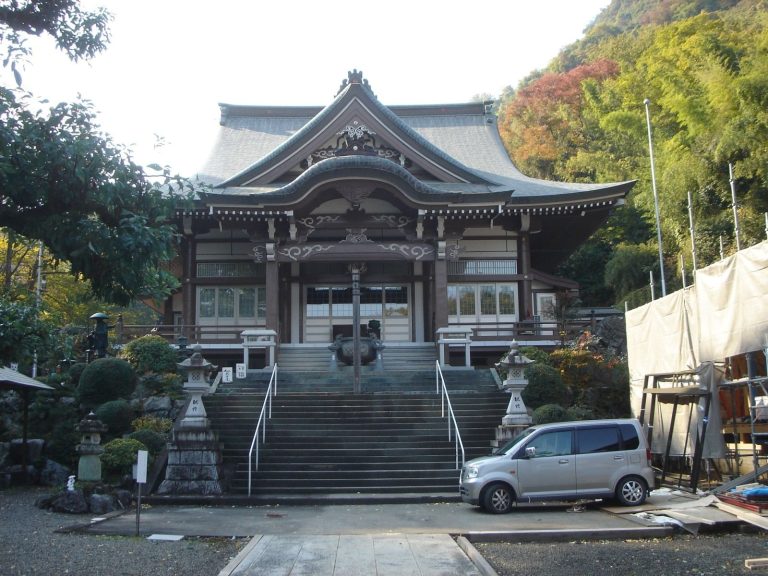
Kegon-ji occupies a rising temple complex whose grounds extend uphill from the entrance gate. An approximately one-kilometre approach leads to the Niomon, followed by a gently ascending stone-paved path and a final flight of stone steps to the Main Hall. The complex includes halls, pilgrimage structures, a bell pavilion, service buildings, and an upper sanctuary area connected by this rising route.
Approach and entrance gates
Cherry-tree approach
The lower approach runs from the main gate toward the Niomon and is lined with Somei-Yoshino cherry trees. Shops, restaurants, and inns border the section below the gate. The approach and temple surroundings are also associated with spring cherry blossoms and autumn foliage, while the long stone-paved route continues the ascent toward the Main Hall.
Niomon
The Niomon is a two-storied gate with an intermediate roof. Two guardian kings flank the passage, giving the entrance its protective character. Beyond the gate, the path rises gently before reaching the final stone steps leading to the Main Hall.
Main Hall and sacred images
Main Hall
The Main Hall’s outer sanctuary has a gabled roof and measures five bays across the front and four bays along the sides. A bay is the structural division between two columns in traditional Japanese architecture. An inner sanctuary is attached to the rear, and a sutra office occupies the right side inside the hall. The present building dates from the 1879 rebuilding.
Juichimen Kannon and attendants
The principal Juichimen Kannon is a hidden Buddhist image kept from ordinary public view. Its date and construction remain unknown. Kunō Takeshi described the figure as 7 feet 5 inches high and carved from a single piece of Japanese hackberry. The Kegon Sutra is written on its body, while its robes depict the 3,000 Buddhas and the samaya forms of various Buddhas. A samaya form is a symbolic representation of a deity’s vow, attribute, or sacred identity.
Fudo Myoo and Bishamonten stand beside the principal Kannon as attendant images. Fudo is an immovable, wrathful guardian, while Bishamonten is a warrior-protector associated with Buddhist law. Both attendant images are kept from public view.
Wooden standing Bishamonten
The wooden standing Bishamonten measures 168.2 centimetres in height and dates from the early ninth century, during the early Heian period. Its sombre expression, heavy-set body, and head that appears to sink into the torso give the sculpture an unusual character among Japanese images of Bishamonten. Its companion Fudo Myoo is a later, early-modern work.
Pilgrimage buildings and upper grounds
Oizuru-do
The Oizuru-do stands to the left of the Main Hall. After completing the Saigoku pilgrimage, pilgrims traditionally deposit worn garments, staffs, umbrellas, and other pilgrimage equipment there while reciting the associated devotional verse. An Oizuru is a pilgrim’s garment worn during the Saigoku pilgrimage.
Amida-do, Koyasu-do, and Mangan-do
Behind the Main Hall are the Amida-do, Oizuru-do, and Koyasu-do. The Mangan-do stands farther uphill beyond another flight of steps. The temple’s three associated devotional poems correspond to present, past, and future pilgrimage stages: the poem of the present is linked with the Main Hall, the poem of the past with the Mangan-do, and the poem of the future with the Oizuru-do. The Okunoin lies approximately a one-hour walk from the Mangan-do.
Bell Pavilion and supporting buildings
The Bell Pavilion stands east of the Main Hall. Other buildings within the complex include the Kuri refectory and the Naibutsu Kyakuden guesthouse. A Great Inari shrine occupies the southwest of the temple grounds.
Pilgrimage features and artworks
Shōjin-otoshi no Koi
Bronze carp known as “Shōjin-otoshi no Koi” are fixed to the left and right pillars of the Main Hall’s principal veranda. Pilgrims who complete the Saigoku pilgrimage traditionally touch the carp to commemorate the achievement.
Thirty-Three Kannon Mandala
The Silk Painting of the Thirty-Three Kannon Mandala is a Kamakura-period work on silk measuring approximately 197.1 by 144.3 centimetres. It depicts Amida Nyorai surrounded by thirty-three Kannon figures. The painting is preserved at the Osaka Museum of Art and is described as the oldest and largest work of its type.
Transport remains
Numerous trolley-tram tracks remained around the Main Hall until the 1980s. The Meitetsu Tanigumi Line, built partly to serve pilgrims, connected Kurono and Tanigumi from 1926 until its closure on October 1, 2001.