Ōya-ji Temple: A Rock-Cut Tendai Buddhist Temple in Japan


Site at a Glance
- Rating
- 4.2
- Popularity
- Medium
- Country
- Japan
- Primary era
- Medieval
- External website
- Open
- Eras represented
- Medieval, Early Modern, Modern
- Civilizations
- Japanese, Tokugawa
- Site type
- Religious
- Remains
- Temple
On this page16 sections
History
Ōya-ji Temple is a Tendai Buddhist temple in Japan, located in Ōya, Utsunomiya, and generally dated to the late Nara or early Heian period. Its formal name is Tenkai-zan Jōdo-in Ōya-ji. The foundation date and founder are uncertain, although temple tradition attributes its establishment in 810 to Kūkai, also known as Kōbō Daishi, a major early Heian Buddhist monk and founder of the Shingon school. Built into the soft volcanic stone of the area, the temple became associated with the rock-cut Buddhist images now known as the Ōya Stone Buddhas.
Origins and medieval development
Human activity around the temple predates its Buddhist history by many thousands of years. The surrounding caves contain evidence from the initial Jōmon period, a prehistoric era associated with hunter-gatherer communities and cord-marked pottery. By the middle Heian period, the site had probably become a place of worship for local inhabitants. This interpretation connects the cave environment with early local religious activity, while the precise development of the temple remains uncertain.
Most of the principal rock-cut Buddhist images had been completed by the end of the Heian period. During the early Kamakura period, Ōya-ji was probably incorporated into the Bandō Sanjūsankasho, a circuit of thirty-three Buddhist temples in the Kantō region, as its nineteenth station. The temple prospered during the Kamakura period and probably through the Muromachi period under the protection of the Utsunomiya clan. These powerful retainers of the Kamakura shogunate also served as priests of Utsunomiya Futaarayama Shrine.
Decline and early Edo revival
Ōya-ji declined after Toyotomi Hideyoshi dispossessed the Utsunomiya clan. Hideyoshi was the late-sixteenth-century military ruler who unified much of Japan. The temple was revived in the early Edo period under the patronage of the Okudaira clan, after Okudaira Tadamasā was reinstated as lord of Utsunomiya Castle.
During the Genna era, from 1615 to 1624, Denkai, a disciple of the prominent monk Tenkai, rebuilt the temple with assistance from Okudaira Tadamasā. The rebuilding was also associated with Kamehime, the eldest daughter of Tokugawa Ieyasu, and with Tenkai himself. Ieyasu founded the Tokugawa shogunate in the early seventeenth century. Tenkai worked closely with Ieyasu and later shoguns, and was involved in the construction of Kan’ei-ji in Ueno and the rebuilding of religious buildings at Nikkō. He had earlier trained at Kokawa-dera near Utsunomiya Castle.
Through Tenkai’s support, Ōya-ji was established as a resting place on the route between Edo and the shrines and temples of Nikkō. Further construction and religious promotion followed with the support of feudal lords during the Hōei era. Fires later destroyed many of the temple buildings, while additional fires at other times contributed to the loss of much of the temple’s documentary history.
Archaeology and cultural protection
An excavation of the precincts in 1965 recovered Buddhist objects from the Kamakura period, a votive stone dated 1363, and a copper bowl dated 1551. These finds provide material evidence for religious activity at the temple during the medieval and early modern periods.
The temple owns the Ōya Stone Buddhas, which received national protection as a Historic Site in 1926, were reclassified as a Special Historic Site in 1954, and were designated an Important Cultural Property in 1986. Several associated objects also have cultural-property protection at prefectural or municipal level. Ōya-ji remains traditionally recognized as the nineteenth temple of the thirty-three-site Bandō pilgrimage route and is also linked with the Shimotsuke Seven Lucky Gods pilgrimage through its worship of Benzaiten, a Buddhist-Hindu goddess associated with learning, eloquence, music, and prosperity.
Remains
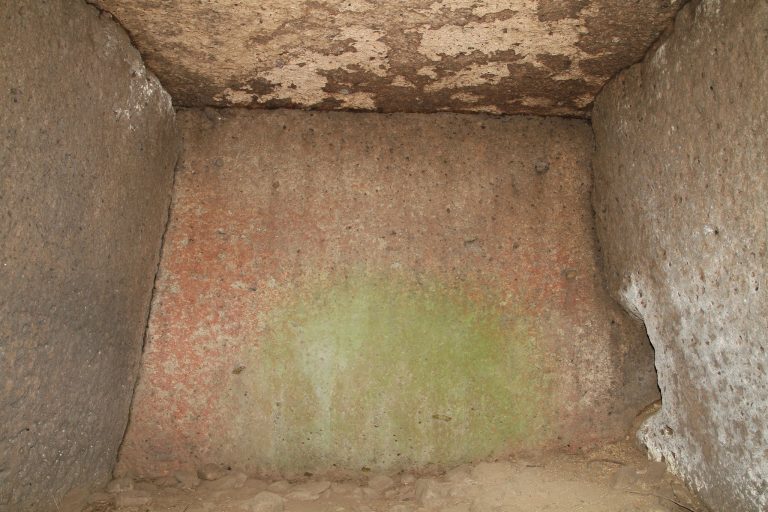
Ōya-ji is a cave temple built into a layer of soft Ōya tuff, a volcanic stone that can be worked readily. Its principal hall stands at the foot of a cliff and is partly constructed into the rock face. On the southwestern side of Otomeyama, a hill formed of Ōya stone, a large natural cave contains the principal rock-cut images. Their wall is divided into four sections of varying size, creating the setting for the temple’s principal Buddhist groups.
Rock-cut Buddhist images
Thousand-Armed Kannon
The western-facing first section contains a standing Thousand-Armed Kannon carved directly from the tuff cliff. Kannon is a bodhisattva associated with compassion, while the Thousand-Armed form represents the ability to respond to suffering in many ways. The image is approximately 4.5 metres high and is generally known as the Ōya Kannon. Temple tradition attributes its carving to Kūkai. It was formerly covered with clay, painted red, and finished with gold leaf.
Shaka triad
The second section contains a seated Shaka Nyorai approximately 3.5 metres high. Shaka is the historical Buddha. The central figure is accompanied by Monju and Fugen Bosatsu, bodhisattvas commonly associated with wisdom and practice. The group is attributed to the late Heian period and is identified as the Shaka triad.
Yakushi triad
The third section contains a seated Yakushi Nyorai approximately 1.2 metres high. Yakushi is the Buddha associated with healing. Nikkō Bosatsu and Gakkō Bosatsu attend the central figure, forming the Yakushi triad. The Yakushi image is attributed to the early Heian period, while the group forms part of the collection known as the Ōya Stone Buddhas.
Amida triad
The fourth section contains a seated Amida Nyorai approximately 2.6 metres high, accompanied by Kannon Bosatsu and Seishi Bosatsu. Amida is the Buddha of the Pure Land, and Seishi is one of his attendants. These figures are attributed to the late Heian to early Kamakura period. Additional seated figures appear on the wall to the right of the Kannon, with another Buddha image above them.
The Thousand-Armed Kannon and the three groups of Shaka, Yakushi, and Amida are collectively called the Ōya Stone Buddhas. They are also described as the stone Thousand-Armed Kannon, Shaka triad, Yakushi triad, and Amida triad.
Temple precinct and bronze objects
Gate and temple bell
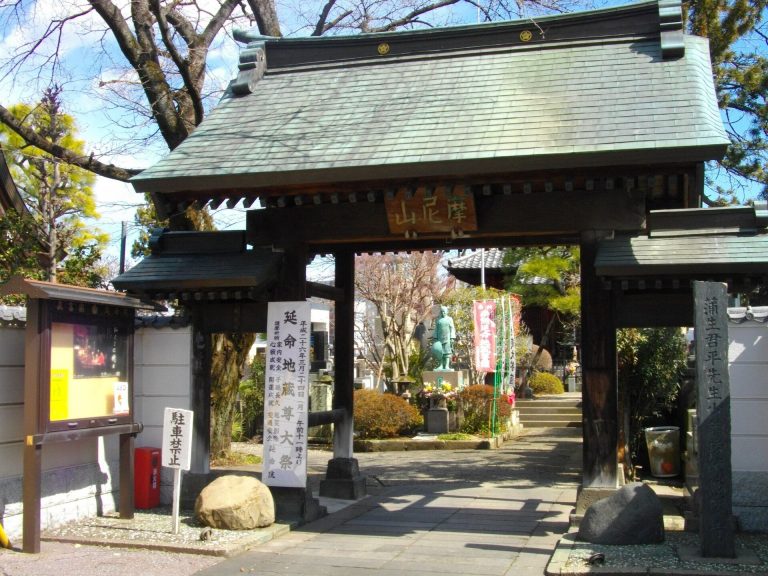
The precinct is entered from the west through a temple gate functioning as a Niō-mon, a gate guarded by two protective figures. The two guardians stand on opposite sides of the passage. Behind the gate is a bronze temple bell from the Edo period, associated with the bell founder Tomuro Sadakuni. The bell is protected as a tangible cultural property of Tochigi Prefecture.
Lantern and waniguchi
A bronze lantern stands in front of the Kannon hall. It is octagonal, was cast in 1716, and was donated by Takahashi Yoshikatsu of Nissato, now part of Utsunomiya. Its inscription names Tomuro Gemba as the caster. The temple also preserves a bronze waniguchi gong from 1667. This type of suspended temple gong is sounded by worshippers pulling a cloth-woven rope beneath the eaves of a religious building.
Cave shelter and Peace Kannon
Ōya Cave-Shelter Site
The Ōya cave also contains the Ōya Cave-Shelter Site. A roughly three-metre-deep archaeological layer yielded the nearly complete, flexed burial of a slender male about twenty years old and approximately 154 centimetres tall. Radiocarbon and fluorine testing conducted in 1998 dated the remains to the initial Jōmon period, approximately 11,000 years ago. The cave is therefore interpreted as having originally served as a rock-shelter dwelling for Jōmon people, distinct from its later use as a Buddhist temple site. A small museum associated with the complex displays artifacts and bones recovered from the Jōmon deposits, including the human remains.
Peace Kannon
Near the temple entrance, in a former Ōya-stone quarry, stands the Peace Kannon. This hand-carved statue was created from 1948 to 1954 as a prayer for world peace and a memorial to the war dead. It is 26.93 metres high, approximately 27 metres, and was consecrated in 1956.
Recent research has noted similarities between the Ōya carvings and the stone Buddhas of Bamiyan. One interpretation proposes that monks from Afghanistan may have made the Kannon after reaching Japan through the Silk Road, but this attribution remains uncertain.