Kasagi-dera Temple: A Historic Maitreya Buddhist Center in Japan


Site at a Glance
- Rating
- 4.3
- Popularity
- Low
- Country
- Japan
- Primary era
- Early Modern
- External website
- Open
- Eras represented
- Early Modern
- Civilizations
- Tokugawa
- Site type
- Religious
- Remains
- Monastery
On this page14 sections
History
Kasagi-dera Temple is a Buddhist temple of the Shingon Chisan school in Kasagi Town, Japan, on Mount Kasagi in Kyoto Prefecture. Its principal image is Maitreya Bodhisattva, the future Buddha expected to renew Buddhist teaching. The temple’s origins are uncertain, but its development reached back to the Nara period and its importance grew as a center of Maitreya devotion.
Mountain worship and early foundations
Mount Kasagi rises to 289 metres on the southern bank of the Kizu River, near the border with Nara Prefecture. Before the growth of Buddhism, the mountain was probably a place of worship focused on natural features and large stones. Buddhist practice later became associated with the exposed granite boulders, where sacred images were carved and a religious complex gradually formed.
Two traditions preserve different accounts of the foundation. The Kasagi-dera origin narrative attributes it to Prince Ōama, later Emperor Tenmu, in 682. Another tradition, recorded in the Konjaku Monogatari, tells that Prince Ōtomo, later Emperor Kōbun, faced danger while hunting and vowed to carve an image of Maitreya if he survived. When he returned to Mount Kasagi in 664, the cliff was too steep for him to work. According to the story, a heavenly being carved the image instead, linking the temple’s beginnings to the creation of its great rock-cut Maitreya.
The temple first appears in written records in 879, when the initiation of a Buddhist lecture ritual at Kasagi-dera was noted. Its actual establishment is generally placed in the Nara period. The Shōgatsudō is traditionally associated with Jitchū of Tōdaiji and dated to around 752, while the mountain’s ascetic practice area, a setting for ritual and physical training, is attributed to En no Gyōja.
Heian prosperity and Maitreya devotion
Kasagi-dera maintained close ties with Tōdaiji and Kōfukuji, major historic Buddhist institutions of Nanto, the traditional religious center around Nara. From the Heian period onward, the temple flourished as a place of Maitreya devotion. Members of the imperial family and aristocracy made pilgrimages to the mountain, including an imperial visitor in 987 and Fujiwara no Michinaga in 1007.
The temple’s location also supported its wider importance. Kasagi was a major land-and-water transportation point where the Tsukigase and Iga routes met. Timber intended for the palaces and temples of Heijō-kyō was reportedly carried by boat along the Kizu River. Local traditions further connect the mountain with Ryōben, the founder and first administrative head of Tōdaiji, and with his disciple Jitchū.
According to these traditions, Ryōben practiced in the Senjukutsu cave and helped make river traffic possible by enabling the removal of a rock from the Kizu River bed. Jitchū is said to have entered the Ryuuketsu cave, reached Tushita Heaven, the Buddhist realm associated with Maitreya before his future appearance in the human world, and brought its ritual practices back to people.
Jōkei and the medieval peak
In 1193, Jōkei, a monk from Kōfukuji known for restoring Buddhist monastic discipline, settled at Kasagi-dera. He remained for fifteen years before moving to Kannonji, now Kaijūsenji, in 1208. During this period the temple reached its medieval peak. The complex was organized around forty-nine subsidiary temples, a number modeled on the forty-nine inner courts of Tushita Heaven.
Several major works belonged to this period. The Hannyadai, a hexagonal hall for the Great Prajnaparamita Sutra, was built in 1194. Chōgen donated the temple bell and a Song-dynasty printed edition of the same scripture in 1196. A wooden thirteen-story pagoda followed in 1198. In 1204, the worship hall for the Maitreya carving was rebuilt with gold dust donated by Minamoto no Yoritomo. The Tōdaiji scholar Sōshō entered Kasagi-dera in 1230.
War, destruction, and rebuilding
Kasagi-dera became involved in the conflict between Emperor Go-Daigo and the Kamakura shogunate in 1331. In August of that year, Go-Daigo escaped from his residence, occupied the temple, and raised an army there. This marked the beginning of the Genkō War, a struggle that ended the Kamakura shogunate’s control. The Battle of Mount Kasagi brought the temple’s fall in September. Go-Daigo fled, was captured, and was exiled to Oki Province.
Fire during the conflict destroyed the mountain complex, including its forty-nine subsidiary temples. The flames caused the surface of the Maitreya rock to peel away, damaging the colossal image, while most carved images on the Yakushi, Monju, Kokūzō, and Two Worlds Mandala rocks were lost. The Kokūzō carving is traditionally said to have retained its original appearance.
Kasagi-dera was rebuilt in 1339 but burned again in 1355. Its main hall was rebuilt in 1381, although a fundraising document from 1482 records reconstruction activity, and another fire destroyed the hall in 1398. The temple never recovered its former scale. In 1619, Kasagi became part of the territory of the Tsu domain. The domain lord Tōdō Takatsugu rebuilt the main hall between 1648 and 1652.
Modern re-establishment and protection
The temple declined during the middle of the Edo period and had no resident monk during the early Meiji period. It was re-established in 1876. Kasagi-dera and Mount Kasagi are now associated with several protected cultural properties. The stone thirteen-story pagoda, temple bell, and Jizō and Maitreya lecture-rite texts are Important Cultural Properties. Mount Kasagi is protected as both a Historic Site and a Place of Scenic Beauty. The Kasagi-dera Restoration Fundraising Petition received Kyoto Prefecture tangible cultural-property status in 1991, and the illustrated Kasagi-dera origin narrative received the same designation in 2016.
Remains
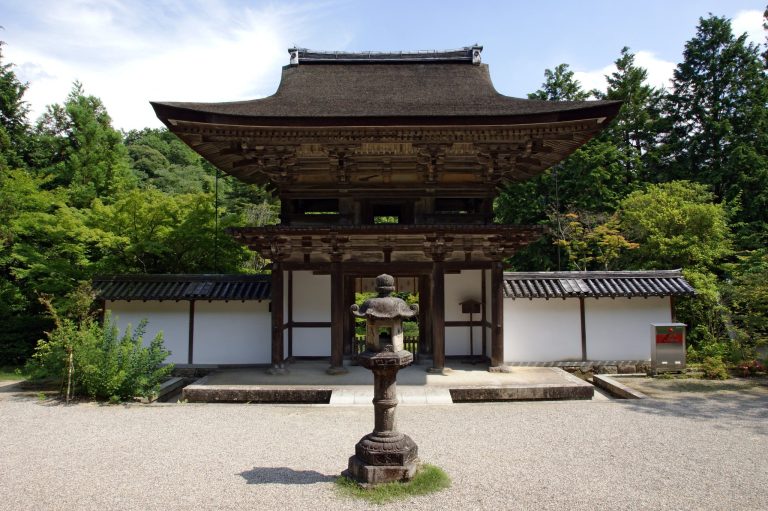
Kasagi-dera occupies Mount Kasagi and consists of a gate, the main temple precinct, a Bishamonten Hall, a repository, and a concrete bell tower. Beyond these buildings, a mountain practice area follows a circuit of approximately 800 metres. Exposed granite boulders form an integral part of this religious landscape, joining the built precinct to the natural rock formations that supported worship on the mountain.
Rock-cut images
The great Maitreya image was carved directly into a natural rock face approximately 15 metres high and 15 metres wide. Such a rock-cut Buddha is an image made in a cliff or boulder rather than as a separate statue. The figure itself has disappeared, while its recessed halo remains visible on the rock. Its former appearance is preserved in an illustrated image in the Kakuzenshō and in the Kasagi Mandala, an important cultural property now held by the Yamato Bunkakan. The Kasagi carving also served as the model for Maitreya rock carvings at Ōnoji in Uda, Nara Prefecture, and in the Tōno district of Kizugawa, Kyoto Prefecture.
The Kokūzō Bodhisattva carving is an incised image on a large boulder, with its halo cut into the stone. Kokūzō is a bodhisattva, a Buddhist figure who seeks awakening while remaining connected with the salvation of other beings. The carving is distinguished from the other named rock images by its survival in the form associated with it before the destruction of 1331.
Halls and pagodas
Shōgatsudō and Hannyadai
The Shōgatsudō is an associated hall traditionally dated to around 752. The Hannyadai, built in 1194, was a hexagonal structure intended to house the Great Prajnaparamita Sutra. Together, these buildings represent the temple’s long association with Buddhist teaching and ritual activity, although the medieval complex was later reduced by fire and rebuilding.
Thirteen-story pagodas
A wooden thirteen-story pagoda was erected in 1198. The Kasagi Mandala depicts it together with the Maitreya rock carving, preserving an image of the precinct during its medieval height. A stone thirteen-story pagoda also survives at the site and is designated an Important Cultural Property.
Bell tower and temple precinct
The present temple area includes a gate, the main precinct, a Bishamonten Hall, a repository, and a bell tower built of concrete. The temple bell is an Important Cultural Property and forms part of the surviving material evidence of Kasagi-dera’s institutional history.
Mountain practice area
The approximately 800-metre practice circuit extends beyond the buildings through a landscape of exposed granite. Its named rock formations include the Womb Passage, Ant’s Traverse, Rocking Stone, and Drum Stone. These features illustrate how natural boulders were incorporated into the mountain’s religious setting and ascetic use.
Memorial feature
A memorial stone commemorates “Kasayan,” a stray cat that lived at Kasagi-dera during the 1990s and became known for guiding visitors. It is a modern feature of the temple grounds rather than a monument from the historical development of the medieval complex.