Kaijūsen-ji Temple: A Buddhist Temple and Kamakura-Period Pagoda in Japan


Site at a Glance
- Rating
- 4.2
- Popularity
- Low
- Country
- Japan
- Primary era
- Medieval
- External website
- Open
- Eras represented
- Medieval, Modern
- Civilizations
- Japanese, Kamakura shogunate
- Site type
- Religious
- Remains
- Temple
On this page12 sections
History
Kaijūsen-ji Temple is a Buddhist temple in Japan, traditionally founded in 735 on the mountainside of Mount Mikami overlooking Mikano-hara, the area where the former capital of Kuni once stood. It belongs today to the Shingon Chizan school, an institutional branch of Japanese esoteric Buddhism that emphasizes ritual, mantra, and mandalas.
Traditional foundation and early history
Temple tradition holds that Emperor Shōmu ordered the monk Rōben to establish Fujiōzan Kannon-ji at the site in 735. Rōben, an important eighth-century Buddhist monk who later became the first abbot of Tōdai-ji, is said to have enshrined an eleven-headed image of Kannon, the bodhisattva of compassion. This form of Kannon represents the ability to perceive and respond to the needs of beings in every direction.
The foundation story connects the temple with the completion of the Great Buddha at Tōdai-ji. According to the tradition, Shōmu received a dream indicating that a temple on the northeast side of Heijō-kyō would help secure the project’s success. The chronology, however, places the traditional foundation before Shōmu issued the Great Buddha edict in 743 and before construction began at Heijō-kyō in 745. Clear historical evidence for Kaijūsen-ji emerges from the thirteenth century, while the principal eleven-headed Kannon is stylistically dated to around the tenth century, suggesting that an earlier temple may have existed by that time.
The mountain complex burned in 1137 and reportedly remained unreconstructed for more than seventy years. In November 1208, the monk Jōkei revived the institution, changed its name from Kannon-ji to Fudaraku-san Kaijūsen-ji, and established the identity it has retained. The new name referred both to Kannon’s vast vow to save living beings, compared with an ocean, and to Fudaraku, the southern oceanic abode of Kannon in Indian Buddhist tradition.
Jōkei and the medieval temple
Jōkei, also known as Gedatsu Shōnin, had previously belonged to Kōfuku-ji. Concerned about the secularization of Nanto Buddhism, he moved to Kasagi-dera in southern Yamashiro in 1192 and later transferred to Kaijūsen-ji. He spent approximately the last five years of his life there, dying in 1213 at the age of 59.
His disciple Kakushin succeeded him. Before entering religious life, Kakushin was known as Fujiwara Nagafusa and had reached the rank of court councillor. He was ordained at 41 and became Jōkei’s disciple. A temple record states that in 1224, on the first anniversary of Jōkei’s death, Kakushin enshrined seven Buddhist relics in the pagoda, an act understood as recording or commemorating its completion. The pagoda itself dates to 1214, in the early Kamakura period, which lasted from 1185 to 1333.
Later affiliations and preservation
During the Muromachi period, from the fourteenth through the sixteenth centuries, the complex contained 58 subtemples. Toyotomi Hideyoshi’s land survey reduced the temple’s income and contributed to its later decline. Until the early modern period, Kaijūsen-ji was subordinate to Kōfuku-ji, the head temple of the Hossō school, a Japanese Buddhist tradition derived from East Asian Yogācāra thought. Since the Meiji period, it has belonged to the Shingon Chizan school.
The five-storied pagoda is designated a National Treasure of Japan. The Monju-dō, the principal eleven-headed Kannon, a second eleven-headed Kannon from the inner sanctuary, the wooden Four Heavenly Kings, the Lotus Sutra mandala, and temple documents are designated Important Cultural Properties. Other paintings, a medieval bell, temple plaques, and a temple-origin picture scroll have related prefectural or municipal cultural-property designations. Kaijūsen-ji is also the third pilgrimage site in the Eighteen Ancient Buddhist Pagodas circuit.
Remains
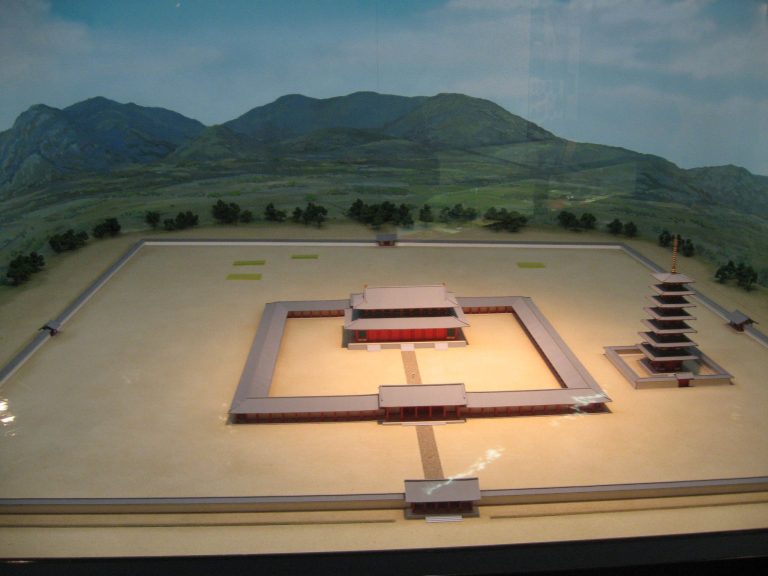
The mountain precinct faces east and covers approximately 10,000 tsubo, or about 33,000 square metres. The traditional Japanese tsubo is an area unit of roughly 3.3 square metres. After the entrance gate, the east-facing main hall stands ahead, with the south-facing Monju-dō immediately to its right. The five-storied pagoda stands to the south, on the left side of the main hall.
Early Kamakura buildings
Five-storied pagoda
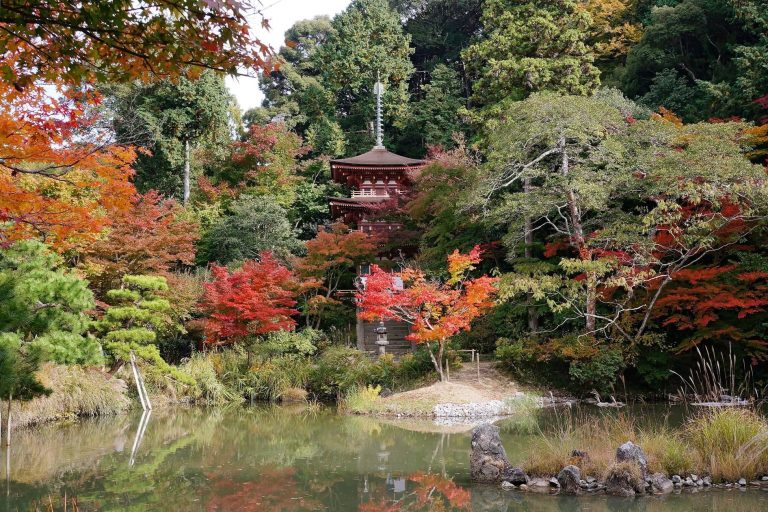
The five-storied pagoda is approximately 17.7 metres high and has tiled roofs. Dated to 1214, it belongs to the early Kamakura period and is identified as the only surviving pagoda from that period. A restoration in 1963 reinstated an additional eave beneath the lowest roof, restoring a feature that had formerly existed. Wooden statues of the Four Heavenly Kings, Buddhist guardian deities associated with protection of the four cardinal directions, are linked with the pagoda and are held on deposit at the Nara National Museum.
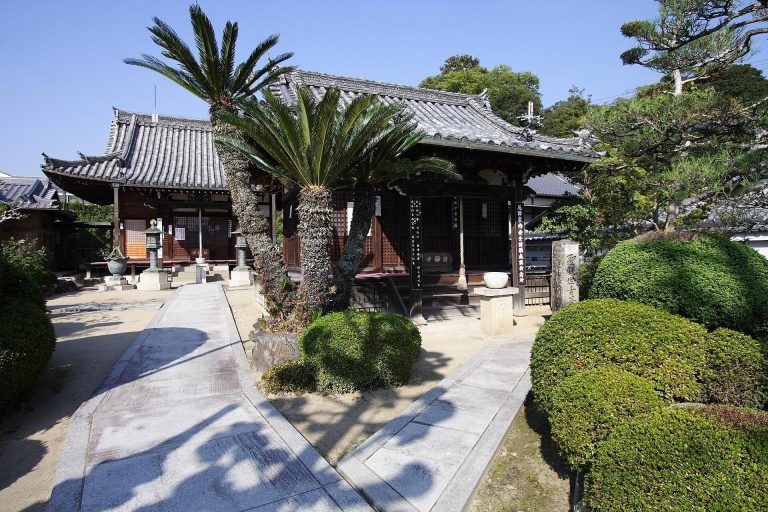
Monju-dō
The Monju-dō is a small early-Kamakura-period hall measuring 7.28 metres across and 4.25 metres deep. Its hipped roof is covered with copper sheet. Inside are a seated wooden image of Amida from the Heian period, which lasted from 794 to 1185, and an image of Monju Bosatsu, the bodhisattva of wisdom.
Main hall and Kannon images
The present main hall dates from the Meiji period and houses the principal eleven-headed Kannon. Made from a single block of wood, the Heian-period image is approximately 1.9 metres high. A second Heian-period eleven-headed Kannon, also carved from a single block, is associated with the inner sanctuary and measures 45.5 centimetres high. Another Heian-period image formerly connected with the main hall is held on deposit at the Nara National Museum.
Memorial features and associated works
Stone basin and memorial statues
In front of the Monju-dō stands a trough-shaped stone basin dated 1258. Monks used it for cold-water bathing. Statues of Jōkei and Kakushin stand in the rear part of the grounds, while their graves lie approximately 100 metres south of the main hall.
Paintings, documents, bell, and plaques
The associated cultural property includes a Kamakura-period Lotus Sutra mandala painted on colored silk, held on deposit at the Kyoto National Museum. Twenty-four temple documents in 16 volumes, dating from the Kamakura through the Muromachi periods, are also held there. A painting of Śākyamuni with two attendant Buddhas and sixteen arhats is held on deposit at the Nara National Museum, as is a painting of a Kasuga palace mandala with sixteen guardian deities at the Kyoto National Museum.
A medieval bell held on deposit at the Nara National Museum was cast during the Muromachi period. It is attributed to the caster Tanji Kunitada and dated 1527. Two wooden temple plaques from the Kamakura period also survive, one formerly associated with the temple gate and the other with the main hall.