Enjō-ji Temple: A Shingon Buddhist Temple in Nara


Site at a Glance
- Rating
- 4.3
- Popularity
- Low
- Country
- Japan
- Primary era
- Medieval
- External website
- Open
- Eras represented
- Medieval, Early Modern
- Civilizations
- Ashikaga shogunate, Tokugawa
- Site type
- Religious
- Remains
- Temple
On this page17 sections
History
Enjō-ji Temple is a Shingon Buddhist temple in Nara, Japan, located along the historic Yagyū Kaidō. It belongs to the Omuro branch, a Shingon tradition associated with Ninna-ji in Kyoto and aristocratic abbots, and is dedicated to Amida Nyorai, the Japanese form of Amitabha Buddha, the central Buddha of Pure Land devotion. Its formal name is Ninnikusen Enjō-ji, and tradition recognizes it as the twelfth temple of the Yamato Thirteen Buddhas pilgrimage.
Foundation and revival
The temple’s foundation is preserved through two traditions rather than a single certain date. One attributes its establishment in 756 to the Chinese monk Korō, who came to Japan with Ganjin during the reign of Emperor Shōmu and Empress Kōken. Ganjin was the monk who helped establish the ordination platform at Tōshōdai-ji in Nara. Another tradition places the foundation between 901 and 923, during the Engi era, when the monk Yakushin, founder of an Enjō-ji in Kyoto, established a temple at Ninnikusen under the same name. Korō is not otherwise confirmed in surviving historical records.
The temple’s revival is associated with Myōzen. His biography in the Honchō kōsōden states that he reached Ninnikusen after travelling through several provinces and established a temple there in 1026. He enshrined an eleven-headed Kannon, a Buddhist form of compassion with multiple faces. Because the image was traditionally believed to have been carved by Kasuga Myōjin, Enjō-ji also acquired the name Kasuga’s inner sanctuary.
Late Heian development
During the late Heian period, a Pure Land teacher known as the holy man of Odawara is said to have built an Amida Hall in 1112 and installed Amida Nyorai as the principal image. Pure Land teaching emphasizes rebirth in Amida’s Western Pure Land through faith and devotional practice. In 1153, the monk Kanpen entered Enjō-ji and established the Ninnikusen branch, one of six branches of the Hirozawa lineage of Tōmitsu Shingon, an esoteric form of Shingon Buddhism.
Kanpen had held major religious offices, including administrator of Kōryū-ji, head of Tō-ji, abbot of Mount Kōya, and administrator of Tōdai-ji. The temple complex appears to have taken shape by the middle of the twelfth century, around the time of his leadership. The surviving eleven-headed Kannon is traditionally identified with the image associated with Myōzen, although its technique and style place it around the end of the tenth century. The present Amida image belongs stylistically to the latter half of the eleventh or the beginning of the twelfth century and may be the image installed by the holy man of Odawara.
War, reconstruction, and early modern growth
Fire during the Ōnin War, a civil conflict that divided the Muromachi shogunate between 1467 and 1478, destroyed most of Enjō-ji’s halls and pagoda structures. Reconstruction was led by Eikō, the abbot of the subsidiary Chion-in. In 1481, Eikō travelled to Korea as an envoy of the retired shogun Ashikaga Yoshimasa and obtained a Goryeo edition of the Buddhist canon. Fourteen buildings had been restored by 1487. A three-volume Chion-in Origin Picture Scroll, made in 1789, later depicted Eikō’s 1482 embassy and his bringing of the canon to Enjō-ji.
At the beginning of the Edo period, the temple held land producing 130 koku, a historical measure of rice-based land income. In 1609, at Tokugawa Ieyasu’s request, Enjō-ji presented the Goryeo Buddhist canon to the Edo shogunate. The temple then received an additional 105 koku, bringing its holdings to 235 koku and the number of its subsidiary temples to twenty-three.
A separate tradition connects Enjō-ji with the family of Yaoya Oshichi. During a major fire in Edo in December 1682, her family is said to have taken refuge at the temple. The tradition also associates the site with Oshichi’s meeting there with the boy with whom she fell in love.
Meiji disruption and later protection
The anti-Buddhist movement and policies of the early Meiji period brought disorder and decline to Enjō-ji, and all of its subsidiary temples were eventually abolished. After a monk entered the temple in 1882, it gradually regained stability. The complex and its contents now have several levels of heritage protection. Kasuga Hall, Hakusan Hall, and the wooden seated Dainichi Nyorai are National Treasures. The main hall, gate, Ugajin sanctuary, Amida image, Four Heavenly Kings, and a stone five-element pagoda dated by inscription to 1321 are Important Cultural Properties. The garden is a nationally designated Place of Scenic Beauty.
The original tahōtō, a two-level Buddhist pagoda, survived only through its first storey when it was dismantled and moved in 1920 to Chōju-ji in Kamakura, where it became a Kannon Hall. The tahōtō now standing at Enjō-ji was reconstructed in 1990.
Remains
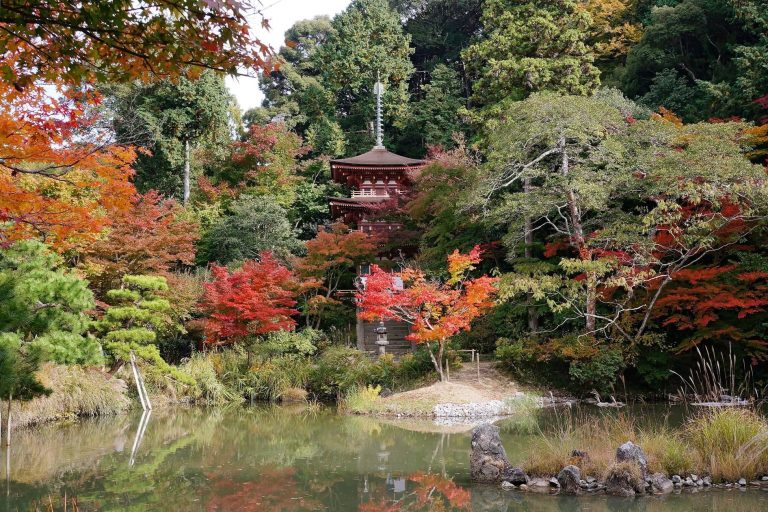
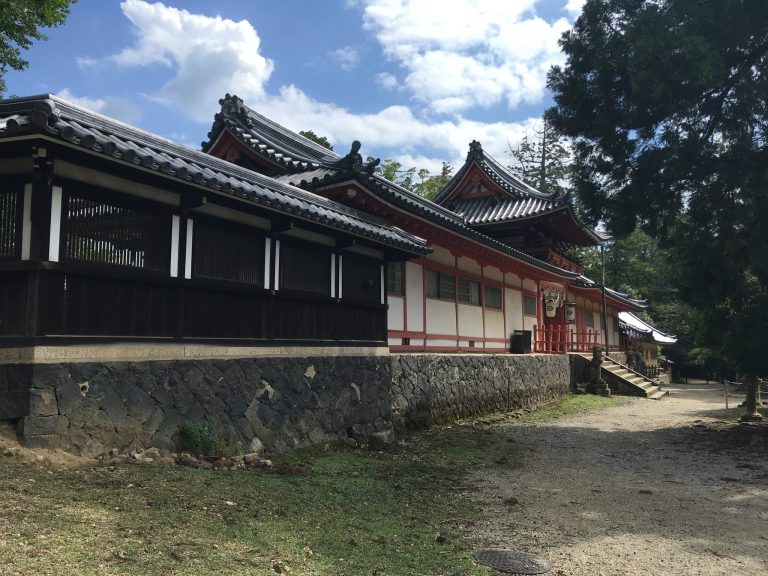
Enjō-ji retains a complex of religious buildings, gardens, sculpture, and stone monuments shaped by its medieval reconstruction and later rebuilding. A pond garden extends before the main gate. Dating from the late Heian period, it combines features of a Pure Land paradise garden and a pleasure-boat garden within a layout associated with shinden-zukuri, the aristocratic residential style of the Heian period. The garden is traditionally attributed to Kanpen.
Main sanctuary and entrance buildings
Main hall
The main hall, also called the Amida Hall, is a Muromachi-period building generally dated to 1472 from an inscription on its ridge timber. A temple explanation gives 1466 instead. Its design recalls shinden-zukuri, with an irimoya roof whose gable end faces the front, an unusual arrangement for a Buddhist hall. The building incorporates a Kasuga-style shrine arrangement with side aisles, a private chamber, treasure storehouse, sutra repository, meditation or retreat space, and hall. A stage projects before the entrance.
Inside are the seated Amida Nyorai and four standing Four Heavenly Kings, Buddhist guardian figures assigned to protect the four directions. Twenty-five bodhisattvas painted on the inner-sanctuary pillars represent Amida’s descent to welcome the dead. The ceiling above the altar is raised and coffered, the main altar platform has a small-grid coffered ceiling, and the surrounding ceiling is divided into four sloping sections. Together, these elements recall Fujiwara-period Amida halls. The open-on-three-sides cabinet housing the principal image and the painted bodhisattva group are particularly unusual features of the interior.
Main gate
The two-storey main gate was rebuilt in 1468. It is a three-bay, single-door structure with an irimoya roof covered in cypress-bark shingles. Both levels use Japanese-style three-step bracket complexes. Floral bracket arms appear on both the front and rear sides of the lower entrance.
Kasuga and Hakusan halls
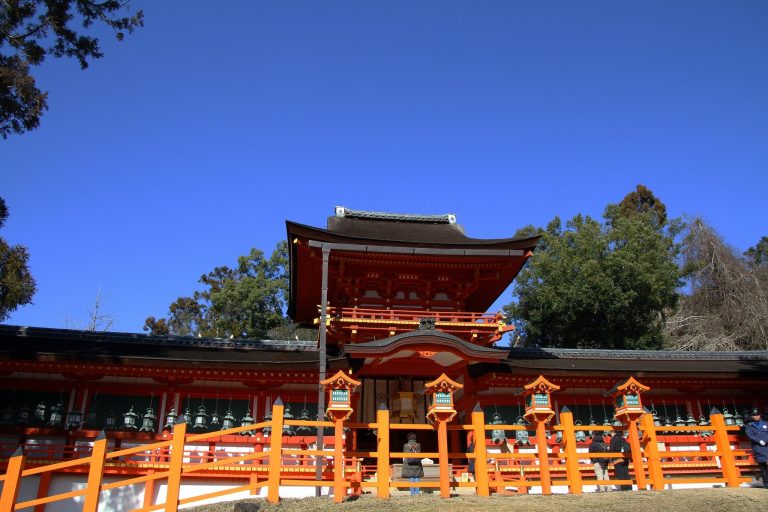
Kasuga Hall and Hakusan Hall stand beside the main hall. These two single-bay shrine buildings share the same scale and form and were transferred from the main sanctuary of Kasuga Taisha in 1228. They are regarded as the oldest surviving examples of Kasuga-zukuri, a compact shrine style with a strongly projecting gabled front. Their fronts have irimoya roofs and their backs have simple gables. Cypress-bark shingles cover both buildings, which retain ridge ornaments, forked finials, and horizontal logs.
Their brackets, decorative struts, hanging ornaments at the roof ends, railings, and related details display early Kamakura-period shrine architecture. They were called halls rather than shrines during the early Meiji separation of Buddhism and Shinto, a policy that placed pressure on Buddhist institutions and their associated shrine traditions.
Other buildings and stone monuments
Ugajin sanctuary and later structures
The Ugajin sanctuary was built during the Kamakura period, probably toward its end. Its worship hall dates from 1675 and is a designated cultural property of Nara City. The grounds also contain the 1990 reconstruction of the tahōtō, a bell tower rebuilt in 1667, a goma Hall for esoteric fire ceremonies, a priests’ residential and service building, and the Sōōden, which houses the seated wooden Dainichi Nyorai.
Stone pagodas
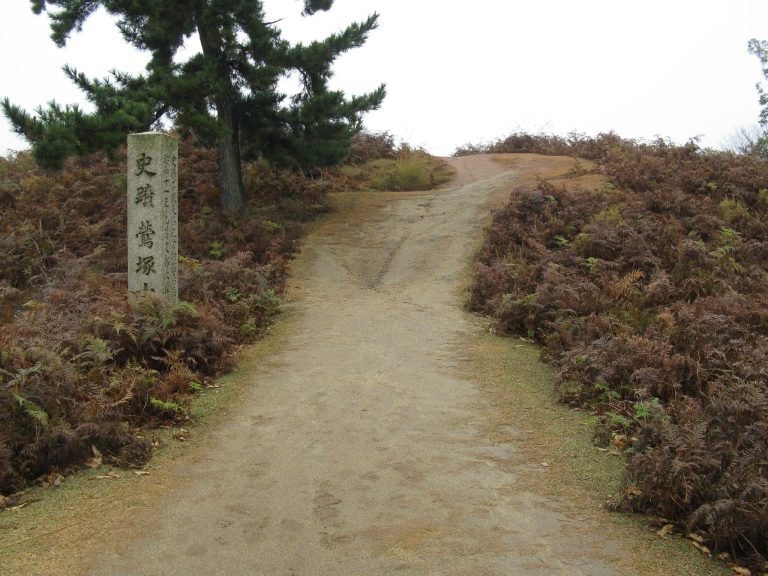
A thirteen-tiered stone pagoda within the grounds dates from the Heian period. A separate stone five-element pagoda, or gorintō, stands in a communal cemetery about 200 metres southwest of the temple. Its inscription is dated 1321.
Buddhist images and preserved objects
Dainichi Nyorai
The seated wooden Dainichi Nyorai was completed by Unkei in 1176. Dainichi Nyorai, the cosmic Buddha central to esoteric Shingon Buddhism, forms the wisdom-fist mudra, a hand gesture expressing the unity of wisdom and Buddhist teaching. The image is 98.8 centimetres high and sits cross-legged. It was made from joined blocks of Japanese cypress, finished with lacquer and gilding, and given crystal-inset eyes.
The sculpture uses a carefully assembled structure. A central head-and-body core is joined along the vertical centre, while the head is divided below the neck. A single transverse piece forms both legs, triangular pieces shape the two sides of the waist, and the arms are built from separately joined sections. The arms meet at the shoulders, elbows, wrists, and upper arms near the armlets, allowing precise adjustment of the hands. The topknot, hanging hair, and sash across the left shoulder are also separate components. The sash is attached rather than carved from the body block, an unusual technique. The wood remains relatively thick but is hollowed, smoothed, and lacquered inside.
The image’s expressive face, balanced proportions, and realistic treatment of flesh and clothing differ from the Fujiwara manner associated with the Jōchō style. They anticipate developments in Kamakura Buddhist sculpture. Unlike Unkei’s later images of the Tathagata, this early work has crystal eyes. Parts of the original halo survive, including the central double-circle and the section supporting the rays, while the outer circumference has been lost. The lotus receptacle and most petals of the original pedestal also remain.
An ink inscription beneath the pedestal identifies Unkei as Kōkei’s “actual disciple” and states that he began the image in November 1175 and finished it in October 1176. It records payment of forty-three bolts of high-quality silk. The wording is understood to indicate that Unkei was both Kōkei’s biological son and his disciple. Part of the inscription is generally regarded as being in Unkei’s own handwriting, making it an early important example of a Japanese Buddhist sculptor writing and leaving his name as maker. The image stood first in the main hall, later in the tahōtō, and is now housed in the Sōōden.
Amida, Kannon, and the Four Heavenly Kings
The principal seated Amida Nyorai is a Heian-period wooden image measuring 145.4 centimetres in seated height. It forms the meditation mudra associated with the highest-grade birth and follows the Fujiwara manner influenced by Jōchō. The figure sits on a nine-tiered lotus pedestal beneath a pierced halo decorated with hōsōge arabesques.
The four wooden standing Four Heavenly Kings in the main hall are painted guardian figures in the Kamakura style. An inscription beneath Kōmokuten’s platform includes the date 1217, placing the group in the Kamakura period. The figures have been attributed, with uncertainty, to Kōshō, described as Unkei’s fourth son.
The standing wooden eleven-headed Kannon is a Heian-period image formerly used as the temple’s principal image. Other preserved works include a standing child Prince Shōtoku made in 1309, a seated monk-form Monju from the Kamakura period, an inlaid lantern, a candle stand, a gilt Yakushi Nyorai, and a Fudō Myōō image from the Nanbokuchō period. The child Prince Shōtoku remains in the main hall and is a designated cultural property of Nara Prefecture.
Paintings, cabinets, and temple records
Two painted silk mandalas depicting the Diamond Realm and Womb Realm date from the Kamakura period and are traditionally said to have been donated by Retired Emperor Go-Shirakawa. Enjō-ji also preserves a black-lacquered palace-shaped image cabinet and two cabinets made to hold hanging paintings. The temple’s three-volume Chion-in Origin Picture Scroll, produced in 1789, presents the story of Eikō’s embassy to Korea and the arrival of the Goryeo Buddhist canon at Enjō-ji.