Tsubai Otsukayama Kofun: An Early Kofun-Period Burial Mound in Japan
Site at a Glance
- Rating
- 3.8
- Popularity
- Very Low
- Country
- Japan
- Primary era
- Classical
- External website
- Open
- Eras represented
- Classical
- Civilizations
- Unclassified
- Site type
- Burial
- Remains
- Burial Mound
On this page12 sections
History
Tsubai Otsukayama Kofun is a large keyhole-shaped burial mound in Kizugawa, Japan, built during the early Kofun period, the era from approximately the third to the sixth centuries when powerful leaders were buried in monumental earthworks. Its construction belongs either to the latter half of the third century or the first half of the fourth century, depending on whether excavated Shonai-style pottery was deposited during construction or came from an earlier phase.
A burial mound at a regional crossroads
The mound stands on the eastern bank of the Kizu River, near the point where the river leaves the Iga Basin, runs west toward the Kyoto Basin, and turns north. Its position overlooked a major land-and-water crossroads. Routes from the Kyoto Basin and the Yodo River system connected this area with the Seto Inland Sea, the Nara Basin, and eastern Japan through the Iga Basin.
The person buried at Tsubai Otsukayama Kofun has not been identified. Its position between the central political sphere of the Yamato polity, an early power centered in the Kinai region around present-day Nara and Osaka, and more peripheral areas has shaped interpretations of the tomb. The absence of a clearly identifiable settlement base for its construction, together with the combination of mirrors, weapons, armor, farming and craft tools, and fishing equipment, has led to different views of the deceased. The individual is generally regarded as belonging to a major political force in the Kinai region, although some interpretations identify a local leader and others propose someone from the Nara Basin.
Traditional identifications include Takehaniyasuhiko no Mikoto, Hikoimasu no Miko, and Otsutsuki Mawako. These figures come from early Japanese genealogical and legendary traditions, so their proposed connection with the burial remains interpretive rather than established fact. The mound has also been compared in scale or form with Hashihaka Kofun, Nishitonozuka Kofun, Sakurai Chausuyama Kofun, and Nakayama Otsuka Kofun. Its reconstructed size is approximately two-thirds that of Hashihaka Kofun.
Railway damage and archaeological investigation
The construction of the Nara Railway, now the JR Nara Line, cut through the mound’s rear circular section in 1894. In 1953, heavy rain caused part of the mound to collapse during work to widen the railway cutting. The collapse exposed the stone burial chamber and led to the discovery of the burial goods. Kyoto University’s Archaeological Research Laboratory carried out an emergency first investigation soon afterward.
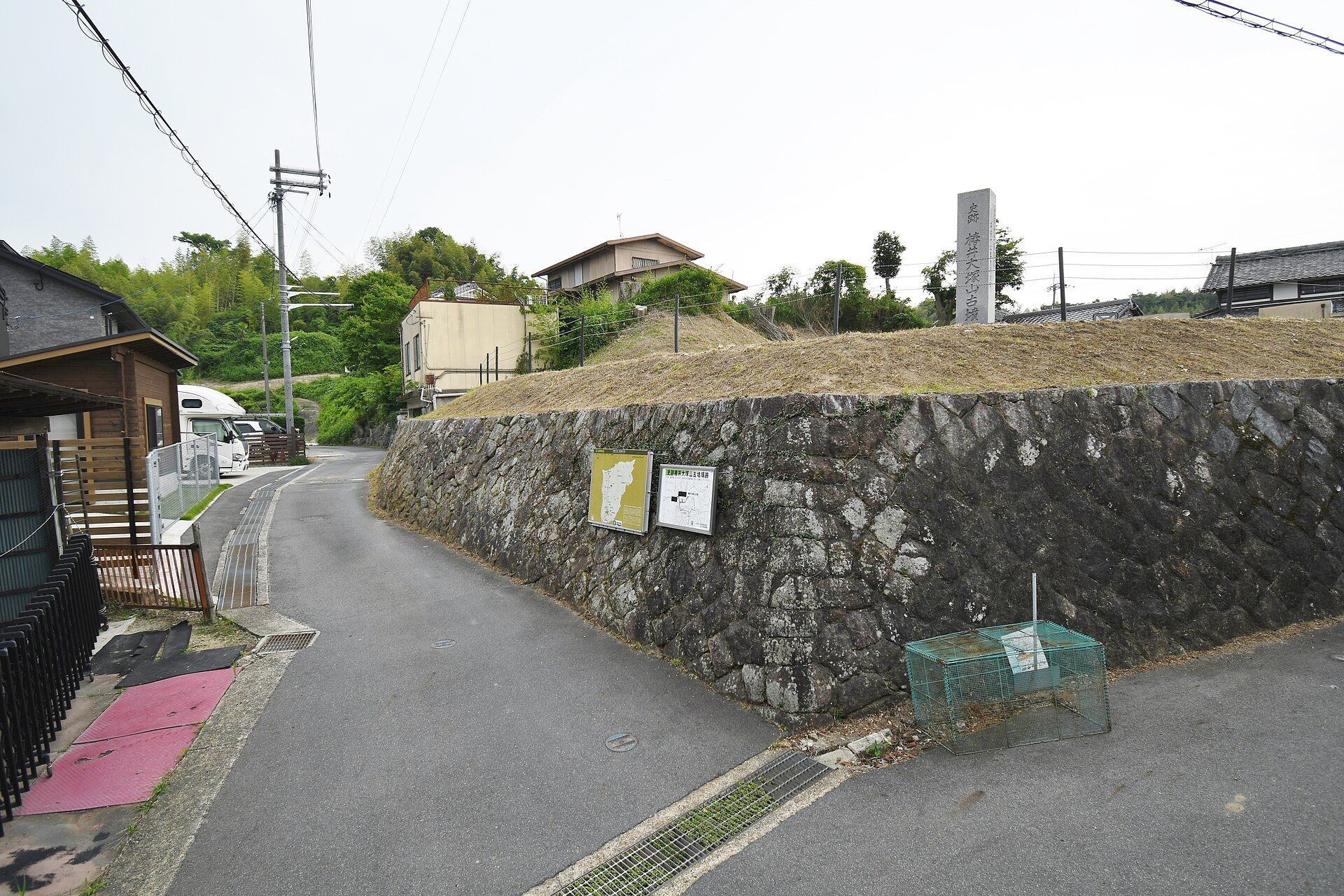
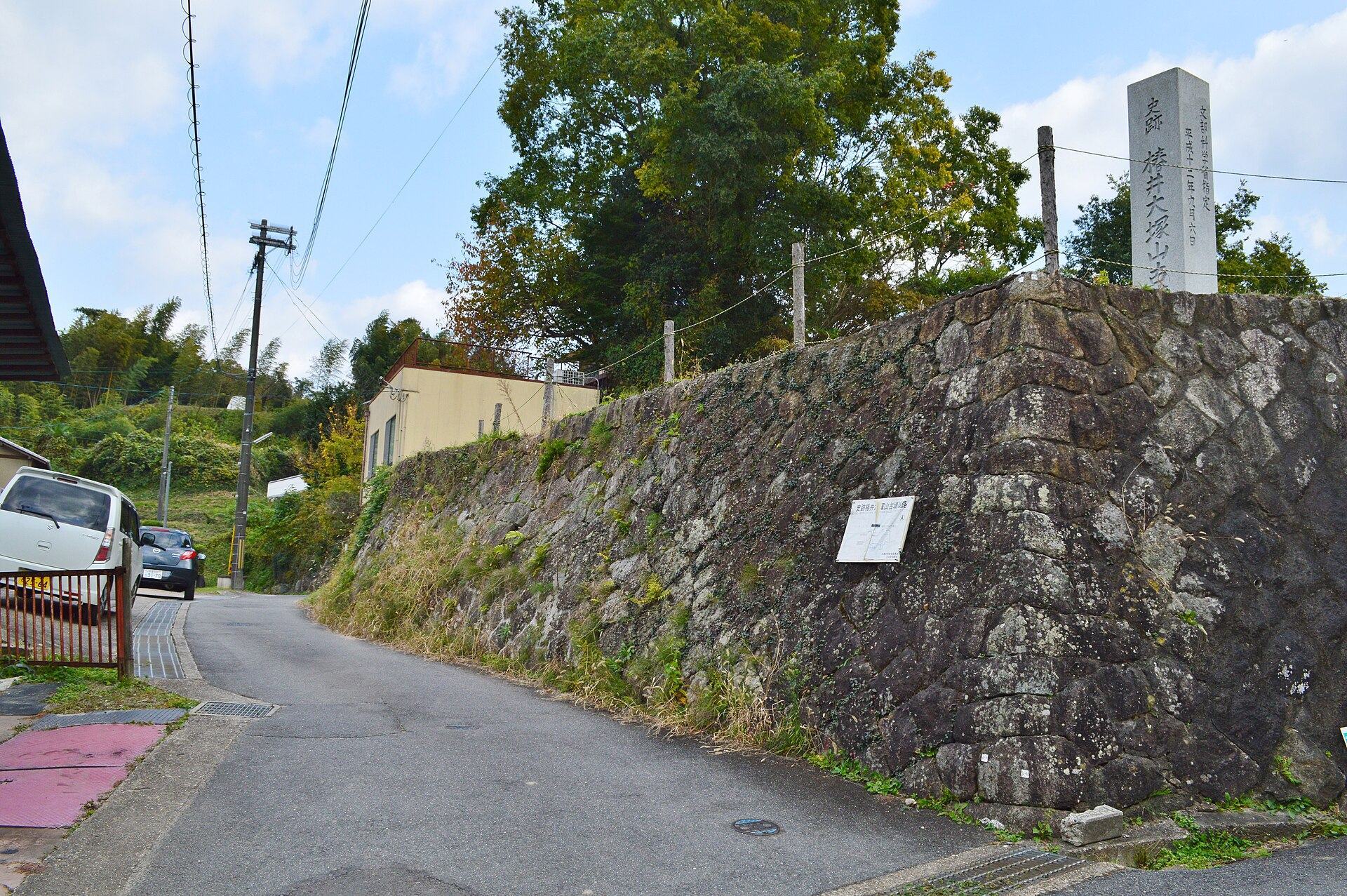
A second excavation of the rear circular section took place in 1971. Boundary and content-confirmation investigations began in 1992, first under the Yamashiro Town Board of Education and later under the Kizugawa City Board of Education. The excavated assemblage became a National Important Cultural Property on June 22, 1992, and the mound became a National Historic Site on September 6, 2000. The ceiling stones of the stone chamber are also designated tangible cultural properties by Kizugawa City.
Mirrors and the study of early political connections
Tsubai Otsukayama Kofun is especially important in the study of the early Kofun period because of its unusually large collection of bronze mirrors, including triangular-rimmed divine-beast mirrors. These are bronze mirrors with triangular-profile rims and designs of divine or mythological figures and animals. The Japanese archaeologist Kobayashi Yukio used mirrors from the mound in developing the same-mold mirror theory, which proposes that matching designs were made from the same mold or closely related molds and circulated among politically connected communities.
Because the mound dates to the latter part of the third century, its mirrors have been speculatively linked with the bronze mirrors described in the Wei zhi, a third-century Chinese history of the polity of Wa and its ruler Queen Himiko. The text states that Cao Rui, emperor of the Chinese state of Wei, sent mirrors to Himiko in AD 239. Later analysis divided the Tsubai assemblage into six designs and indicated that the mirrors were made in Japan, in nearly the same region, within a short period. The possibility that further mirrors were lost through grave robbery remains open.
Remains
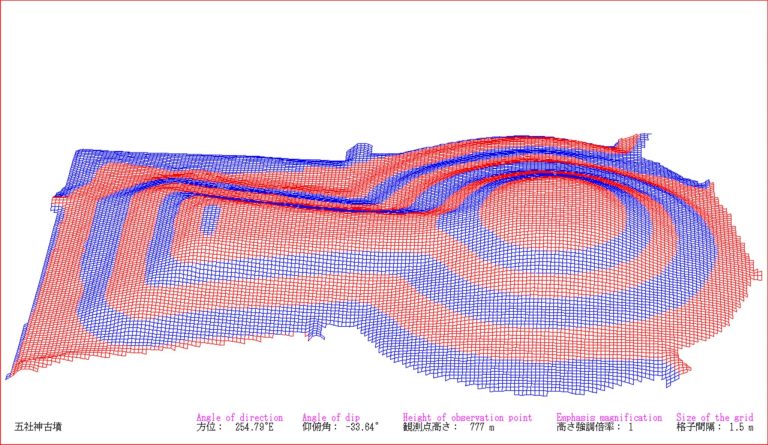
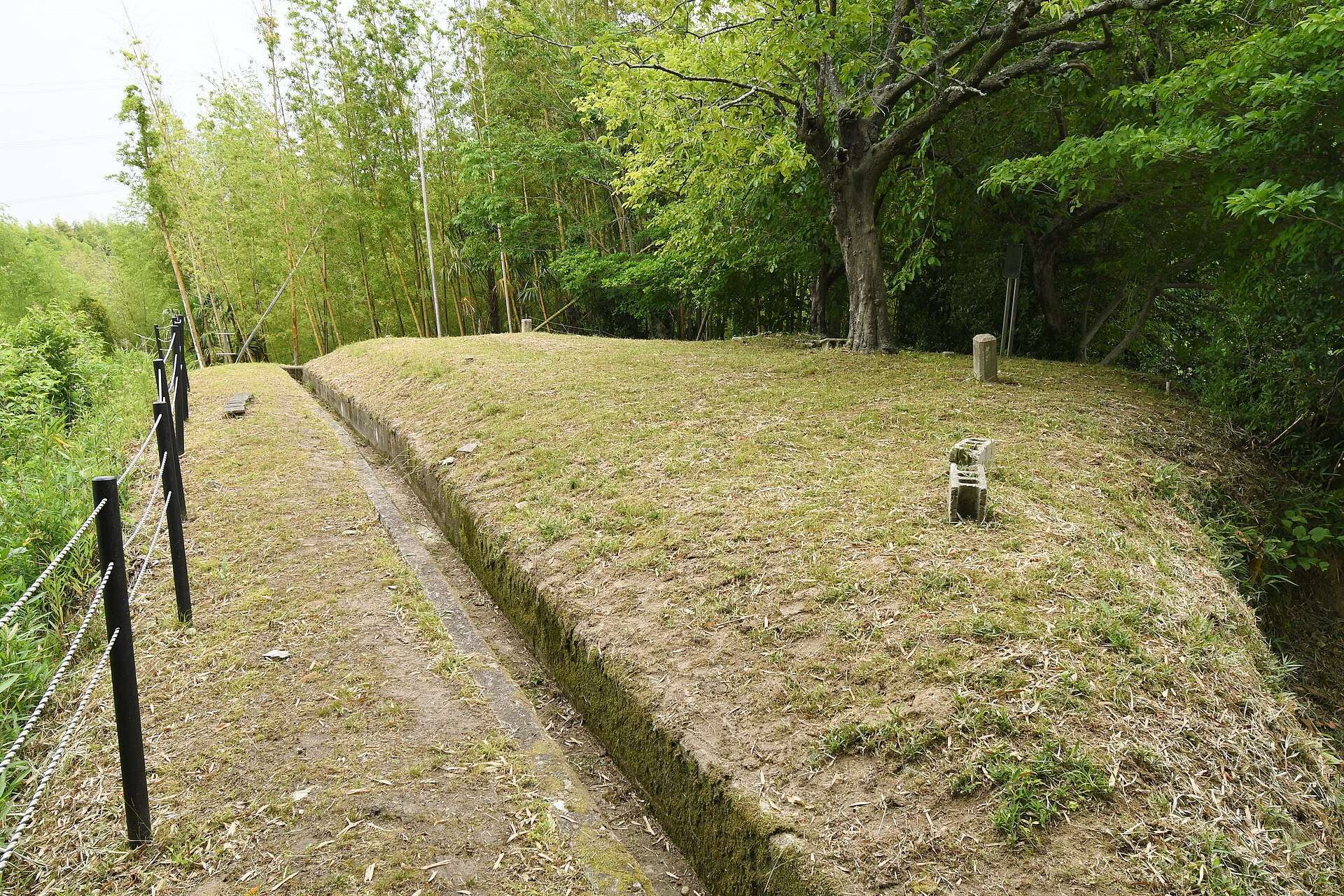
Tsubai Otsukayama Kofun is a keyhole-shaped mound with a rounded rear section and a projecting front section. The front is fan-shaped and opens toward the southwest. Its reconstructed total length is approximately 175 meters, although a reconstruction using the retaining wall beside a village path as the front limit gives a length of about 173 meters. The mound was built on a westward-descending slope at the end of a river terrace formed by the Kizu River and its tributaries.
Mound form and construction
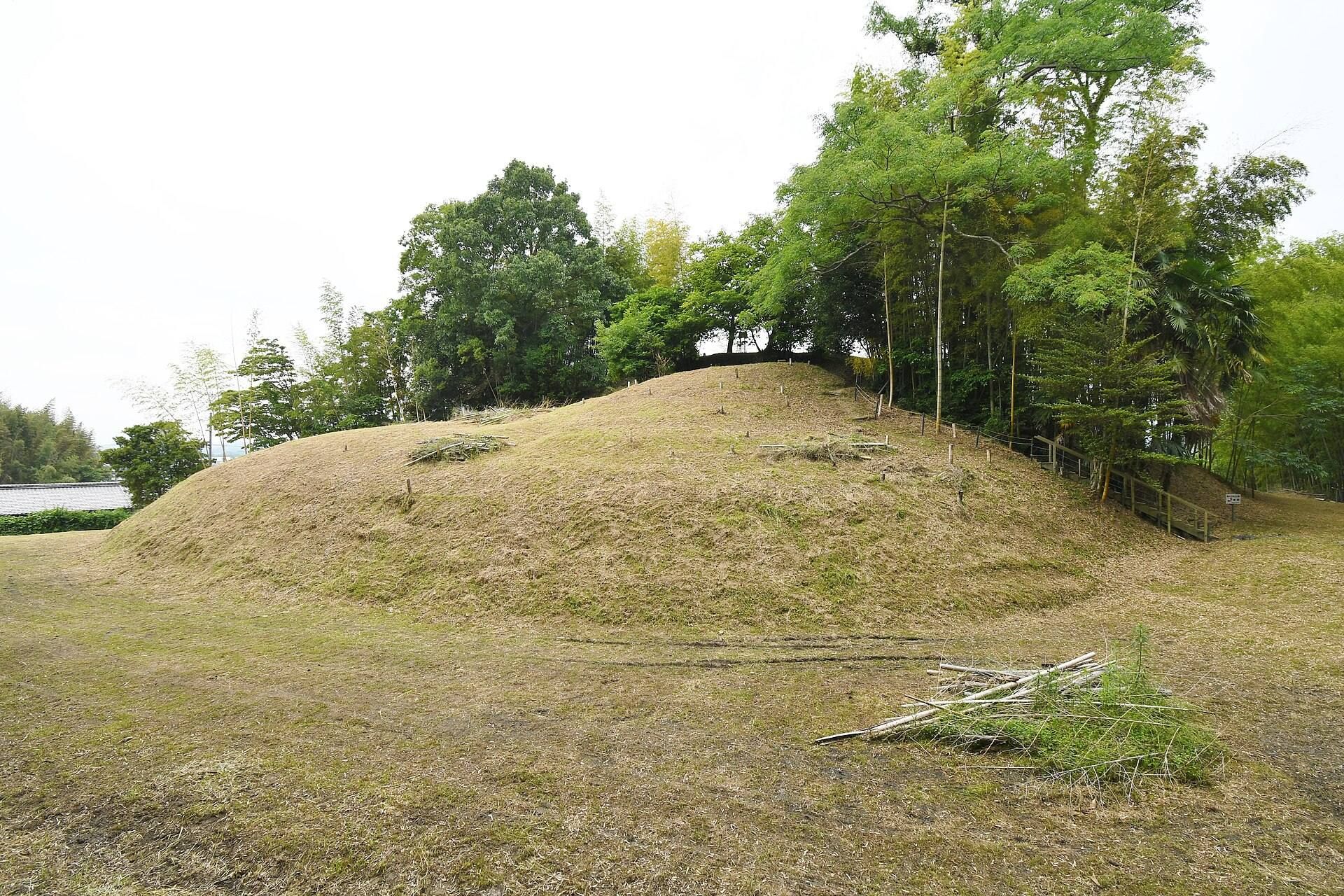
The rear circular section measures about 110 meters in diameter and 20 meters high in the principal reconstruction. It was built in three or four tiers. Another interpretation gives a diameter of approximately 92 meters and a height of 12 to 14 meters, arranged in three tiers. The front section is about 80 meters long, 76 meters wide, and 10 meters high, with two tiers. The rear end stands roughly 10 meters higher than the front, while the base of the rear section and the top of the front section are at approximately the same elevation.
The terrain made the rear section somewhat elliptical, and the eastern side was shaped by the high ground. An approximately 15-meter-wide cut on that side separates the hill from the surrounding land and has been interpreted as the remnant of a surrounding moat. Construction combined the cutting and shaping of the river-terrace slope with the addition of earth. The first terrace of the rear section was cut from the terrace itself, while the second and third terraces were formed with fill on a stepped, artificially prepared slope.
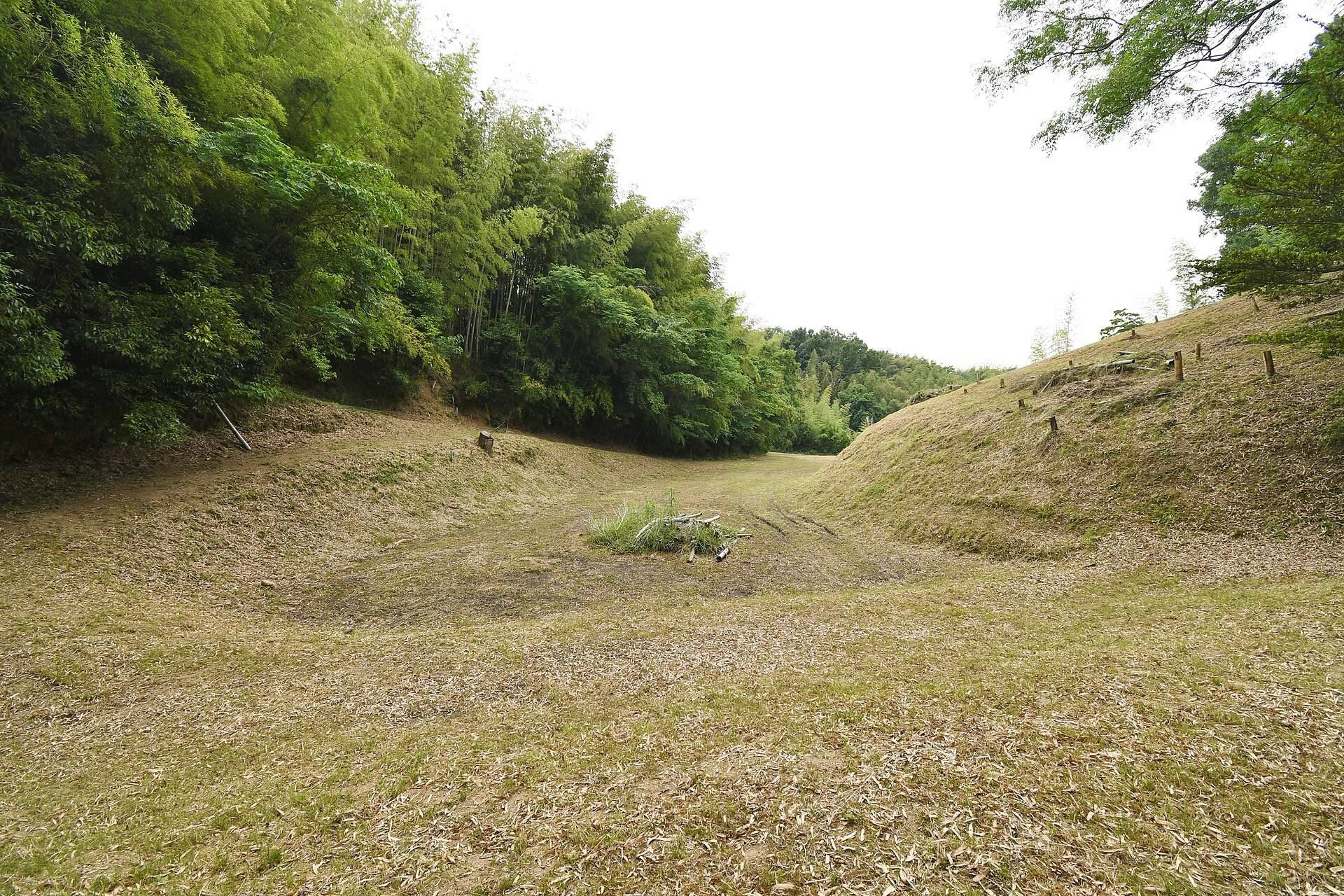
Split stones covered the outer surfaces as a protective facing. Arrangements of double-rimmed jars probably stood on the summit of the rear section. Several types of Haji pottery, an unglazed ancient Japanese earthenware, were recovered from the front section. The rear portion is now partly semicircular because of the railway cutting and is covered by bamboo woodland. The front portion was partly levelled and is occupied by private housing.
Burial facilities
Main stone chamber
The principal burial facility lies at the center of the rear summit. It is a pit-style stone chamber, a burial room built below ground within a large pit and lined or roofed with stone slabs. The reconstructed burial pit measures approximately 21 meters long and 13 meters wide, making it one of the largest known examples of this type. An arrangement of double-rimmed jars probably stood above it.
The chamber runs approximately north to south. It is about 6.8 to 6.9 meters long, 1.1 meters wide at the northern end, 1.0 meter wide at the southern end, and 3.0 meters high. Its lower walls are vertical, while the upper portions incline slightly inward. Granite and andesite split stones form the chamber. The floor has two layers of stone slabs, gravel, and sand covered with clay to create a clay coffin bed. Eight ceiling stones covered the chamber, whose interior was painted vermilion. More than 10 kilograms of cinnabar were scattered over the clay floor.
A split-bamboo-shaped coffin made from Japanese umbrella pine stood inside the chamber. This was a long wooden coffin whose form resembled bamboo split lengthwise, and the bronze mirrors were arranged around it.
Subsidiary burial facility
About three meters west of the principal chamber was a subsidiary facility with a gravel surface covered in clay. Three bronze mirrors were recovered there, including a divine-beast mirror showing paired figures facing one another. The arrangement resembles facilities at Shimoikeyama Kofun and Yanagimoto Otsuka Kofun, while its structure and the burial of a large inward-facing floral-pattern mirror distinguish it from those examples.
Mirrors, weapons, and tools
Bronze mirror assemblage
Approximately 40 bronze mirrors were recovered from the mound. The collection includes two inward-facing floral-pattern mirrors, one divine-beast mirror with paired facing figures, one square-and-compass mirror with four deities, and at least 32 triangular-rimmed divine-beast mirrors. The triangular-rimmed group was the largest known collection of its kind until 33 examples were excavated at Kurozuka Kofun in 1997 and 1998.
Burial goods
Nearly 300 high-quality objects accompanied the burial. They include more than 10 iron swords, seven iron spears, approximately 200 iron arrowheads, 17 bronze arrowheads, and one piece of iron armor. A group of iron arrowheads retained lacquer-film traces with a herringbone pattern, suggesting that they had once been kept in a quiver.
Farming and craft equipment included three iron sickles, ten iron axes, eight iron drills, and three iron chisels. Fishing equipment consisted of ten iron harpoons, several iron fishing spears, and one iron fishhook. An iron object possibly interpreted as an iron crown was also recovered. The excavated burial goods are kept by Kyoto University. A ceiling stone from the chamber is preserved at Yamashiro Junior High School, while replicas of the mirrors and other objects are displayed at local cultural institutions.