Iwase Senzuka Kofun Group: An Ancient Elite Cemetery in Japan


Site at a Glance
- Rating
- 4
- Popularity
- Very Low
- Country
- Japan
- Primary era
- Medieval
- External website
- Open
- Eras represented
- Classical, Medieval
- Civilizations
- Yamato
- Site type
- Burial
- Remains
- Necropolis
On this page20 sections
History
Iwase Senzuka Kofun Group is a large ancient Japanese cemetery in Wakayama City, Japan, built between the late fourth and seventh centuries during the Kofun period and its transition into the Asuka period. The cemetery is associated with the Kii kuni no miyatsuko, hereditary provincial rulers or chiefs of ancient Kii Province, and with clans connected to them, including the Otomo and Ibe.
Formation and Political Associations
The cemetery developed over several centuries, although most of its mounds were constructed in the sixth century. A kofun is an ancient Japanese burial mound, generally made for members of elite or ruling communities. At Iwase, the concentration of different mound forms and burial chambers reflects the funerary practices of powerful communities centered on the Kii kuni no miyatsuko.
The cemetery extends across eight named clusters: Hanayama, Otaniyama, Dainichiyama, Iwase Maeyama, Wasa, Ibe, Ibe Maeyama, and Terauchi. Its northern range reaches Narukami and Hanayama, while its southern range extends toward Okazaki and the Ibe Hachimanyama area. Westward, it reaches Miya, where the Hinokuma and Kunikakasu shrine complex is associated with the Kii kuni no miyatsuko.
The construction of group burials ended by the close of the sixth century, before the mid-seventh-century Taika Reforms introduced an ordinance favoring modest burials. One or two generations after the principal sixth-century phase, the building of tomb groups largely ceased, and further burials and funerary activity became limited. Ibe No. 1 Tomb, a later square tomb apparently made for a clan leader, provides important evidence for this final phase.
Recognition and Preservation
The cemetery was traditionally known by the local name Iwase Senzuka, which became widely used after excavation reports published during the Taisho period. Its initially recognized extent covered southern Iwase. Investigations in 1962 expanded the group to include the Ibe, Ibe Maeyama, and Terauchi areas.
Tokugawa Yorinori made the first recorded modern field survey in 1906. Tsuboi Shogoro then sent Ono Ungai to investigate, and Ono’s excavation in 1907 brought the group’s distinctive lateral-entry stone chambers to wider academic attention. Further work by Kuroita Katsumi, Iwai Taketoshi, and Tazawa Kingo followed in 1918, and the first investigation report appeared in 1921. Wakayama City and Wakayama Prefecture conducted additional surveys in 1962 and 1967. A three-year investigation began in 2003, while detailed distribution mapping has continued since fiscal year 1980.
Part of Iwase Senzuka was designated a National Historic Site on July 31, 1931. The principal area became a Special National Historic Site on March 29, 1952, with additions in 1988, 2000, and 2016. The 2016 addition included parts of Tennō-zuka Tomb and Otaniyama No. 22 Tomb. During the Second World War, some mounds were requisitioned as air-raid shelters. The Wakayama Prefectural Kii Fudoki-no-Oka facility opened in 1971 to preserve and interpret the cemetery, and the surrounding area is maintained as an open-air museum.
Remains
Landscape and Burial Forms
The Special National Historic Site covers about 62 hectares, while approximately 65 hectares around the cemetery form the open-air museum. Larger estimates place the cemetery at more than 900 tumuli, with about 500 inside the designated area. It is one of Japan’s largest concentrations of clustered burial mounds.
The cemetery occupies the Iwase mountain massif in eastern Wakayama, west of Yada Pass on an east-west extension of the Ryumon Mountains. The massif rises about 120 metres above its surroundings and overlooks the Wakayama Plain. The site extends for roughly four kilometres from east to west, with the lower Kinokawa River nearby and the Hinokuma and Kunikakasu shrines about two kilometres to the west.
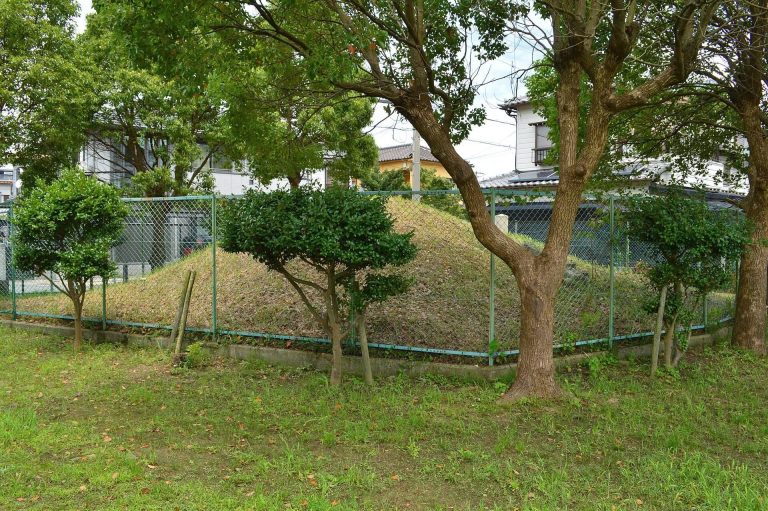
Twenty-seven confirmed mounds have the keyhole form, with a rounded rear section joined to a narrower rectangular front section when viewed from above. Four are square, and most of the remaining mounds are round. Keyhole tombs account for about one percent of the group. Burial facilities include clay-lined chambers, box-shaped stone coffins, vertical stone chambers, and lateral-entry stone chambers, which are approached through a passage from the side of the mound.
The earliest facilities, used through approximately the middle of the fifth century, include clay-lined chambers and box-shaped stone coffins. Vertical and lateral-entry chambers became more common from the end of the fifth century into the first half of the sixth. The local lateral-entry form is known as an Iwase-type chamber. Builders split locally quarried chlorite schist into slabs and stacked them upward from the floor, using inward-stepped courses. Many chambers contain internal stone shelves and several structural beams, with large slabs covering the ceilings. Thirty-four stone-shelf chambers are known in the cemetery, while 21 tombs contain stone beams and 19 contain both features. Related construction appears elsewhere in the Kinokawa and Arida river basins, and traces at Kainan Ryuto-ri Tomb indicate that Iwase craftsmen contributed to its construction.
Hanayama and Otaniyama
Hanayama lies on the 77.2-metre Hanayama in Iwase and Kurisu. It originally contained nine keyhole and 75 round tombs, although land development destroyed three keyhole and 13 round mounds. Most were built in the fifth century, making Hanayama one of the earliest areas of the cemetery. Clay-lined chambers predominate, and lateral-entry chambers were introduced here at an early stage.
Hanayama Tombs
Hanayama No. 8 Tomb was built in the early fifth century at the summit. The fan-shaped keyhole mound is about 52 metres long, with a rear circular section 35 metres across, a 17-metre front projection, and a height of 4.6 metres. Its rear burial facility was probably clay-lined, while the front section contained a clay floor measuring 12.3 by 1.3 metres. Finds include an iron sword, talc tubular beads, curved beads, small beads, glass beads, and stone beads. Local tradition also connects the subgroup with a triangular-rimmed divine-beast mirror, tubular bronze objects, and stone bracelets.
Hanayama No. 44, now lost, was an early- to mid-fifth-century keyhole tomb about 30 metres long. Its rear section measured 23 metres across, and each principal section contained two clay-lined burial facilities. One rear facility was 4.9 metres long and 0.73 metres wide; two further clay floors occupied the rear section.
Built in the latter half of the fifth century, Hanayama No. 6 is a 49-metre keyhole tomb with a rear section 27 metres in diameter and a mound 4.5 metres high. Built-out projections marked both sides of its narrowed central area. Cylindrical haniwa surrounded the mound, and numerous figurative haniwa were recovered. Its two-shouldered lateral-entry chamber is 7.07 metres long, with a main chamber four metres long, 2.6 metres wide, and 2.5 metres high. Haniwa are clay funerary figures or cylinders placed on and around burial mounds.
Otaniyama rises about 132 metres between Hanayama and Dainichiyama No. 35 Tomb. It contains five keyhole and approximately 20 round tombs. Otaniyama No. 22 occupies the summit, while branches to its north contain clusters including Nos. 4–6, 20, 27, 28, and 39, as well as Nos. 14–17 and 35–37.
Early Lateral-Entry Chambers
Otaniyama Nos. 6, 27, and 28 are associated with the early introduction of lateral-entry chambers at Iwase. No. 6 was built in the early sixth century as a 25-metre keyhole tomb with a rear section 15 metres in diameter. Cylindrical and figurative haniwa surrounded it. Its one-shouldered chamber measures 3.8 by 2.3 metres and has three wall projections linked to traditions from Kyushu. The tomb also contains a vertical stone chamber and composite box-shaped stone-coffin facilities.
Otaniyama No. 27 is an early-sixth-century keyhole tomb 21 metres long, with a rear section 13 metres in diameter and a square, one-shouldered chamber with sides 6.1 metres long. No. 28 measures 25 metres, with a rear section 15 metres across. It contains an early-sixth-century lateral-entry chamber in the rear section and a box-shaped stone coffin in the narrowed central area that belongs to the late sixth century.
Later and Earlier Round Tombs
Otaniyama Nos. 4 and 5 are round tombs about 19 metres in diameter, built in the latter half of the sixth century. Their main chambers are relatively small in comparison with their passageways. Otaniyama No. 16, built in the middle of the sixth century, is 26.5 metres across and six metres high. Its Iwase-type, two-shouldered chamber has a southeast entrance and an interior height of 3.6 metres.
Otaniyama No. 39 is a fifth-century round tomb 20 metres in diameter at the group’s lowest elevation, about 38 metres. Before lateral-entry chambers were introduced, it used a clay-lined chamber coated inside with red pigment. The chamber contained a split-bamboo-shaped wooden coffin about 6.7 metres long and 0.53 metres in diameter, together with a stone coffin. Iron axes, a straight sword, and small iron objects were recovered. Otaniyama No. 22 produced horse equipment, Sue ware, weapons and armour, and haniwa depicting wrestlers and shrine maidens. Sue ware is a high-fired ceramic tradition of ancient Japan.
Dainichiyama and Iwase Maeyama
Dainichiyama occupies the western side of the massif at a relative elevation of about 141 metres. It borders Iwase Maeyama, lies south of Otaniyama, and comprises two keyhole and approximately 50 round tombs.
Dainichiyama No. 1
Dainichiyama No. 1 lies at an elevation of about 120 metres. The keyhole mound is 32 metres long, with a rear section 25 metres across and a front projection seven metres long. Figurative and cylindrical haniwa were scattered on the mound, which is surrounded by approximately six round tombs. Except for No. 8, whose burial facility is a vertical stone chamber, the surrounding tombs contain lateral-entry chambers.
Dainichiyama No. 35
Built in the first half of the sixth century, Dainichiyama No. 35 is an 83–86-metre keyhole tomb with a rear section 37 metres in diameter and a front projection 46 metres long. Cylindrical haniwa encircled the mound. Its two-shouldered lateral-entry chamber lies in the rear section and measures 7.5 metres overall; the main chamber is 4.5 metres long, 2.4 metres wide, and 2.8 metres high.
The mound produced cylindrical and house-shaped haniwa, along with distinctive examples of a bird with outspread wings, a two-faced human figure, and a quiver-shaped object. The restored mound provides a view toward central Wakayama.
Iwase Maeyama forms the central subgroup on terrain averaging about 130 metres in relative elevation, between Wasa to the east and Otaniyama, Dainichiyama, and Ibe to the west. Its eastern sector has been called Maeyama A since the Taisho period, while the remainder is known as Maeyama B. The subgroup contains three keyhole tombs, approximately 300 round tombs, and one square tomb. Four mounds reconstructed after a 1975 survey are grouped as Maeyama B Hanaki Garden Nos. 1–4, southwest of the Kii Fudoki-no-Oka museum, at elevations of 30–37 metres.
Maeyama Keyhole Tombs
Shogun-zuka, also called Maeyama B53, is a 42.5-metre keyhole tomb with a lateral-entry chamber open to the public. Excavated materials include silver bracelets, iron objects, Haji ware, Sue ware, beads and other precious stones, and horse equipment. Haji ware is a lower-fired earthenware tradition of ancient Japan. Chiji-zuka, or Maeyama B67, is about 30.5 metres long and yielded haniwa and Sue ware. Gunchō-zuka, or Maeyama B112, is another keyhole tomb measuring about 30.5 metres.
Maeyama Round Tombs
Maeyama A47 is the largest round mound in the Maeyama A sector, measuring about 27 metres in diameter and eight metres high. Its stone chamber is open to the public. The entrances or interiors of chambers in Maeyama A13, A56, A100, and A111 are also known.
Wasa and Ibe
Wasa lies on the summit and northern slope of the Iwase massif, about one kilometre east of Iwase Maeyama. It contains one keyhole and nine round tombs, and part of its northern slope is used as a citrus orchard.
Tennō-zuka Tomb
Tennō-zuka occupies the highest point of the massif, at 155 metres. Built in the latter half of the sixth century, it is Wakayama Prefecture’s largest tomb, measuring about 86–88 metres long and six metres high. Its rear section is 44 metres in diameter, while the front projection extends 42 metres. The Iwase-type, two-shouldered lateral-entry chamber is 10.59 metres long. Its main chamber measures 4.22 by 2.89 metres and is 5.9 metres high, making it the second-highest known chamber in Japan when measured from floor to ceiling.
The Ibe subgroup lies at the foot of Dainichiyama No. 35, at a relative elevation of about 30 metres. It is approximately 500 metres southwest of Ibe Maeyama and 400 metres east of Terauchi No. 18. The subgroup contains three square and approximately 30 round tombs.
Ibe No. 1 Tomb
Ibe No. 1 is a square tomb built from the end of the sixth century to the beginning of the seventh. Its south side is 40 metres long, the north side 28 metres, and the east and west sides 39 metres, producing a trapezoidal mound plan. Its stone chamber is 10.8 metres long, with a main chamber 4.15 metres long, 2.7 metres wide, and 2.8 metres high.
Ibe Maeyama and Terauchi
Ibe Maeyama occupies Fukaimine, a small hill on the western side of the massif, at a relative elevation of 102.2 metres. The subgroup extends about 800 metres from east to west and 200 metres from north to south, with orchards to the south. It is divided into central, eastern, and western clusters. The central cluster contains Ibe Hachimanyama Tomb. The eastern cluster has three keyhole and five round tombs, together with the Morikoteho haniwa kiln site. The western cluster contains one keyhole and 31 round tombs. Overall, the subgroup is also described as having five keyhole and 49 round tombs.
Terauchi extends across Terauchi, Morikoteho, and Kire on the southern side of the massif. It covers about one kilometre from east to west and 1.5 kilometres from north to south, with Sōkōjigayatani to the south. Its 96 tombs are predominantly equipped with lateral-entry chambers.
Terauchi Round Tombs
Terauchi No. 57 is a round tomb about 35–40 metres in diameter with a lateral-entry chamber. Terauchi No. 63 is about 20 metres across and contains a clay-lined chamber with a wooden coffin.
Terauchi No. 18
Terauchi No. 18 is a 28.6-metre keyhole tomb with a rear section 13 metres in diameter and a front projection 15.6 metres long. Cylindrical haniwa stood around and on top of the mound. Both sections contain lateral-entry chambers. The front chamber is 6.5 metres long, with a main chamber 2.63 metres long and 1.96 metres wide. The rear chamber measures 0.9 by 1.65 metres, and its central passage is 0.5 metres wide.
Many Maeyama tombs and Dainichiyama No. 35 lie along the paths of Kii Fudoki-no-Oka, and some of their stone chambers are open for viewing. Archaeological finds from the cemetery are displayed at the Kii Fudoki-no-Oka Museum of History.