Kimii-dera Temple: A Buddhist Pilgrimage Temple in Wakayama, Japan


Site at a Glance
- Rating
- 4.3
- Popularity
- Medium
- Country
- Japan
- Primary era
- Early Modern
- External website
- Open
- Eras represented
- Medieval, Early Modern, Modern
- Civilizations
- Ashikaga shogunate, Japanese, Tokugawa
- Site type
- Religious
- Remains
- Monastery
On this page19 sections
History
Kimii-dera Temple is a Buddhist temple in Wakayama, Japan, traditionally founded in 770 by the Tang monk Tamemitsu and now the head temple of the Kusei Kannon sect. Its principal image is a hidden eleven-headed Kannon, a form of the Buddhist bodhisattva associated with compassion. The temple is the second stop on the Saigoku Kannon Pilgrimage, a route linking thirty-three temples associated with Kannon worship in western Japan.
Foundation and Sacred Traditions
According to the foundation tradition, Tamemitsu saw a beam of light rising from Mount Nagusa. He followed it, found a small golden statue of Senju Kannon, the thousand-armed form of Kannon, and carved an eleven-headed image. He placed the golden statue inside the larger figure and enshrined both in a hermitage. This hermitage is regarded as the beginning of Kimii-dera.
The temple’s formal name is Kimii-san Kongōhō-ji Gokoku-in. Its popular name is traditionally linked with three sacred springs on Mount Nagusa, called Seijo-sui, Yoryu-sui, and Kissho-sui. Another explanation appears in the Kii Zoku Fudoki, which connects the name with the earlier nearby place-name Kemiura.
Imperial Patronage and Medieval Growth
At the end of the Heian period, Emperor Go-Shirakawa designated Kimii-dera as an imperial prayer temple. Go-Shirakawa was a twelfth-century emperor who later exercised political influence as a retired sovereign. Following this designation, the temple became highly prosperous. By the Kamakura period, more than 500 monks were said to live there, while its revenues included approximately 49 cho of medieval estates. These estates, known as shōen, were landed properties whose income supported institutions such as temples and shrines.
Kimii-dera developed as a single-mountain temple, with numerous monks and subtemples operating across Mount Nagusa. Married monks served as temple priests, while Kokuya, now Kokuya-ji, organized fundraising for building work and repairs. The Kokuya institution was a nunnery that distributed wooden votive prints to pilgrims.
The temple also maintained a close medieval relationship with Hinokuma-Kunikakasu Shrine. Mount Nagusa was known as the sacred mountain of the three wells, and during the Oei era Kimii-dera sent armed guards to the shrine’s festival.
Fire, Conflict, and Reconstruction
A fundraising letter dated 1449 states that Kimii-dera suffered a devastating blow in 1441, probably in a fire connected with conflict between remnants of the Southern Court and the Hatakeyama clan, the military governors of Kii Province. The halls were rebuilt, but restoration of the Tahoto pagoda remained incomplete. A second fundraising letter, dated 1522, appealed for donations to repair the temple buildings.
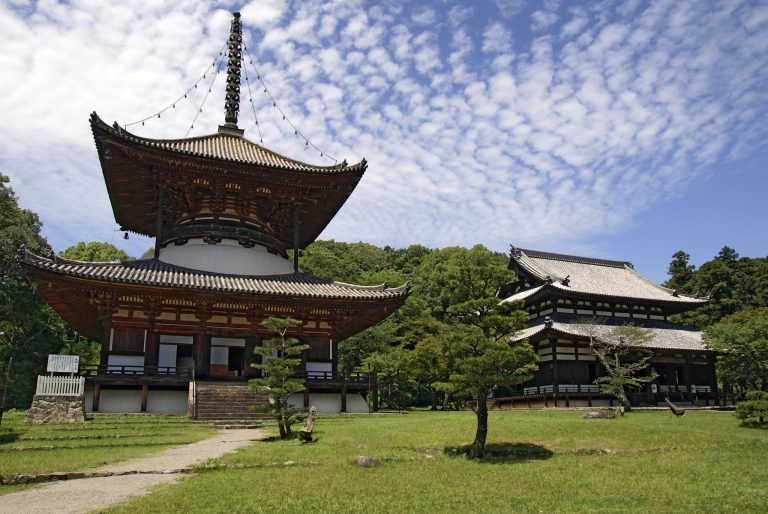
The Tahoto is a Japanese Buddhist pagoda with a square lower section and a rounded upper section. Its survival gives the medieval rebuilding history a visible architectural presence within the precincts.
Hideyoshi’s Campaign and Early-Modern Support
In 1585, during Toyotomi Hideyoshi’s invasion of Kii Province, a nun of Kokuya negotiated directly with Hideyoshi and obtained a document guaranteeing the temple’s security. Hideyoshi was the late-sixteenth-century military ruler who unified Japan and led the campaign against Kii Province. The guarantee saved Kimii-dera from burning, although Hideyoshi ordered the disarmament of its armed monks and confiscated most of its estates.
The temple’s medieval landholdings were lost during the campaign. In 1601, Asano Yukinaga, lord of Wakayama Castle, donated 13 koku of land for Kimii-dera’s support. A koku was a historical Japanese measure of land or rice yield. Tokugawa Yorinobu, founder of the Kishu branch of the Tokugawa family and lord of the Wakayama domain, later donated another 8 koku, provided funds for lamps, and exempted the precincts from land taxes. In 1647, killing animals within the temple grounds was prohibited. Successive lords of the Wakayama domain frequently visited Kimii-dera, which was revered as a major regional prayer center.
Changes to Kokuya-ji and Modern Religious Status
Kokuya-ji began as Hongan-bo in 1586 and was renamed Gokoku-in during the Meireki era, between 1655 and 1658. Regulations introduced under the Tokugawa government, including the religious-institution rules of 1665, weakened the authority of the temple’s fundraising organization. Kokuya-ji moved outside the Romon gate at the foot of the mountain in 1705. In 1735, a head-temple and branch-temple relationship reduced the formerly influential subtemple to the status of an affiliated temple.
Kimii-dera was formerly affiliated with the Yamashina branch of Shingon Buddhism and became independent in 1951. It now includes six subtemples within its precincts and fourteen affiliated temples. The temple is designated as the head temple of the Kusei Kannon sect, a Japanese Buddhist tradition centered on devotion to Kannon.
The three springs were restored and improved at the end of the twentieth century. An elevator connecting the mountainside parking area with the Main Hall was completed in 2020, followed by a cable railway between the area below the Romon and a mountainside station in 2022. Kimii-dera’s Romon, bell tower, and Tahoto pagoda are nationally designated Important Cultural Properties. Several Edo-period buildings have cultural-property designations from Wakayama Prefecture, while the springs and two individually identified trees have municipal scenic or natural-monument designations. The springs are also included among Japan’s 100 Famous Waters, and the precincts are one of Japan’s 100 Best Cherry Blossom Viewing Spots.
In 1868, Sasaki Tadasaburō, a military figure fleeing toward Wakayama, died at Kimii-dera. A grave associated with him remains connected with the temple.
Remains
Kimii-dera occupies the western mid-slope of Mount Nagusa, about 50 meters above sea level. The mountain rises to 228.7 meters in the southern part of the Kinokawa River estuary plain, and the grounds overlook Wakaura Bay. The precincts extend upward from the entrance gate to a central upper area and further terraces containing the Main Hall, the Tahoto pagoda, and related buildings.
Approach and Upper Precinct
Romon Gate and Stairway
The Romon marks the entrance to Kimii-dera. Built in the Muromachi period and dated to 1509, it leads toward a steep stone stairway of 231 steps. The stairway rises to the central precinct on the mountainside, linking the entrance with the principal group of temple buildings.
Upper-Precinct Buildings
At the center of the upper precinct stand the Rokkakudo Hall, the New Buddhist Hall built in 2002, and the Main Hall. The Tahoto pagoda stands farther uphill beside the Main Hall, together with other buildings on the upper terrace. The Main Hall, Founder’s Hall, Rokkakudo Hall, Daishido Hall, three Sansha Gongen structures, and Study are Edo-period buildings. The Main Hall received its Wakayama Prefecture designation in 1974, while the other named buildings were designated in 2016.
Main Hall
The present Main Hall was rebuilt in 1759. It has a gabled roof covered with its original tiles and five bays on both the front and side elevations. Chidori gables, triangular decorative gables applied to the roof, form part of its exterior, while a three-bay front veranda carries a curved karahafu roof. The hall’s details follow the Zen style and include arched beams, wooden projections attached to the heads of the beams, architraves, and three-armed joints.
Medieval and Early-Modern Structures
The Tahoto pagoda dates to 1449 and belongs to the Muromachi period. The bell tower dates to 1588 and belongs to the late sixteenth century. Together with the Romon, these three structures received national cultural-property designation in 1908.
Kannon Images and Pilgrimage Features
Daikomyoden Hall
The principal eleven-headed Kannon and the Senju Kannon were moved to the Daikomyoden Hall at the rear of the Main Hall. The building was completed in 1983 as an earthquake-resistant and fire-resistant storage structure connected to the Main Hall. The eleven-headed Kannon stands on the left and the Senju Kannon on the right. Both images are displayed once every fifty years. The eleven-headed figure is the hidden principal image, while the Senju Kannon is the concealed image placed within it according to the foundation tradition.
Outer Sanctuary
The outer sanctuary of the Main Hall is open to pilgrims and contains thirty-three Kannon statues. Each is modeled on the principal image of one of the thirty-three temples on the Saigoku Kannon Pilgrimage route, for which Kimii-dera serves as the second temple.
Buddhist Images and Painted Scrolls
The precincts contain Heian-period wooden images of Senju Kannon, eleven-headed Kannon, Bonten, and Teishakuten. Other cultural-property objects include a wooden standing Tenbu image, a silk painting of standing Jizo Bosatsu, and a wooden image of Shaka Nyorai. Two painted scrolls, the Kimii-dera Pilgrimage Mandala and the Kumano Ten Worlds Mandala, are also associated with the temple. The pilgrimage mandala relates directly to the historical representation of Kimii-dera and its pilgrimage landscape.
Three Springs and Natural Features
Sansei-sui Springs
Three springs, collectively called the Sansei-sui, are associated with the precincts. Seijo-sui forms a small waterfall on the right side of the stairway. Yoryu-sui is a well at the end of a side path from the waterfall, while Kissho-sui is a well several hundred meters north of the Romon, outside the gate. Each spring has a sandstone water tank inscribed with its name and the date 1650. Tokugawa Yorinobu ordered the installation of the tanks.
Cherry and Camphor Trees
A cherry tree to the left of the Main Hall is the Somei-Yoshino specimen used by the Wakayama Regional Meteorological Observatory to determine the beginning of the spring flowering season. Kimii-dera’s cherry trees generally flower earliest in the Kinki region. A camphor tree and another individually identified tree within the precincts are municipal natural-monument features.