Akasaka Tennōzan Kofun: A Kofun-Period Burial Mound in Japan

Site at a Glance
- Rating
- 4
- Popularity
- Very Low
- Country
- Japan
- Primary era
- Medieval
- External website
- Open
- Eras represented
- Medieval
- Civilizations
- Yamato
- Site type
- Burial
- Remains
- Burial Mound
On this page8 sections
History
Akasaka Tennōzan Kofun is a Japanese burial mound in Sakurai, Nara, constructed between the end of the sixth century and the beginning of the seventh during the Kofun period, when large earthen tombs were built for members of the elite. It is also called Akasaka Tennōzan No. 1 Kofun and forms part of the Akasaka Tennōzan Kofun Group at Kurahashi.
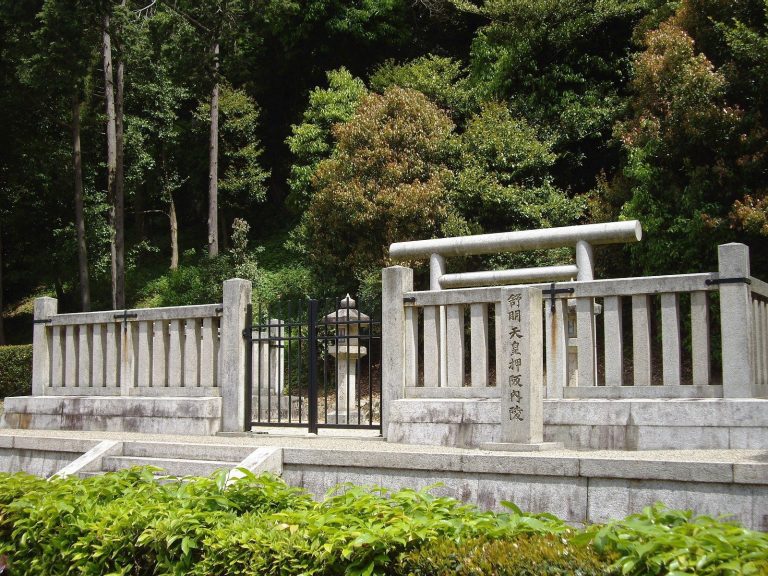
Possible tomb of Emperor Sushun
The mound has been identified as a possible tomb of Emperor Sushun, a ruler traditionally dated to approximately AD 552–592. The Nihon Shoki, an early Japanese historical chronicle concerning the imperial line, states that Sushun was buried at Kurahashi after his assassination. Since no other comparable mound in the area had been identified, Akasaka Tennōzan Kofun was regarded as his tomb until the Meiji period.
During the Meiji period, the Imperial Household Agency designated a different circular mound as Sushun’s official mausoleum. That mound lies about 1.7 kilometers southwest, near the former site of Sushun’s Kurahashi Shibagaki-no-miya palace. The identification of Akasaka Tennōzan Kofun as Sushun’s tomb has nevertheless continued to influence historians and archaeologists, including Koichi Mori.
Protection and investigation
The tumulus was designated a National Historic Site of Japan on December 25, 1954, under the name “Tennōzan Kofun.” It has since been surveyed through detailed measurement and three-dimensional recording of its stone chamber. The mound has not undergone archaeological excavation. Early opening and looting of the chamber have left no known grave goods.
Remains
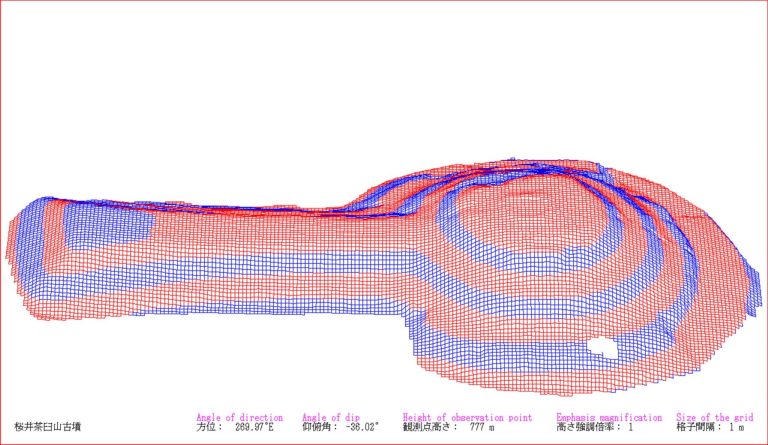
Akasaka Tennōzan Kofun is a large square-shaped mound at the tip of a ridge extending northwest from Mount Tonomine, near the left bank of the Oubara River. Its plan narrows toward the south. The northern side measures approximately 50.5 meters, the southern side 43.2 meters, the eastern side 46.5 meters, and the western side about 47 meters. The mound rises in three tiers, each covered with protective stone surfacing. Its summit forms a level area approximately 10 meters square.
Mound and stone chamber
Burial chamber
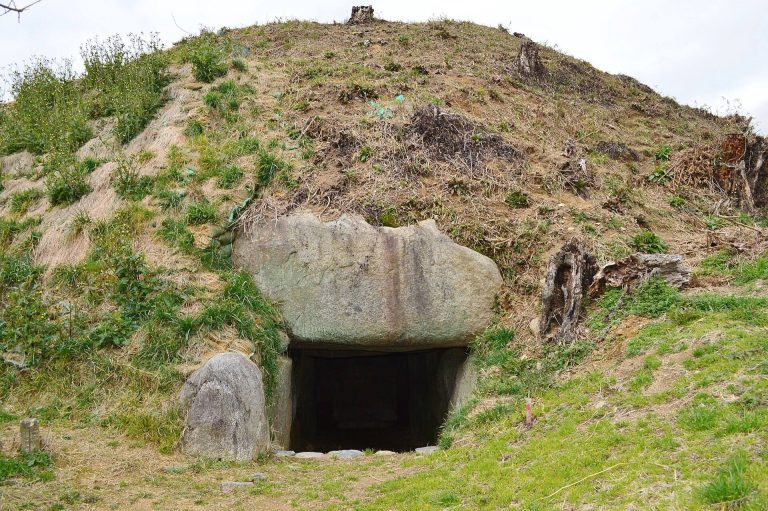
The burial facility is a south-facing, horizontal-entry stone chamber built from natural granite. It extends more than 15.3 meters and includes paired side extensions at the entrance. The burial chamber is approximately 3 to 3.2 meters wide and more than 4.2 meters high. Its walls use corbelled construction, in which successive courses of stone project inward over those below. Gravel covers the floor, and a blocking stone remains at the entrance to the passage.
Granite construction
The rear wall is formed in three courses, with a megalith more than 2 meters high accompanied by two additional stones measuring approximately 1 meter each. The side walls are also arranged basically in three courses, with small stones packed into the gaps. The passage is about 8.5 meters long, 1.8 meters wide, and 2 meters high. Apart from the doorway stone, it is built mainly from granite blocks measuring about 1 meter each.
Sarcophagus
A hollowed, house-shaped stone sarcophagus stands parallel to the main axis at the center of the burial chamber. Its lid imitates the roofed form of a dwelling, and its separately made lid and body were fitted together. Made from white tuff quarried at Mount Nijō, it measures approximately 2.4 meters long, 1.7 meters wide, and 1.1 meters high.
The lid carries horizontally positioned rope-holding projections near the upper parts of the roof slopes. There is one pair at the front and rear, together with two pairs along the long sides. On the southern short end, slightly left of center, a square carving measuring 48 centimeters on each side extends from the lid into the body, with a smaller window opened within it. A square hole is also pierced in the upper edge of the body facing the passage. No objects remain inside the sarcophagus because of ancient looting.