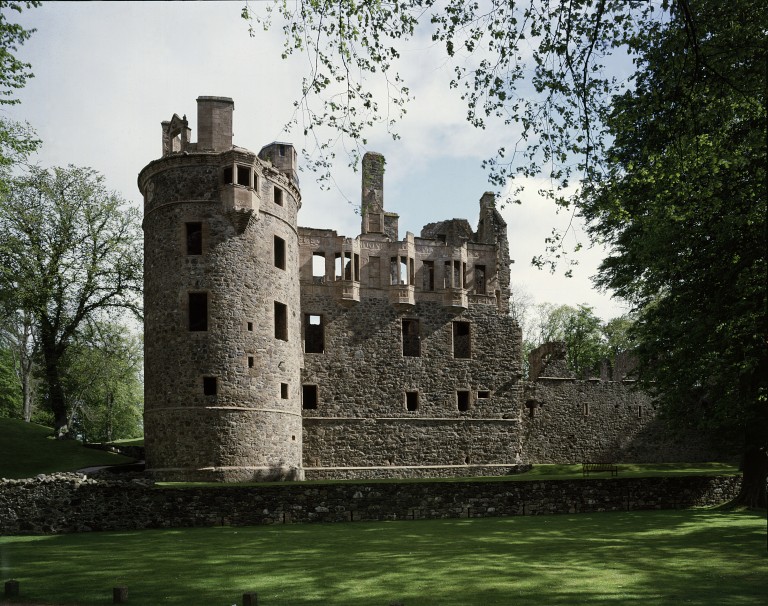
Inchdrewer Castle: A Sixteenth-Century Scottish Tower House


Site at a Glance
- Rating
- 4.2
- Popularity
- Very Low
- Country
- United Kingdom
- Primary era
- Early Modern
- External website
- Open
- Eras represented
- Early Modern, Modern
- Civilizations
- British, Kingdom of Scotland
- Site type
- Military
- Remains
- Castle
On this page9 sections
History
Inchdrewer Castle is a sixteenth-century Scottish tower house in the United Kingdom, standing near Banff and overlooking Banff Bay. Built as a fortified residence, it began as a simple L-shaped structure in the early to mid-sixteenth century and later became the principal seat of the Ogilvie family of Dunlugas.
The Currours and the Ogilvies
The castle was originally held by the Currour family. James Currour, a notary in Banff, was associated with contracts and lease witnessing connected with Dunlugas. Although Walter Ogilvie of Dunlugas purchased Inchdrewer in 1557, the Currours continued to use the designation “lairds of Inchdrewer.” In 1599, George Currour, who held the land under a feu tenure arrangement, became involved in a dispute concerning the family pew at the Kirk of Inverboyndie.
During the later sixteenth century, the Ogilvies refurbished and enlarged the castle. Courtyard buildings were added, along with a circular tower on the south side that contained a staircase and included the hall on its first storey. These works changed the original tower house into a more extensive residential complex.
Royalism, attack, and destruction
An act confirming the lands to George Ogilvy, Walter Ogilvy’s son, received royal ratification from King Charles I in late June 1633. George was a committed Royalist, supporting the monarchy against the Covenanters, Scottish Presbyterians who opposed royal interference in church government and became involved in armed conflict with royal supporters.
In 1640, Covenanter forces commanded by General Robert Monro attacked Inchdrewer Castle. The assault left the castle in ruins, and another Ogilvy property, a town house, was also devastated. George Ogilvy was raised to the peerage in 1642 as the first Lord Banff, creating a formal noble title associated with the family and its estates.
George Ogilvy, 3rd Lord Banff, inherited Inchdrewer after his father, the 2nd Lord Banff, died on 10 September 1668. The 3rd Lord Banff was murdered in 1713. His body was concealed inside the castle, which was then destroyed by fire. Restoration followed, although the surviving record does not establish what that work involved.
Government troops led by the Duke of Cumberland attacked the castle in 1746 during the Jacobite rising of 1745–46, an attempt to restore the exiled Stuart dynasty to the British throne. Further restoration took place later in the eighteenth century, continuing the building’s repeated cycle of damage and repair.
The Abercrombys and abandonment
When William Ogilvy, 8th Lord Banff, died on 4 June 1803, the estate passed to his sister Jean, also known as Jane. She was married to George Abercromby of Birkenbog, and their son, Sir Robert Abercromby, later succeeded her. Sir Robert represented the Banff constituency in the House of Commons from 1812, but financial difficulties prevented him from standing for re-election in 1816.
In 1820, Sir Robert asked King George IV either to revive the dormant or extinct Banff peerage by making his mother Baroness Banff, or to grant him the title of Lord Banff. The request was refused. The Abercrombys lived principally at Forglen House near Turriff, while Inchdrewer remained sufficiently intact to be leased to tenants until 1836. It was then abandoned and deteriorated. By 1887, two parts of the ground-floor plan were described as ruinous, and the castle was abandoned again at the beginning of the twentieth century.
Twentieth-century restoration and later ownership
Count Robin Mirrlees bought Inchdrewer Castle in 1962 or 1963. Renovation may have been attempted in 1965 by the architect Oliver Hill, although Hill’s undated drawings may not have been fully carried out. After visiting in 1966, the writer and historian Nigel Tranter called the building a “ruinous shell of a house.”
Structural restoration and limited repairs made the castle wind- and watertight by 1971. The work included additional windows and new glazing, but the building was abandoned again afterward. Mirrlees never lived there, and the interior received only basic treatment. Local belief held that the interior was used during this period for a ceremony marking completion of the external work.
Historic Scotland gave Inchdrewer Castle category A listed status in February 1972. In Scotland, this is the highest level of statutory protection for buildings regarded as having national architectural or historical importance. Concern over the castle’s condition followed in 1999. Inspections in 2008 found broken windows and inadequate maintenance, while further deterioration was noted in 2010 and again in December 2012.
Mirrlees died on 23 June 2012. The ruins and the title “Baron of Inchdrewer” were offered for sale in April 2013 and bought by Olga Roh in November that year for about £400,000. She intended to restore the castle for possible use as a residence, fashion-shoot venue, film location, holiday property, or boutique hotel. Marc Ellington led the restoration until his death in 2021.
A modern haunting tradition connects the castle with the ghost of George Ogilvy, 3rd Lord Banff. During a visit in the 1970s, Nigel Tranter saw a large white dog emerge from the building. A later account described the castle as haunted by a lady appearing in the form of a white dog.
Remains
Setting and original tower house
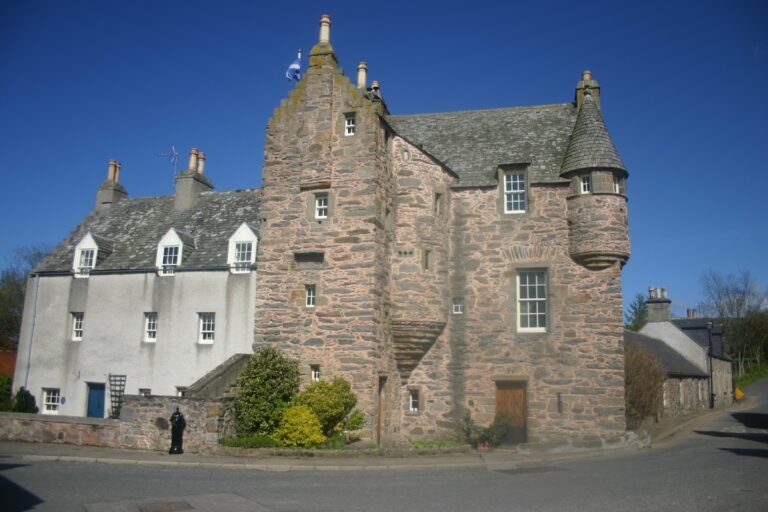
Inchdrewer Castle stands on a slight rise about 3.5 miles, or 5.6 kilometres, south-west of Banff, at approximately 104 metres above sea level. Its position overlooks Banff Bay. The earliest structure was an L-shaped tower house, a fortified Scottish residence centred on a tall stone tower. It was built from tooled ashlar-dressed rubble, a rubble masonry construction incorporating regularly dressed stone for facing or detail. The precise building date is unknown, but the tower belongs to the early to mid-sixteenth century and may have been built during the reign of James IV or James V.
Courtyard expansion
The late-sixteenth-century enlargement added a circular tower on the south side. This tower contained a staircase and incorporated the hall on its first storey. Further buildings were placed along the north and south sides of the courtyard, creating a more complex arrangement around the earlier L-shaped core.
The first-floor entrance of the original building was blocked when new entrances were introduced. A narrow, round-headed entrance was made on the west side, while a wider main doorway was inserted into the south elevation. The towers had corbelled wallheads, which project outward on supporting stone corbels, and battlements with notched parapets intended to provide defensive cover. The first-floor hall received light through a large elongated opening, and the south-west tower contained shot holes, small openings for firearms.
Later alterations and present condition
A wing added in the late eighteenth century contained larger and more regular windows than the openings in the earlier parts of the castle. The 1971 restoration introduced additional windows and new glazing while protecting the structure from wind and rain. After the later abandonment, exposure to the weather and vandalism caused further structural decay.
In 2013, Inchdrewer Castle was ruinous and unfit for habitation. It remains a ruin, with the surviving fabric reflecting its early tower-house core, later courtyard expansion, repeated damage, and incomplete restoration.
Nearby sites