Sospel Castle: A Medieval Fortified Residence in France


Site at a Glance
- Rating
- 4.3
- Popularity
- Very Low
- Country
- France
- Primary era
- Medieval
- Eras represented
- Medieval
- Civilizations
- County of Provence
- Site type
- Military
- Remains
- Castle
On this page8 sections
History
Sospel Castle is a medieval fortified castle in Sospel, France, whose construction began in the thirteenth century. Built as a seigneurial residence, it formed part of the defenses of a settlement that grew on a height between the Merlanson and the Bévéra before spreading toward the Bévéra.
From Ventimiglia to Provence
By about 1230, Sospel was enclosed by a fortified enceinte, or defensive enclosure, while the settlement belonged to the County of Ventimiglia, a medieval lordship centered on Ventimiglia. In 1232, Sospel promised the podestà, the chief civic magistrate of an Italian commune, that it would demolish its walls if the Republic of Genoa required this. The town later became connected first with the obligations of the counts of Ventimiglia toward Genoa and then with the counts of Provence.
On 19 January 1257, Guillaume VI, Count of Ventimiglia, transferred his family’s possessions in the County of Ventimiglia and the Val de Lantosque to Charles I in return for Provençal properties providing up to 5,000 sols in annual revenue. The Treaty of Lucéram, signed on 28 March 1258, transferred Breil, Saorge, and other fiefs from the counts Boniface and Georges of Ventimiglia to the Count of Provence. The Count of Ventimiglia subsequently accepted the suzerainty of the Count of Provence.
Administrative and military development
An act issued by Charles II of Anjou on 26 January 1307 reorganized Provence and made Sospel the seat of the viguerie of the County of Ventimiglia and the Val de Lantosque. A viguerie was a Provençal administrative district governed by a viguier. The county parliament was also intended to meet at Sospel, although its representatives repeatedly protested that assembling there was difficult. The counts of Provence renewed this right in 1312, 1347, and 1382.
The comital court repaired the castle in 1358. In 1376, the Count of Provence assigned the castle of Castillon to Sospel’s defense. The fortifications were raised and enlarged in 1383 during the conflict between rival branches of the Angevin family, following the death of Queen Joanna, whose succession triggered a struggle for control of Provence. The enclosure remained in good condition in 1556.
Ruination and protection
Sospel Castle later became a ruin, while ownership is now held by the commune of Sospel. The château’s remains received protection as historic monuments in France through a decree dated 6 June 1933.
Remains
Castle and settlement defenses
Castle tower and ruins
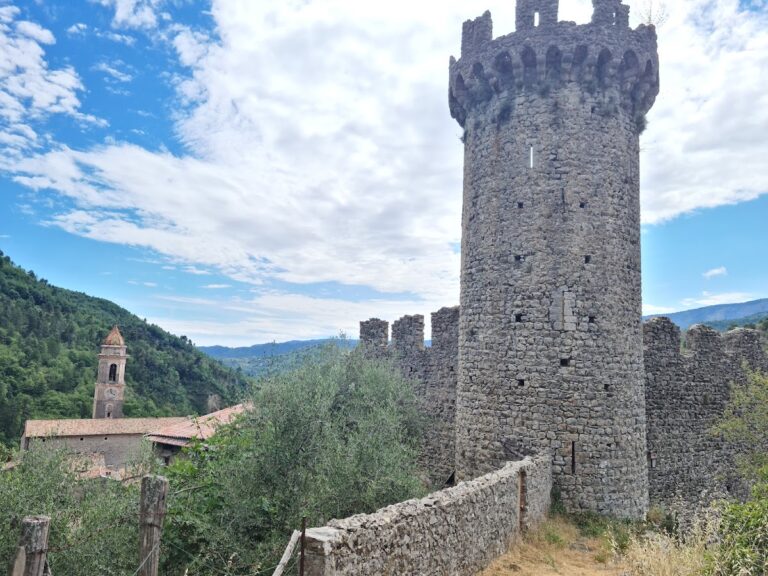
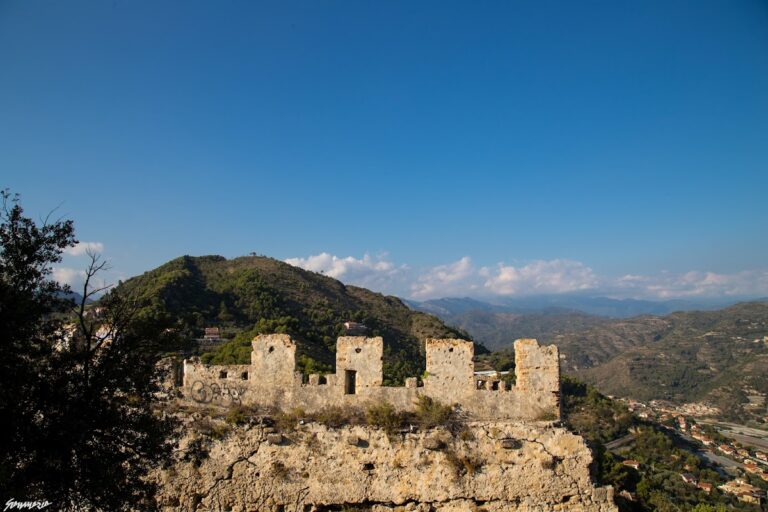
The surviving castle remains include the château’s tower and other ruined elements. They belong to a medieval fortified complex that began as a seigneurial residence and formed part of Sospel’s defensive system. The ruined condition of the castle contrasts with the enclosure’s recorded state in the sixteenth century.
Fortified enclosure
The settlement’s defenses formed an enceinte around Sospel. In 1333, the clavaire, a medieval official responsible for financial or administrative oversight, described the enclosure as modest and used the Latin term discopertum, indicating an open or insufficiently covered or defended enclosure. The walls were rebuilt and expanded in 1383, creating the defensive framework associated with the later medieval fortifications.
Nearby sites