Ise Jingū: Japan’s Imperial Shinto Shrine Complex


Site at a Glance
- Rating
- 4.7
- Popularity
- Very High
- Country
- Japan
- Primary era
- Medieval
- External website
- Open
- Eras represented
- Medieval
- Civilizations
- Yamato
- Site type
- Religious
- Remains
- Sanctuary
On this page17 sections
History
Ise Jingū is a Shinto shrine complex in Japan, located in Ise, and centered on the Inner Shrine, Naikū, and the Outer Shrine, Gekū. The traditional foundation account places Naikū in 4 BCE, while archaeological interpretations generally favor a much later formation, especially the late fifth century. The complex follows yuitsu-shinmei-zukuri, a distinctive Ise form of an austere Shinto architectural tradition derived from ancient raised-floor storehouses. In its wider sense, Jingū includes 125 shrines distributed across Ise and neighboring parts of Mie Prefecture.
Origins and early organization
Naikū is dedicated to Amaterasu Ōmikami, the solar kami traditionally regarded as the ancestor of the Japanese imperial line. According to tradition, Amaterasu was first worshipped within the imperial residence and later moved through temporary sanctuaries during the reign of Emperor Sujin. Princess Yamatohime-no-mikoto eventually brought the sacred mirror and Amaterasu’s spirit to Ise after receiving divine instruction to establish a permanent sanctuary there.
The historical date of Ise Jingū’s formation remains debated. Proposed dates range from the third century to the late seventh century, although archaeological arguments favor the late fifth-century reign of Emperor Yūryaku. A beginning in the late sixth century has also been proposed, while the traditional 4 BCE date remains the official foundation tradition.
Gekū is traditionally dated to the late fifth century, during the reign of Emperor Yūryaku. In the origin story, Amaterasu appeared to the emperor in a dream and requested that Toyouke Ōmikami be brought from Tanba to provide her food. Toyouke, a kami associated with food, agriculture, clothing, shelter, industry, and material sustenance, was therefore transferred to Ise as the provider of Amaterasu’s meals.
During the reigns of Emperor Tenmu and Empress Jitō, the shrine’s ritual institutions and buildings were substantially organized. The first ceremonial rebuilding of Naikū took place in 690, followed by the first rebuilding of Gekū in 692. The architectural and ritual pattern established during this period shaped the form of the shrine for later centuries.
Imperial institution and medieval change
From antiquity, Ise was closely connected with the imperial court. When it functioned as a state cult center, private offerings by rulers, nobles, and commoners were formally prohibited, and the emperor alone was understood to perform its public rites. The sacred mirror at Ise was regarded as inseparable from the mirror enshrined in the imperial palace. Ise later held the foremost position among the Twenty-Two Shrines, a medieval group that received especially high imperial recognition.
The ancient state supported the shrine through tax-paying households, agricultural estates, and sacred districts. At one stage, 1,130 shrine households were distributed across seven provinces, while 36 chō and 1 tan of sacred fields supplied produce for offerings. Watarai and Taki were treated as sacred districts belonging to Ise, and additional districts were incorporated by the Heian period. Administrative and ritual regulations were set out in the Inner Shrine and Outer Shrine ritual codes commissioned in 804 and in the Engishiki, completed in 927.
The Saiō institution was established in the late seventh century. An unmarried imperial princess served as the shrine’s principal female ritual representative, with Princess Ōku, the daughter of Emperor Tenmu, traditionally regarded as the first Saiō. The institution continued until the Nanboku-chō period and ended in 1336.
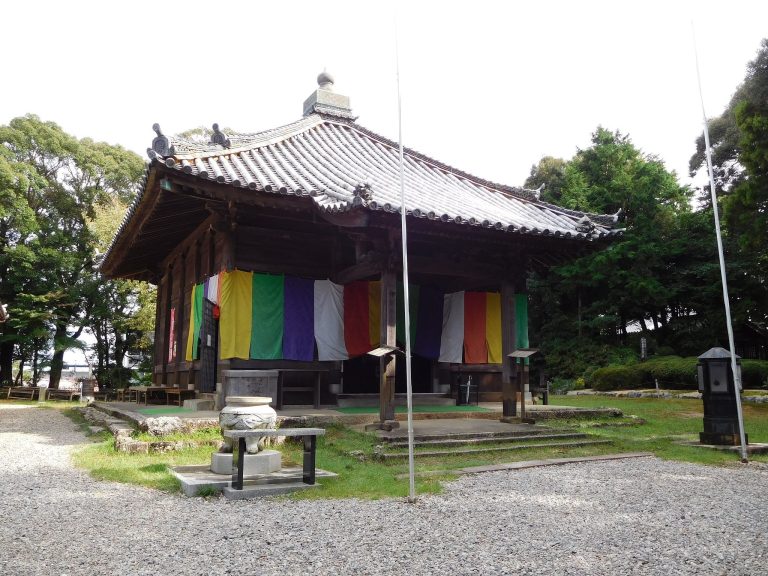
Ise resisted Buddhist terminology and ritual in its official practice, and its shrine temple was abolished as early as the Nara period. Buddhist devotion nevertheless grew among shrine priests, who later established Buddhist temples, clan temples, and sutra mounds. Medieval systems of Shinto-Buddhist syncretism, in which kami worship and Buddhist institutions were interpreted together, treated Naikū and Gekū as paired sacred realms.
From the eleventh century, the decline of the ritsuryō system, Japan’s early centralized framework of administration, taxation, and official ritual, weakened Ise’s traditional economic base. The shrine responded through the levy called yakubukōmai and through the creation of mikuriya, or shrine estates whose revenues supported ritual institutions. Landholders, warrior groups, and local elites donated estates to Ise, while lower-ranking priests known as kuchiire kannushi collected revenues and spread devotion.
Worship expanded beyond the court and warrior classes to wider sections of society. Shrine estates established branch shrines dedicated to Amaterasu or Toyouke, and priests who promoted pilgrimage and prayer helped extend Ise worship into eastern Japan and among commoners. At the same time, disputes between Naikū and Gekū concerned status, titles, revenue, and control of offerings. Their shrine towns developed separate autonomous organizations, Uji associated with Naikū and Yamada with Gekū.
Warfare during the Nanboku-chō and Sengoku periods interrupted rituals and damaged the shrine’s economic base. Imperial envoys to the Kannamesai ceased after the Ōnin War, and the Shikinen Sengū was suspended for more than 120 years. In 1487, conflict between Uji and Yamada caused Yamada to burn, with fire reaching Gekū, while a counterattack devastated Uji except for Naikū’s principal sanctuary.
Rebuilding and pilgrimage in the early modern period
The rebuilding tradition was restored in the late sixteenth century. The nun Shue of Keikō-in raised funds to rebuild Uji Bridge, and her successor Seijun helped secure the rebuilding of Gekū in 1563. The nun Shuyō then obtained major donations from Oda Nobunaga and Toyotomi Hideyoshi, enabling the rebuilding of Naikū and the restoration of simultaneous renewal for both principal shrines.
Under Toyotomi rule, lands east of the Miyagawa River were protected as shrine territory and exempted from the Taikō land survey. The Tokugawa shogunate confirmed shrine estates, donated additional land for salt production, and established the Yamada magistracy in 1603. This office supervised shrine security, rebuilding, repairs, shrine lands, and shipping through Toba Harbor.
Emperor Go-Kōmyō restored the imperial envoy to the Kannamesai in 1647. During the Edo period, onshi, or Ise religious agents, solicited offerings, distributed talismans, arranged lodging, and promoted pilgrimage. Village Ise associations pooled funds and sent representatives to the shrine.
Okage mairi, also called O-Ise mairi, became especially prominent. Major pilgrimages attracted approximately 3.62 million people in 1705, 2.07 million in 1771, and 4.76 million in 1830. In 1790, a village headman sent his dog to Ise as a proxy pilgrim, helping establish the custom of dog pilgrimage.
Modern reorganization and continuing ritual
The Meiji government reorganized Ise Jingū as the highest shrine within a state-centered Shinto system. In 1871, hereditary priestly offices were abolished, the Arakida and Watarai priestly families were removed from their traditional positions, the Jingū Shichō was established, and the number and structure of priestly offices were sharply reduced. The onshi were also abolished.
The early Meiji separation of Buddhism and Shinto led to the destruction of 109 Buddhist temples in Uji and Yamada. Shrine rites were later formalized through the Jingū Saishi Rei of 1914, which classified ceremonies as major, middle, or minor rites.
After the Second World War, Ise ceased to be administered as a state institution and became a religious corporation under law. It remained the principal shrine of the Association of Shinto Shrines, while the Jingū Shichō became its executive administrative office. The annual cycle continues to include imperial envoys, agricultural rites, daily offerings, and the Kannamesai. Ise is not registered as a UNESCO World Heritage Site, a circumstance associated with the difficulty of reconciling cyclical rebuilding with the emphasis on material permanence.
The Shikinen Sengū is normally held every twenty years and involves the ritual transfer of the sacred seat to a newly built sanctuary. The first recorded renewal took place at Naikū in 690. Despite postponements and the long interruption during the Sengoku period, the practice continued for roughly 1,300 years. The sixty-second renewal was completed in 2013, and the sixty-third is planned for 2033.
Ise’s religious identity is expressed through an annual agricultural cycle. The Kinen-sai prays for a prosperous harvest, the Kazahinomisai seeks favorable weather and sufficient rain, and the Kannamesai in October presents the first harvested rice and other offerings to Amaterasu. Food is also offered every morning and evening. Worship has traditionally joined national concerns, including protection of the country and the imperial family, with prayers for harvests, household safety, healing, safe childbirth, and prosperity.
Remains
Principal layout and architectural tradition
Ise Jingū is organized around two principal complexes, Naikū and Gekū, which stand approximately six kilometers apart. Gekū is traditionally visited first, followed by Naikū. Across the wider organization are two principal shrines, 14 betsugū directly ranked below them, 43 sessha, 24 massha, and 42 shokansha, distributed through Ise and parts of neighboring municipalities.
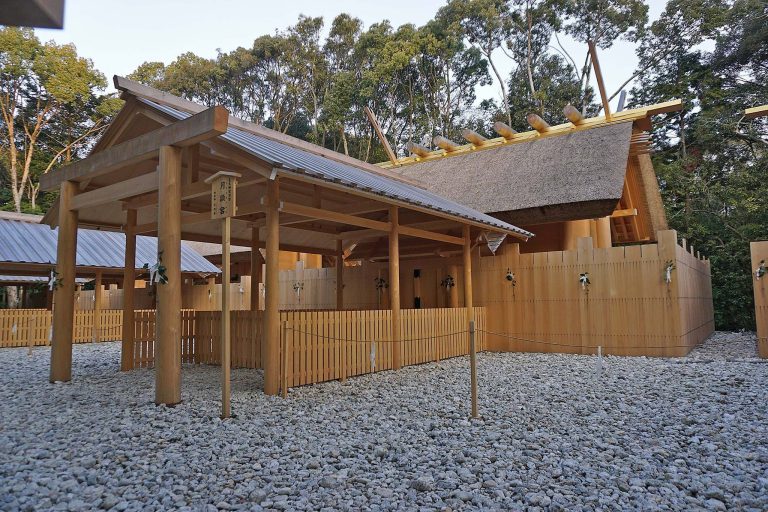
The principal buildings use yuitsu-shinmei-zukuri, the special Ise form of shinmei-zukuri. Japanese cypress structures stand on pillars set directly in the ground and are assembled with wooden joints rather than nails. A principal building measures approximately 10.9 by 5.5 meters, with a raised floor, surrounding verandas, and a stairway leading to a central entrance.
Thatched roofs carry ten ridge billets called katsuogi, while forked finials known as chigi rise above the roof ends. Two free-standing ridge-support posts, the munamochi-bashira, support the roof structure. At Naikū, the chigi have flat tops, a feature associated with the female deity Amaterasu.
The adjacent kodenchi is the empty site reserved for the next rebuilding. Covered with white stones, it contains a small hut called the oi-ya, which houses the unseen central sacred post, the shin-no-mihashira, more than two meters high. A new sanctuary is built around this post before the oi-ya is removed, while the post of the former sanctuary is placed beneath a new oi-ya. The renewal extends to buildings, gates, fences, external halls, storehouses, Uji Bridge, sacred garments, and ritual treasures.
Naikū and its subordinate shrines
Naikū entrance and ritual buildings
Uji Bridge forms the entrance to Naikū. The traditional wooden bridge is approximately 100 meters long, crosses the Isuzu River, and has a torii at each end. Its bridge and gateways mark the transition from the secular world to the sacred precinct and are renewed during the Shikinen Sengū.
Within Naikū are the Temizusha, a roofed place for washing the hands and mouth, the Saikan purification hall, and the Anzaisho, a hall used for visits by the emperor, empress, or imperial representatives. The Saikan provides ritual seclusion before ceremonies. The Kaguraden serves individual prayers and the presentation of donations, talismans, amulets, and dedicatory scrolls.
Naikū principal sanctuary
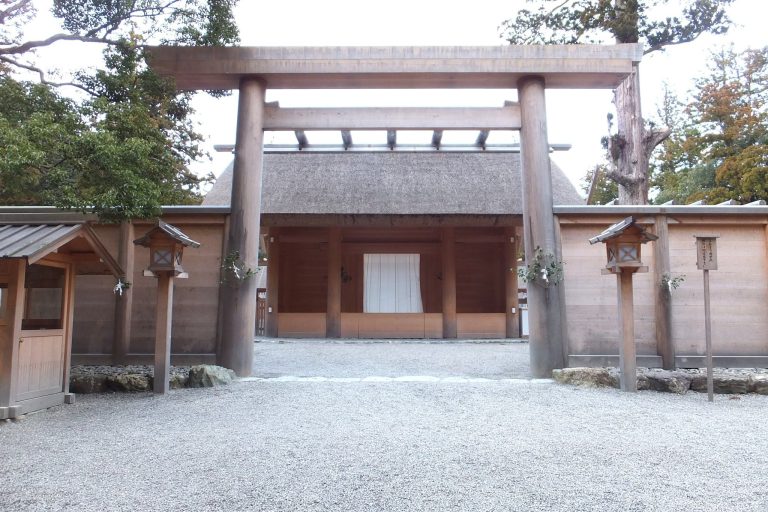
The principal sanctuary stands beyond stone steps and four enclosing fences. The first gate is the point reached by visitors, and part of the thatched roof can be seen from outside. The neighboring open kodenchi was used for the 2013 rebuilding. The Imibiyaden contains the sacred fire used to cook food offerings, which are kept in cypress containers and purified at the Haraedo before presentation.
Naikū subordinate shrines
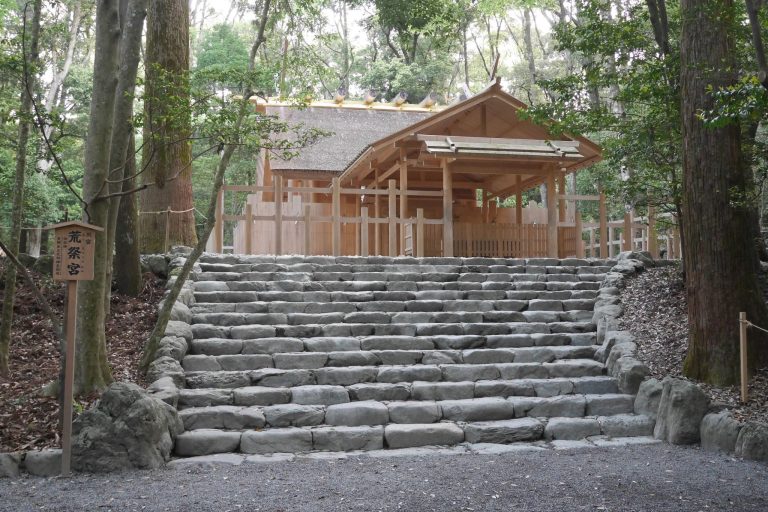
Aramatsuri-no-miya stands approximately 50 meters north of the principal sanctuary. It is dedicated to the aramitama, the vigorous aspect of Amaterasu’s spirit, and receives ceremonies corresponding to those of the principal sanctuary. Kazahinomi-no-miya, approximately 100 meters south of the Kaguraden, is dedicated to the deities of wind and rain.
Outside the main Naikū precinct, Tsukiyomi-no-miya is a four-shrine complex dedicated to Tsukiyomi, his aramitama, and the deities Izanagi and Izanami. Other subordinate shrines include Takihara-no-miya and its companion shrine, both dedicated to spirits of Amaterasu; Izawa-no-miya in Shima, associated with the rice-planting ceremony Otaueshiki; and Yamatohime-no-miya in Ise, dedicated to the legendary founder Yamatohime-no-mikoto.
Gekū and its subordinate shrines
Gekū approaches and ritual buildings
Gekū has eastern and northern approaches, the Daiichi-torii-guchi sandō and Kitamikado-guchi sandō, linked with bridges and ablution facilities. Its Saikan and Anzaisho serve the same purification and imperial-visit functions as their counterparts at Naikū. The Kaguraden stands near the center of the complex and provides a place for prayers, donations, talismans, amulets, and dedicatory scrolls associated with Toyouke.
Gekū principal sanctuary
Toyouke Daijingū, the principal sanctuary of Gekū, is enclosed by four fences, with the first gate forming the approach point. Its buildings are reconstructed in the same architectural tradition as those of Naikū, and the present structures derive from the sixty-second renewal completed in 2013.
Gekū subordinate shrines
Taka-no-miya stands on a small hill approximately 200 meters south of the principal sanctuary. It is dedicated to Toyouke’s aramitama and receives ceremonies corresponding to those performed at the principal sanctuary. Tsuchi-no-miya, approximately 100 meters south, is dedicated to the deity associated with protecting the ground of the Gekū precinct. Kaze-no-miya, approximately 90 meters south, is dedicated to the deities of wind and rain.
A separate Tsukiyomi-no-miya lies approximately 300 meters north of Gekū. It is dedicated to Tsukiyomi and to both the peaceful and vigorous aspects of that deity’s spirit. Other Gekū facilities include the Kitamikadoguchi Torii, an imperial horse stable, the Imibiyaden sacred-fire building, the Misakadono for producing sacred sake, Mikeden for presenting sacred food, Gojoden and Kujoden for ceremonies, and Magatama Pond with a platform for special events.
Sacred forest and ritual production
The shrine forest, called Jingu Miyakirin, extends across roughly 5,400 hectares on the mountains of Kamiji, Shimaji, and Takakura and includes the headwaters of the Isuzu River. The principal sanctuaries stand within protected forest, while other areas are managed for Japanese cypress and water conservation.
The forest once supplied cypress for shrine rebuilding, but timber shortages caused the sacred wood source to move away during the medieval period. Reforestation and forest-management programs begun in the twentieth century seek to restore a local supply, with approximately 20,000 cypress trees planted annually.
Facilities under shrine control supply agricultural and crafted offerings. Rice fields lie at Kusube and Izawa-no-miya, salt is produced at Futami, and vegetables and fruit are grown in the Misono gardens. Facilities in Matsusaka produce sacred silk and hemp textiles, an installation at Toba processes abalone, and dried sea bream is prepared on Shinojima. A pottery workshop in Mino makes plain, unglazed vessels for sacred food, approximately 60,000 each year.
Sacred rice passes through separate sowing, transplanting, and harvesting ceremonies. At Futami, seawater is evaporated into blocks of sacred salt. Sacred sake is prepared at the Misakadono facilities of Naikū and Gekū, including the varieties shiroki, kuroki, and hitoyozake; sumisake is also used but is not distilled at Ise.
The sacred fire is made by rotating a wooden drill against a wooden fireboard, using implements resembling those known from archaeological evidence approximately 1,500 years old. Sacred water is drawn daily from the well of Kamino-mii for preparing offerings. Priests may remain in the Saikan for one or two nights, while certain rites require seclusion of up to five days, with restrictions on movement, speech, food, and contact with the outside world.
Cultural facilities and libraries
Four cultural facilities stand on Mount Kurata between Naikū and Gekū. The Jingū Chōkokan, founded in 1911, presents the shrine’s history, cultural materials, models, and works of art. The Jingū Nōgyōkan focuses on agriculture and industry and holds historical documents and Meiji-period objects.
The Jingū Bijutsukan was built in 1993 in connection with the sixty-first Shikinen Sengū and displays works donated by artists as offerings. The Jingū Bunko library, founded in 1871 through the union of earlier Naikū and Gekū libraries, contains at least 260,000 volumes concerning Shinto and Ise traditions.
The former Hayashizaki Bunko library at Naikū and Toyomiyazaki Bunko at Gekū were founded in 1686 and 1648 respectively. Their surviving buildings are treated as nationally significant monuments. The Jingū Bunko complex also includes Kuromon, a wooden gate built in 1780 as the entrance to the residence of the Edo-period priestly Fukushima Misakidayu family.