Iigaoka Hachimangū: A Historic Provincial Hachiman Shrine in Japan


Site at a Glance
- Rating
- 4.1
- Popularity
- Low
- Country
- Japan
- Primary era
- Medieval
- External website
- Open
- Eras represented
- Medieval, Early Modern
- Civilizations
- Ashikaga shogunate, Yamato
- Site type
- Religious
- Remains
- Sanctuary
On this page17 sections
History
Iigaoka Hachimangū is a historic Hachiman shrine in Japan, traditionally originating in 675 at Yawata in Ichihara, Chiba. Hachiman is a major Japanese deity associated with warfare, protection, and the imperial lineage. The shrine was regarded as the sole Hachiman shrine of the province and later became the provincial sōja, a shrine representing the deities of a province.
Origins and provincial status
A foundation tradition places the legendary imperial prince Yamato Takeru at the site around 110 during his eastern expedition. Shrine personnel are said to have offered him food, whose fragrance he praised. The hill then known as Mikage-yama was traditionally renamed Iigaoka, meaning “Fragrant Rice Hill.” Before acquiring its present name, the shrine was reportedly called Rokusho Mikage Shrine.
The shrine buildings were constructed in 749, and an imperial order of 759 designated the institution as the provincial Hachiman shrine. It conducted the hōjō, or life-release rite, a Buddhist-influenced ceremony in which living creatures were released as an act of religious merit. During the medieval period it became the provincial sōja of Kazusa, a historical province corresponding broadly to central Chiba Prefecture, and was consequently honored as the “Provincial Sōja.”
In 1158 the shrine was identified as the “Ichihara Detached Shrine” of Iwashimizu Hachimangū in Yamashiro Province. From the medieval period onward, it attracted the devotion of the Minamoto, Chiba, Ashikaga, and Tokugawa, successive warrior houses that dominated different periods of Japanese political history.
Imperial and Minamoto patronage
The record of rebuilding and patronage includes work ordered by the imperial court in 879 and 940. Construction was attributed to Minamoto no Yorimitsu in 1008. Minamoto no Yori yoshi donated 1,000 koku of rice in 1064, and construction funded by that gift followed in 1065. In 1091 Minamoto no Yoshiie presented an iron arrow case and two arrowheads.
Chiba Tsunetane repaired the shrine in 1171 while praying for enduring military success and prosperity for his family. In 1180 Minamoto no Yoritomo, founder of the Kamakura shogunate, dedicated a sword, while Adachi Morinaga dedicated the Ichitō estate. In 1189 Yoritomo prayed for victory in his campaign against Fujiwara no Yasuhira and dedicated another sword and a suit of armor through Morinaga.
In 1192 Yoritomo ordered boundary-protection notices to be erected in Fuchū, Goi, Sōja, Ichihara, Kikuma, and Yawata. The following year, while praying for control of the country, he ordered a new sanctuary to be built. The officials connected with the project included Fujiwara no Chikayoshi, Nakahara no Nakazane, Wada Yoshimori, the Ichikawa-clan chief priest Fujiwara no Yoshishige, and the master builder Masahiro.
Kamakura and Muromachi administration
In 1258 the lord of Ichitō Estate donated a sword after a prayer was fulfilled. In 1281 Prince Koreyasu, the shogun, sent offerings through Hōjō Nobutoki and dedicated a sword and bow. During the Mongol invasions, the shrine was ordered to conduct prayers for national peace and military success. Its prayers for the defeat of the Mongols were later commended, and stricter observance of its rites was ordered.
During the early fourteenth century, the Kamakura shogunate appointed a Buddhist cleric as the shrine’s bettō, an administrative head of a religious institution. In 1350 Kō no Moronao, an official of the Muromachi shogunate, appointed Kakuyū of Jizō-in, a senior monk of Daigoji, to the office. Ashikaga Yoshiakira ordered that the appointment be formally delivered, and it was confirmed again in 1351.
Enzō, who had performed the shrine’s yabusame, a mounted archery ritual offered to the deities, became a monk in 1358. Taking the religious name Genmei, he established a small monastic residence within the shrine grounds.
Ashikaga Yoshimitsu ordered a sanctuary in 1369, altered the shrine buildings in 1383, and dedicated four mikoshi, or portable shrines, after a prayer was fulfilled in 1384. He donated the principal grand torii in 1387. The four portable shrines were made in the area below the Hokkedo in Kamakura.
The shrine’s administration and finances also underwent changes. Interference by Ishikawa Saemon-no-jō disrupted administrative affairs and religious rites in 1371. In 1372, responsibility for financing the May festival was assigned to five local districts. Wider provincial and estate obligations were distributed among named districts and administrative territories in 1375.
Ashikaga reconstruction and later medieval changes
Ashikaga Yoshimochi dedicated a sword in 1412. In 1459, 1,000 ryō provided under Ashikaga Yoshimasa enabled repairs to the main sanctuary and construction of the offering hall, worship hall, worship porch, stone altar, and railings. Ashikaga Yoshiaki ordered new shrine buildings in 1460, while his brother Minamoto no Motoyori dedicated a sword in 1465. Yoshiaki also constructed the principal grand torii.
At Yoshiaki’s request, the roof covering was changed from cypress bark to copper sheeting in 1469. Additional construction donations were administered by a local official. The shrine buildings were repaired again in 1547. In 1539 a shrine to Shirahata Gongen was established at the former Oyumi residence, with Iigaoka Hachimangū’s priests providing its offerings. In 1559 Chiba Chikazane, lord of Kikuma Castle and younger brother of Chiba Tomotane, rebuilt and donated the first torii after a prayer was fulfilled.
Warrior rule and Tokugawa patronage
Oda Nobunaga seized the shrine’s sacred rice fields in 1571. Because its endowed territory had already been reduced, shrine officials petitioned the Hōjō authorities in 1576 for permission to obtain contributions from surrounding districts. Permission to establish a new market was granted in 1581 to finance construction, and Yawata was made a protected area exempt from interference by local military authorities.
In 1590 Tokugawa officials investigated the shrine’s history, landholdings, and exemptions, and the shrine submitted written records and maps. The Tokugawa administration also prohibited military disorder in Yawata. In 1591 Tokugawa Ieyasu, founder of the Tokugawa shogunate, endowed the shrine with 150 koku of land and established its festival rank.
Honda Masatsuna dedicated a large sword in 1592 while praying for Ieyasu’s military success. Four affiliated monastic residences, Enzōbō, Jakukōbō, Enjōbō, and Hongakubō, were serving the shrine at that time. Chiba Tomotane donated a suit of armor in 1593, and a shrine building was erected in 1594. Honda Ōkurano-suke served as chief priest and Ōtsuka Sukenosuke as supervising official. Nagai Ukon-daibu reportedly donated 200 bags of warehouse rice in the same year for repairs to the main sanctuary and worship hall.
The shrine was repaired in 1604. From 1616 it held an annual memorial rite for Tokugawa Ieyasu after his posthumous deification as Tōshō Daigongen. Tokugawa Hidetada dedicated an iron war fan in 1617. Between 1623 and 1728, the shrine repeatedly conducted three- or seven-day prayers for national peace and military success in connection with the journeys, appointments, or religious observances of Hidetada, Tokugawa Iemitsu, Tokugawa Ietsuna, and Tokugawa Yoshimune. The four mikoshi dedicated by Yoshimitsu were repaired in 1630.
Repairs, records, and modern status
The large torii was repaired in 1653 with timber selected from a forest at Chibadera in Shimōsa Province. A temple bell was cast in 1655, a hand-washing basin was dedicated in 1662, and Nagai Naoyori donated a framed inscription in 1664. Tanaka Sasuke and Kawaguchi Sukehei dedicated guardian-dog figures in 1686.
Hori Naohiro and Ōkubo Tadanao financed alterations to the offering hall and worship hall in 1691. During the 1694 life-release rite, 1,096 male pigeons were released. The subsidiary Mikage Shrine was rebuilt in 1695, with its railings added in 1697. The shrine’s Record of Origins was compiled in 1697, followed by another account of the shrine in 1760 and a record of annual rituals in 1819. Further repairs took place in 1728, 1835, and 1861.
Four mikoshi, known as the First, Second, Third, and Wakamiya shrines, were newly made in 1845. The lord of Oyumi Castle dedicated a sword in 1860, and in 1868 the chief priest presented a tamagushi, a prayer offering, to Prince Arisugawa Taruhito.
In 1871 the shrine was ranked as a village shrine and surrendered its former 150-koku endowment and related exemptions. It received prefectural support for festival and repair expenses during the 1870s. In 1880, income from the former landholding was used to construct and donate the Yawata Branch of the Chiba Police Station. The shrine was elevated to prefectural shrine status in 1893. Repairs to the worship hall took place in 1891 and 1904, the latter work also involving the offering hall, raised floor, and openwork grilles.
The main sanctuary became an Important Cultural Property of Japan in 1954, and its major repair was completed in 1968. The worship hall received prefectural cultural-property designation in 1966. Tatsumidai Shrine was established in 1968 as an affiliated shrine. Iigaoka Hachimangū is also identified as the former provincial sōja of Kazusa and a former prefectural shrine, and has been selected among the “500 Attractions of Bōsō” and the “100 Chiba Heritage Sites.”
The shrine remains associated with the autumn grand festival held on the fifteenth day of the eighth lunar month. Child-rearing prayers and rites intended to ward off childhood illness are traditionally performed that day, giving the shrine the additional popular name “Child-Rearing Hachiman.” At the Kamitate Festival, traditionally held on the thirtieth day of the ninth lunar month, families with unmarried daughters visit to pray for suitable marriages. Tradition holds that the deities depart for Izumo on that day, where the assembled deities deliberate over marriages and arrange suitable matches.
Remains
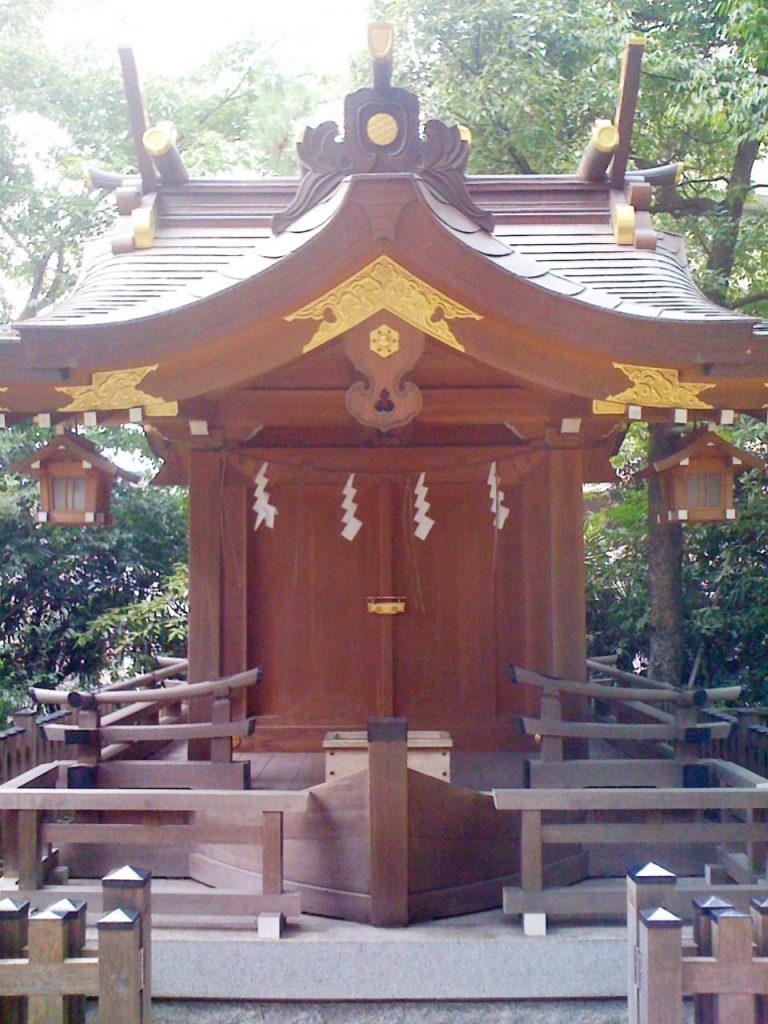
Iigaoka Hachimangū preserves a shrine complex centered on a medieval main sanctuary, with offering and worship halls, a worship porch, a stone altar, sacred railings, large torii gates, the subsidiary Mikage Shrine, ritual furnishings, and the pair of ginkgo trees known as the “married ginkgo trees.” The surviving buildings and objects reflect repeated rebuilding, alteration, and repair from the Muromachi period through the modern era.
Sanctuary complex
Main sanctuary
The main sanctuary is a single-story building with a three-bay front, a two-bay depth, and a three-bay worship porch. Its irimoya roof combines hipped and gabled sections and is covered with copper sheeting. The building is attributed to the middle Muromachi period, approximately 1393 to 1466. Its original cypress-bark roof was replaced with copper sheeting in 1469, and a major repair was completed in 1968. The sanctuary is an Important Cultural Property of Japan.
Offering and worship buildings
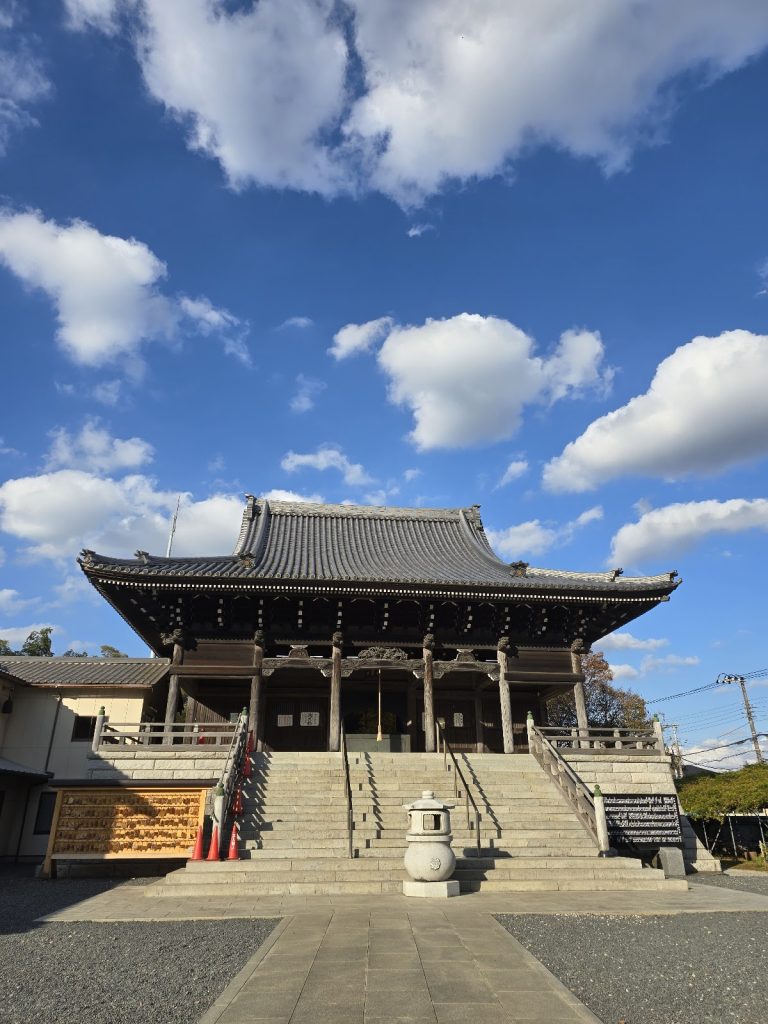
The sanctuary is accompanied by a heiden, or offering hall, a haiden, or worship hall, a worship porch, a stone altar before the sanctuary, and sacred railings. The offering and worship halls were altered in 1691, while repairs to the worship hall’s ceiling took place in 1891. Further work in 1904 repaired the worship hall, offering hall, raised floor, and openwork grilles. The worship hall received prefectural cultural-property designation in 1966.
Torii and Mikage Shrine
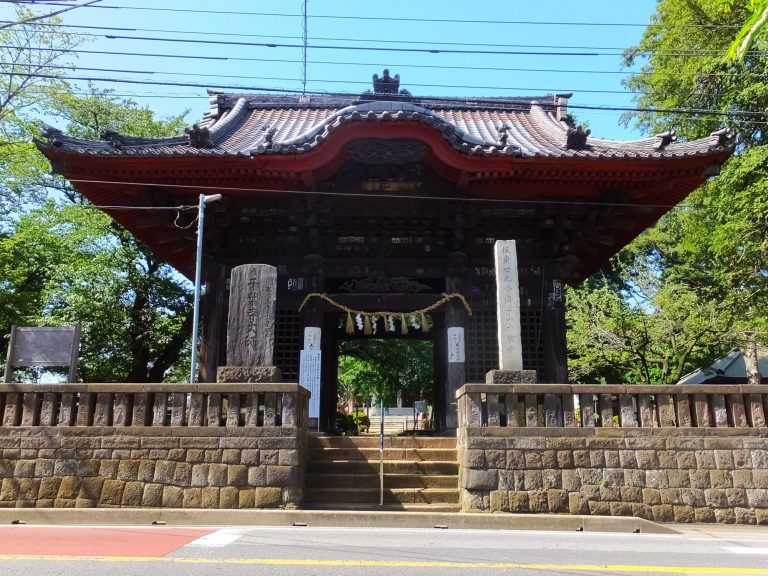
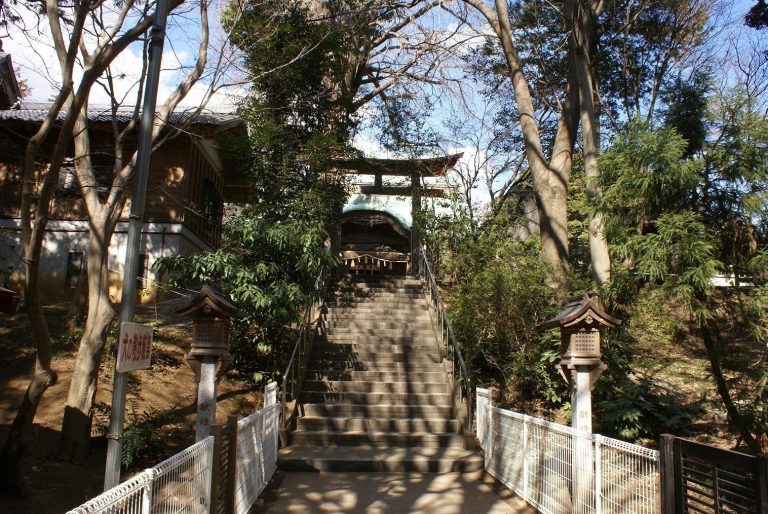
Large torii form part of the shrine’s surviving architectural heritage. Ashikaga Yoshimitsu donated the principal grand torii in 1387, and Ashikaga Yoshiaki constructed another in 1465. The first torii was rebuilt and donated by Chiba Chikazane in 1559, while the large torii underwent repair in 1653 using timber selected from a forest at Chibadera in Shimōsa Province. The subsidiary Mikage Shrine was rebuilt in 1695, with its railings constructed in 1697.
Portable shrines and ritual furnishings
Mikoshi
Four mikoshi dedicated by Ashikaga Yoshimitsu in 1384 formed an important group of portable shrines used in the shrine’s ritual tradition. The First, Second, Third, and Wakamiya mikoshi were newly made in 1845, and a Fifth mikoshi was added in 1902. The First was remade in 1952 and again in 1997, the Wakamiya mikoshi was remade in 1954, and the Second, Third, and Fifth were remade in 1965 by Gotō Naomitsu. The four mikoshi associated with Yoshimitsu were repaired in 1630.
Offerings and furnishings
The shrine’s recorded offerings and ritual furnishings include an iron arrow case, two arrowheads, swords, bows, suits of armor, an iron war fan, a temple bell, a hand-washing basin, a framed inscription, and guardian-dog figures. These objects entered the shrine’s history through donations and religious observances from the eleventh through the seventeenth centuries. The principal deities are Hondawake no Mikoto, Okinaga Tarashihime no Mikoto, Tamayorihime no Mikoto, and seven other deities.
Ginkgo trees
Married ginkgo trees
The grounds include a pair of ginkgo trees traditionally known as the “married ginkgo trees.” The pair received prefectural cultural-property designation in 1935, adding a recognized natural feature to the shrine’s architectural and ritual heritage.