Eigen-ji Temple: Head Temple of the Eigen-ji Rinzai Branch


Site at a Glance
- Rating
- 4.3
- Popularity
- Medium
- Country
- Japan
- Primary era
- Early Modern
- External website
- Open
- Eras represented
- Early Modern, Modern
- Civilizations
- Japanese, Tokugawa
- Site type
- Religious
- Remains
- Monastery
On this page24 sections
History
Eigen-ji Temple is a Buddhist temple in Higashiomi, Japan, founded in 1361 by Sasaki Ujiyori and the Zen master Jakushitsu Genko. It belongs to Rinzai Zen, a Japanese tradition emphasizing disciplined monastic practice, meditation, and direct instruction, and is the head temple of the autonomous Eigen-ji branch. The temple developed from a mountain site patronized by a medieval provincial governor into an institution with a wide network of affiliated temples.
Foundation and medieval prosperity
Sasaki Ujiyori, the shugo, or military governor, of Omi Province, donated the scenic site of Raikei to Jakushitsu Genko, whom he supported. Ujiyori became the temple’s founder-patron, while Jakushitsu served as its founding master. The institution was first called Iitaka-san and was renamed Zuishaku-san during construction. The new name was associated with auspicious traditions concerning stones, including the movement of a huge stone by only a few laborers and the belief that the principal image appeared on a large rock.
The name Eigen-ji combines “Ei,” taken from Ujiyori’s Buddhist name, with “gen,” referring to his descent from the Omi Genji lineage. Jakushitsu’s reputation drew about 2,000 monks to the temple at its height. Fifty-six subsidiary temples occupied the mountainside, creating an extensive monastic community. After Jakushitsu died, four senior disciples continued to maintain the institution.
Eigen-ji also held the status of an imperial prayer temple and prospered under the protection of the imperial court and the Ashikaga shogunal house. During the Onin War, a conflict that devastated Kyoto and weakened the Ashikaga political order, Zen monks including Yokokawa Keizan left Kyoto and took refuge at Eigen-ji.
Destruction and revival
The temple was burned in 1492 and again in 1563. Both fires destroyed the entire complex and were followed by a period of decline. A tradition from Inabe in Mie Prefecture connects the later destruction of a related Eigen-ji across the Suzuka Mountains with troops of Takigawa Kazumasu, a retainer of Oda Nobunaga, during the Eiroku era. According to that tradition, monks carried the temple treasures over Ishigure Pass in a single night to the Eigen-ji in Omi. Eigen-ji’s own records do not mention this episode, while parts of the Mie site’s stone walls are said to remain around rice fields.
Revival began in 1631, when Beppo Shoin, a monk of Myoshin-ji, and his disciple Kuushi Genpu started a restoration movement. Kuushi later became Eigen-ji’s seventy-ninth abbot. In 1643, Emperor Go-Mizunoo ordered the monk Isshi Bunshu to enter the temple. Support from Tofukumon-in and Hikone Domain enabled the buildings to be restored, and Isshi came to be regarded as Eigen-ji’s second founder.
Modern institutional history and religious life
In 1873, under Meiji government policy, Eigen-ji was placed within the Tofuku-ji branch of Rinzai Zen. It became independent as the Eigen-ji branch in 1880. A head temple is the senior institution governing or representing a recognized branch of a Buddhist school. The Eigen-ji branch now administers more than 120 temples and one monastery.
The temple’s principal image is the hidden Yotsugi Kanzeon Bosatsu, a form of Kannon associated with prosperity for descendants. Kannon is a Buddhist bodhisattva associated with compassion, while a hidden sacred image is normally kept from public view and revealed only on designated occasions. The image’s tradition is linked to Rokkaku Mitsutaka’s prayers for a child and the eventual birth of his heir, Rokkaku Mitsutsuna. It is generally shown approximately once every twenty-five years and was last opened in 2016.
Eigen-ji’s recurring observances include the memorial service for Isshi Bunshu on March 19, the three-day Maninko rites for the spirits of the dead from April 1 to 3, and the memorial service for Sasaki Ujiyori on June 7. On July 21, the Ming edition of the Buddhist canon kept in the sutra repository is aired. Jakushitsu Genko’s founder’s memorial takes place on October 1. The temple is formally affiliated with the Rinzai Eigen-ji branch and is also associated with the Eigenji-zakura variety of cultivated cherry.
Remains
Eigen-ji occupies a mountainous setting associated with the Suzuka Mountains. Its surviving complex combines halls for worship and monastic practice with administrative buildings, subsidiary temples, gates, a shrine, a cemetery, and repositories for religious objects and scriptures. Rebuilding from the seventeenth century onward produced the present arrangement, while later repairs and additions preserved the institutional functions of the site.
Principal halls
Main Hall
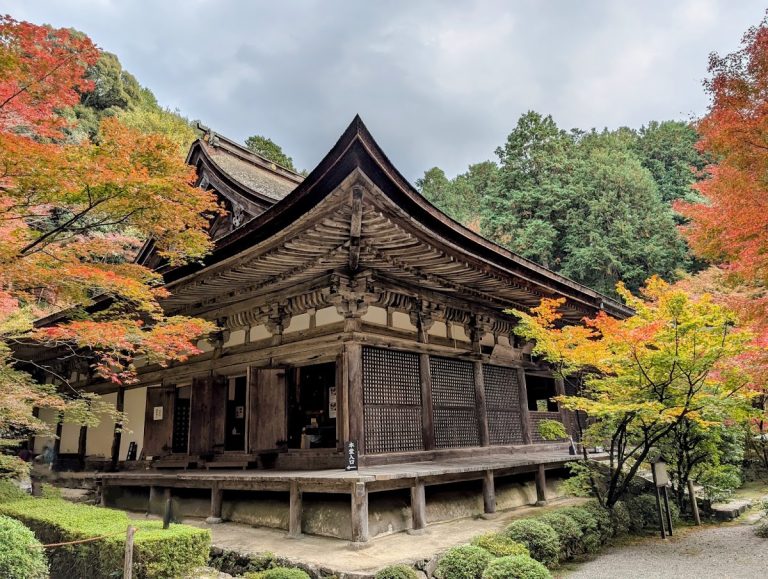
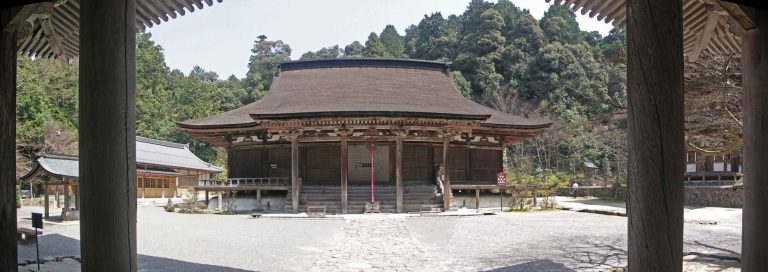
The main hall, known as the Abode of Peace, was rebuilt in 1765. Its roof is thatched with reeds from Lake Biwa and is renewed approximately every ten years. A plaque bearing the name “Zuishaku-san” is attributed to Jakushitsu Genko. A dot added to the stone character is explained as signifying a stone with corners or a split stone, recalling the traditions connected with the temple’s name.
Dharma Hall
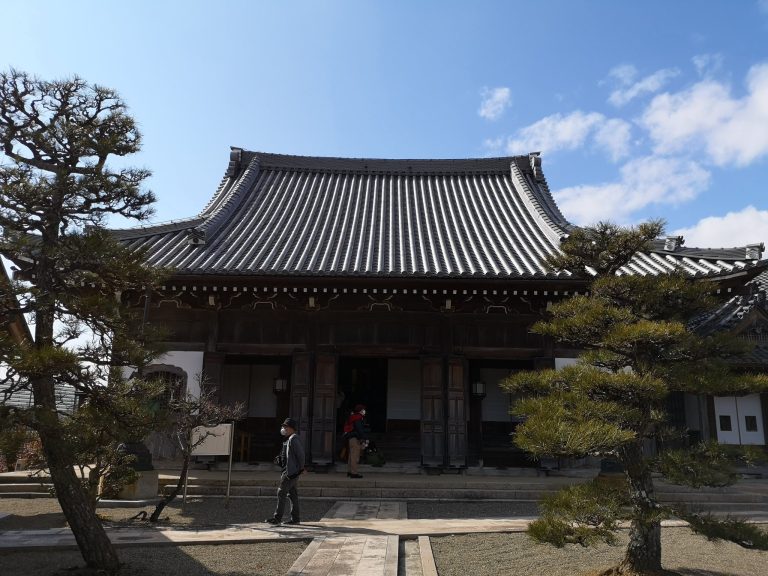
The Dharma Hall, called the Daiyu Hoden, was rebuilt in 1728. Its ceiling carries “Dragon Playing in the Void,” a painting by Brian Williams, an American artist who resides in Otsu.
Founder’s Hall
The Founder’s Hall, or Daijakuto, was rebuilt and remodeled after Hikone-domain lord Ii Naonori donated a Noh stage in 1725. A Noh stage is a platform designed for Japan’s classical masked drama. The hall’s plaque bearing “Daijaku” is attributed to Ingen Ryuki. On October 30, 1908, a princess planted a maple in front of the hall.
Zen Hall
The Zen Hall, called the Mokushudo, was rebuilt in 1933 through numerous donations. One named donor was Kawakami Sadayakko, described as the first Japanese actress.
Supporting buildings and sacred spaces
Kuri and Shoin
The kuri, the temple’s service, administrative, and residential building, was rebuilt in 1980 as a two-story reinforced-concrete structure. It houses the Eigen-ji branch administrative headquarters, a cultural-property storage facility, and a training hall. The shoin is a named reception and study building within the complex.
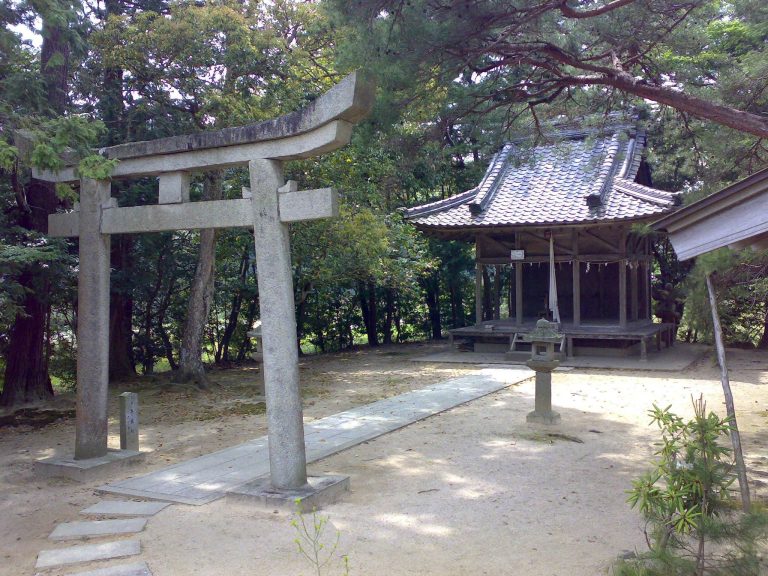
Katsuyama Shrine
Katsuyama Shrine serves as the temple’s guardian shrine and enshrines Nyakuichi Oji. It was built in accordance with Sasaki Ujiyori’s dying instruction.
Ganku-in
Ganku-in is a subsidiary temple within Eigen-ji’s institutional network. Its monks’ hall also serves as the subsidiary temple’s kitchen and residential building, and it was rebuilt in 2015. The Ganku-in garden includes a maple planted by a princess on October 30, 1908. The subsidiary temple also has a front gate.
Hyogetsu-tei and the Columbarium
The Hyogetsu-tei is a guest hall remodeled in 1935. A columbarium, a structure for storing cremated remains, was built in 1971. A cloister was constructed in 2005.
Gates, bell tower, and cemetery
Bell Tower
The bell tower, called the Kageiro, was rebuilt in 1772 and repaired in 2003. Its bell was requisitioned under wartime metal-collection regulations during the Pacific War and recast in 1948.
Gates
The main gate was rebuilt in 1802 and repaired in 1998. The outer gate was rebuilt in 1746.
Ii Family Cemetery
The Ii family cemetery is a designated historic site and contains the grave of Ii Naooki.
Repositories, images, and memorial features
Sutra Repository
The sutra repository, the Biru Hozo, was rebuilt in 1676. It houses a Ming-edition Buddhist canon purchased in China by the monk Nanrei. The collection’s airing on July 21 forms part of the temple’s annual religious observances.
Hidden Image and Founder’s Maple
The tradition surrounding the hidden principal image links it to a small Kannon statue found on a rock near the temple. According to the tradition, Jakushitsu Genko commissioned the sculptor Gotokan to create a larger image incorporating the smaller statue. The founder’s maple is traditionally said to have been planted by Jakushitsu; the present tree is identified as the third generation. The grounds also include a monument to tea whisks.
Paintings, Portraits, and Founder’s Statue
The associated cultural-property collection includes eleven colored paintings on silk depicting Jizo and the Ten Kings, attributed to Lu Xinzhong. The Ten Kings are Buddhist judgment figures associated with the postmortem assessment of the dead. The collection also includes a colored silk portrait of Yakuyo Tokken bearing a self-inscription dated 1319, and a modeled seated statue of Jakushitsu Genko with deposited contents.
The deposited contents of the statue include Buddhist scriptures, spells, praises, devotional names, stamped Buddha images, a bronze sutra cylinder, and documents bearing colophons dated to 1372 and 1374. Other Eigen-ji materials include calligraphic works, letters, a death verse, a final admonition, and a grouped collection of documents commemorating the founder. The Eigen-ji archive comprises thousands of documents, including 8,747 items in the nationally recorded inventory.
Maple and cherry traditions
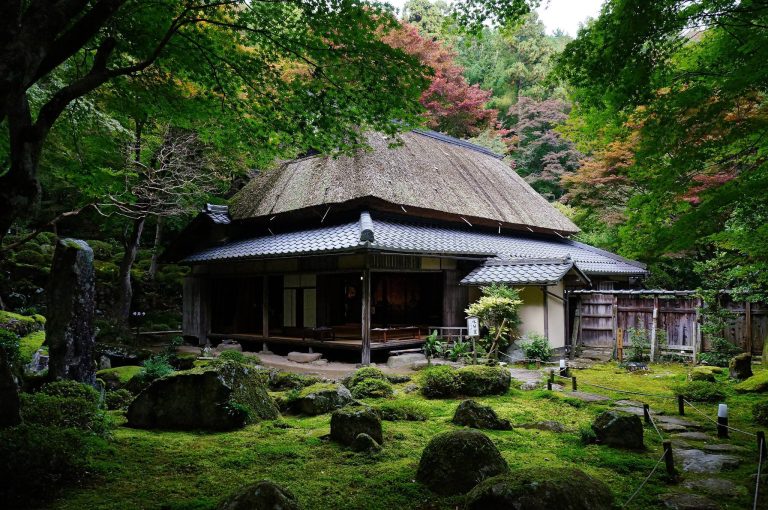
The temple’s mountain grounds are noted for autumn maple foliage. Eigen-ji is also associated with Eigenji-zakura, a cultivated cherry variety that originated from a tree formerly growing within the temple grounds.