Hōrin-ji Temple: An Asuka-Period Buddhist Temple in Japan


Site at a Glance
- Rating
- 4.1
- Popularity
- Low
- Country
- Japan
- Primary era
- Early Modern
- External website
- Open
- Eras represented
- Medieval, Early Modern
- Civilizations
- Tokugawa, Yamato
- Site type
- Religious
- Remains
- Sanctuary
On this page14 sections
History
Foundation in the Asuka Period
Hōrin-ji Temple is a Buddhist temple in Japan, located in Mii, Ikaruga, and associated with the Asuka period and the early development of Buddhism in Japan. The temple belongs to the Shōtoku-shū tradition and venerates Yakushi Nyorai, the Buddha associated with healing, as its principal image. Its formal name is Myōken-san Hōrin-ji, and it is also known as Mii-dera.
The circumstances of its foundation remain uncertain. A tradition recorded in 1238 attributes its establishment in 622 to Prince Yamashiro no Oe, the son of Prince Shōtoku, who founded the temple while praying for his father’s recovery from illness. Another tradition places its construction in 670, after the burning of Hōryū-ji, and credits three people from Baekje. Archaeological evidence places the temple’s existence by the middle of the seventh century, when the Asuka period was drawing to a close.
Excavations revealed roof tiles comparable to those used at the rebuilt Hōryū-ji, together with an older type of tile. Post holes and ditches point to an earlier building beneath or near the later complex. The original temple followed a Hōryū-ji-style arrangement, with the Golden Hall on the east and the pagoda on the west, while its overall plan was about two-thirds the size of Hōryū-ji.
Destruction and Edo-Period Revival
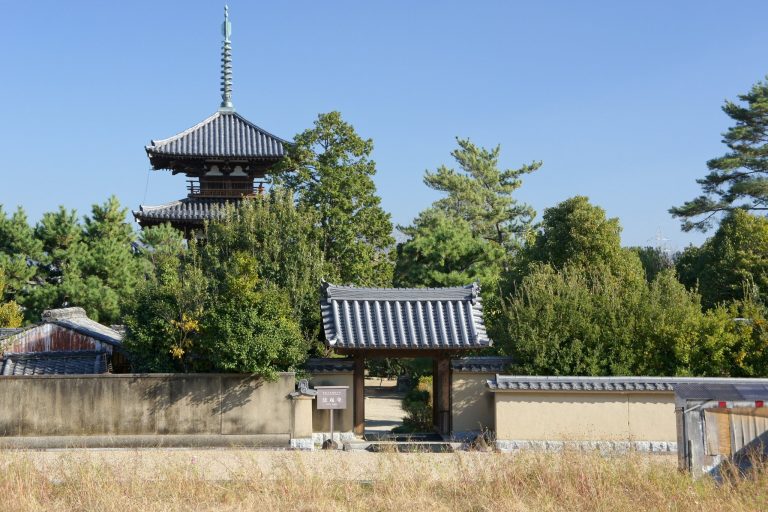
Hōrin-ji burned in 1367, after which its influence declined. By the Edo period, the three-storied pagoda was the complex’s principal surviving building. A typhoon in 1645 brought down the other buildings.
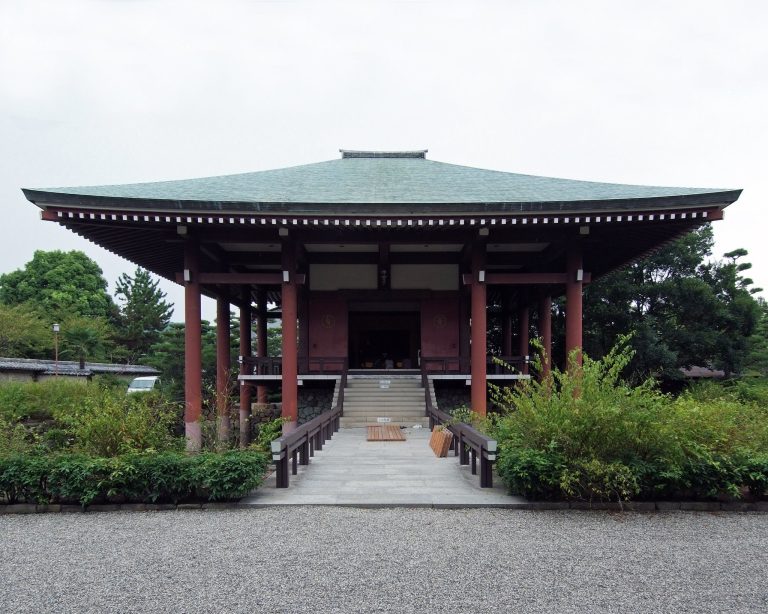
The temple was revived during the Kyōhō era under Hōyū Shōnin, a respected Buddhist teacher who promoted worship of Myōken, an astral deity associated with the Pole Star and the Big Dipper. Restoration of the complex followed. The Myōken Hall was rebuilt in 1731, the three-storied pagoda was repaired in 1760, and the Golden Hall, Lecture Hall, and South Gate were rebuilt in 1761.
Twentieth-Century Loss and Reconstruction
The three-storied pagoda was dismantled and repaired in 1903 after its designation as a National Treasure. On July 21, 1944, lightning struck the building and caused a fire that destroyed it. Its lightning rod had been removed under the wartime metal collection order during the Pacific War.
In 1950, the Buddhist archaeologist Ishida Mosaku excavated Hōrin-ji and clarified the layout of its original complex. The three-storied pagoda was reconstructed in 1975, and the original reliquary rescued from the 1944 fire was placed inside it. Because the existing pagoda is a reconstruction, Hōrin-ji lies outside the UNESCO World Heritage property known as Buddhist Monuments in the Hōryū-ji Area.
The temple stands about one kilometer north of the East Precinct of Hōryū-ji. It is the sixteenth station of the Shōtoku Taishi Sacred Sites pilgrimage and the fifty-third station of the Northern Yamato Eighty-eight Sacred Places pilgrimage. Nearby Mii, within the former temple precinct, is traditionally identified as one of three wells associated with Prince Shōtoku. The surviving well is designated a National Historic Site.
Remains
Temple Layout and Buildings
The surviving complex preserves the arrangement of a seventh-century Buddhist temple through later buildings and archaeological evidence. Its original plan placed the Golden Hall to the east and the three-storied pagoda to the west, following the pattern associated with Hōryū-ji. Post holes and ditches mark an earlier building, while excavated roof tiles include examples comparable to those from the rebuilt Hōryū-ji and an older type.
Pagoda and Halls
Three-Storied Pagoda
The existing three-storied pagoda dates from the 1975 reconstruction. Its original reliquary, saved from the fire of 1944, is housed inside the rebuilt structure. The pagoda’s earlier history includes repairs in 1760 and the dismantling and repair carried out in 1903.
Myōken Hall and Other Buildings
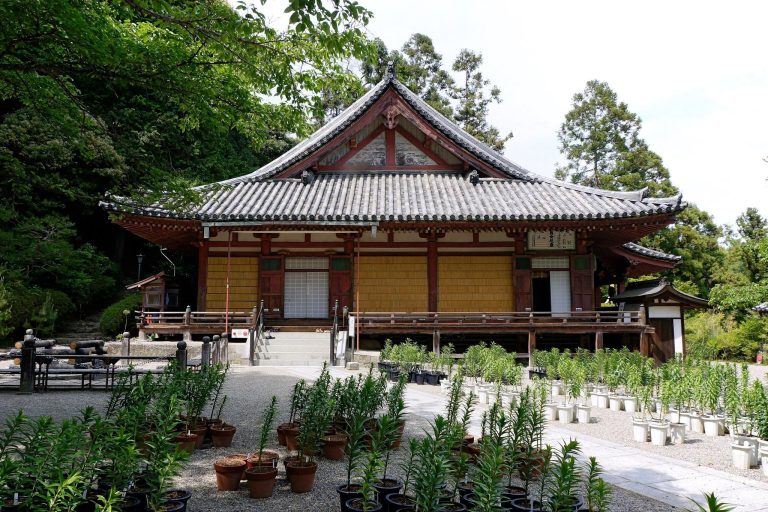
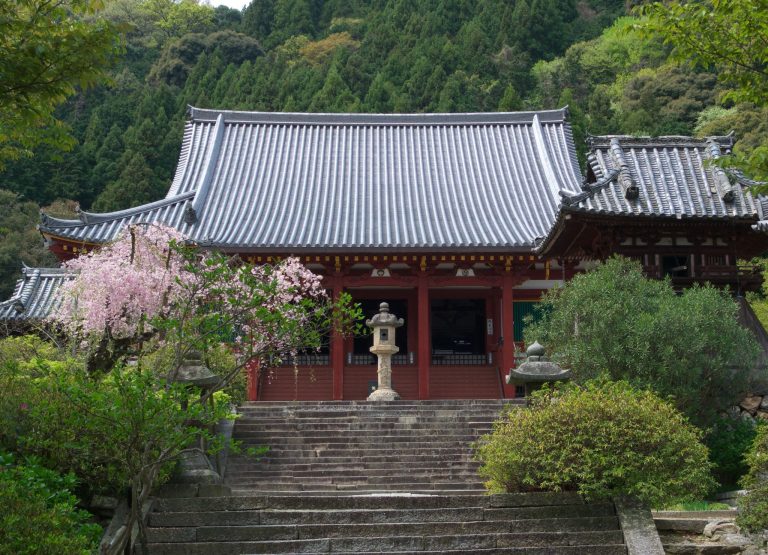
The Myōken Hall was rebuilt in 1731. The Golden Hall, Lecture Hall, and South Gate were rebuilt in 1761. A West Gate is also recognized as a cultural property associated with Hōrin-ji. The Lecture Hall contains a wooden standing statue of Juichimen Kannon, a form of Kannon shown with eleven faces, which rises more than 3.5 meters and serves as the hall’s principal image.
Wooden Buddhist Images
Yakushi Nyorai
The wooden seated statue of Yakushi Nyorai, formerly the principal image of the Golden Hall, is kept in the storage facility. It is a late-Asuka-period work measuring 110.2 centimeters in height and carved mainly from a single block of camphor wood. The principal parts of its head and body come from one piece, while the right side of the body and both legs use additional pieces. Most of the paint has peeled away, revealing the wood. The figure sits cross-legged on a skirted seat, raises the right hand with its palm forward, and rests the left hand palm-up on the lap. Its pedestal is made of hinoki cypress, and its halo was added later.
The statue is generally dated to the later Asuka period, around the second half of the seventh century. Its clothing, elongated face, long neck, and lack of a carved neck crease resemble the Shaka Nyorai in Hōryū-ji’s Golden Hall, while its double-lidded eyes and the loss of the so-called archaic smile distinguish it from that image. A lower garment line crosses the chest, and part of the skirt tie appears beneath it. The robe over the right shoulder is separate from the garment worn with the shoulder exposed, showing that the figure wears two garments.
Kokūzō Bosatsu
The wooden standing image now called Kokūzō Bosatsu is another late-Asuka-period work. It is 175.4 centimeters high and was carved from a single block of camphor wood. Formerly placed in the Golden Hall, it is now kept in the storage facility. The figure stands on a lotus pedestal, extends the right forearm with the palm upward, and lowers the left arm while holding a water pitcher in the left hand.
The carving runs from the main head and body through the lotus flesh and the tenon at the feet. It was not hollowed out, although an internal cavity may reflect the use of partially decayed wood from the beginning. Most of the paint has peeled away. The wrists and hands, topknot, and robe hanging from the left arm are later additions. Although the image is called Kokūzō Bosatsu, its original identity is unknown. The name probably reflects a later belief that Prince Shōtoku was an incarnation of Kokūzō, while the statue may originally have represented Kannon Bosatsu. Its posture and hand positions resemble the Hōryū-ji image commonly called Kudara Kannon, but its larger head, more compact proportions, and asymmetrical robe differ from that work.
Heian-Period Images
The Lecture Hall’s standing Juichimen Kannon dates from the Heian period, which followed the Asuka period and lasted from 794 to 1185. Other Heian-period wooden standing images include Miroku Bosatsu, whose official cultural-property designation identifies it as a standing Shōkanzeon image, as well as Jizō Bosatsu, Kisshōten, and an eleven-headed Kannon.
Associated Objects and the Mii Well
Hōrin-ji’s associated cultural properties include an Asuka-period bronze reliquary from a pagoda core, a Heian-period ritual gong decorated with a Tahōtō design, an Asuka-period rush mat traditionally linked with Empress Suiko, and fragments of an Asuka-period shibi, a decorative roof-end ornament derived from Chinese architectural traditions.
The Mii well lies near the temple within the former precinct. Tradition identifies it as one of three wells connected with Prince Shōtoku, and the surviving well has National Historic Site status.