Dainenbutsu-ji Temple: Head Temple of the Yuzu Nembutsu School


Site at a Glance
- Rating
- 4.3
- Popularity
- Low
- Country
- Japan
- Primary era
- Early Modern
- External website
- Open
- Eras represented
- Early Modern
- Civilizations
- Tokugawa
- Site type
- Religious
On this page9 sections
History
Dainenbutsu-ji Temple in Osaka, Japan, is the head temple of the Yuzu Nembutsu school of Pure Land Buddhism. Founded in 1127 by the Tendai monk Ryōnin under the patronage and prayer of Emperor Toba, it is regarded as Japan’s first Nembutsu practice center. Yuzu Nembutsu is a Pure Land tradition based on the belief that the merit of individual recitation of the Nembutsu can be shared or harmonized among practitioners.
Origins and early development
The institution developed from Shūraku-ji, a Nembutsu center and branch temple established in the private residence of Hirano-dono Sakanoue no Hirono, lord of the Hirano Estate in Sumiyoshi District. Shūraku-ji originally belonged to Shingon Buddhism, a Japanese esoteric school associated with ritual practice and sacred formulas. After Ryōnin visited the temple in 1127, it became affiliated with the Yuzu Nembutsu school under Gongen, Ryōnin’s successor.
After the death of the sixth patriarch, Ryōchin, in 1182, the temple’s influence declined because no suitable successor was available. Yuzu Nembutsu practice continued at other Buddhist institutions, including Seiryō-ji, Hōkongo-in, and Jizō-in.
Revival and establishment at Hirano
In 1321, Hōmyō became the seventh patriarch after a 139-year interval and revived the Dainenbutsu school, also known as the Yuzu Nembutsu school. He began the Manbu Oneri procession, drawing on the welcome-descent procession performed at Taima-dera in Yamato Province. The event represents the Buddha’s welcoming descent, when Buddhist figures receive the dead into the Pure Land.
In 1615, Sueyoshi Yoshiyasu, a local magistrate and member of Hirano’s Seven Notable Families, donated land to the temple. Dainenbutsu-ji had previously lacked a fixed location for its grounds. After the donation, its buildings and religious facilities were established at the present site.
Religious authority and later rebuilding
In 1649, Ōhara Minamibō, a subtemple of Raigō-in at Ōhara and one of the Five Yuzu Nembutsu Branches, claimed that Dainenbutsu-ji was its branch temple. Dainenbutsu-ji brought the dispute before the shogunate’s magistrate responsible for temples and shrines, and won the case in 1661.
The 43rd patriarch, Shunkū, established the temple’s great hall. Between 1688 and 1704, the 46th patriarch, Daitsu, rebuilt several halls and completed the temple’s ritual equipment. In 1703, he changed the school’s name from the Dainenbutsu school to the Yuzu Nembutsu school. Dainenbutsu-ji has remained the school’s head temple, with approximately 350 affiliated temples.
Ritual traditions and protection
The Manbu Oneri takes place each year from May 1 to 5. Twenty-five bodhisattvas, Buddhist figures who seek enlightenment while assisting other beings, walk from the secular world toward the Pure Land represented by the main hall. The procession enacts the world of the Buddha’s welcoming descent and is designated an Osaka City Intangible Folk Cultural Property.
The temple’s principal image, the Eleven-figure Tendetoku Buddha, is also carried to Yuzu Nembutsu temples and to believers’ homes. These visits support ancestral memorial rites and prayers for household safety and physical health. The main hall is a nationally registered tangible cultural property and an Osaka City tangible cultural property, while the main gate, sutra repository, and south gate also have Osaka City protection.
Remains
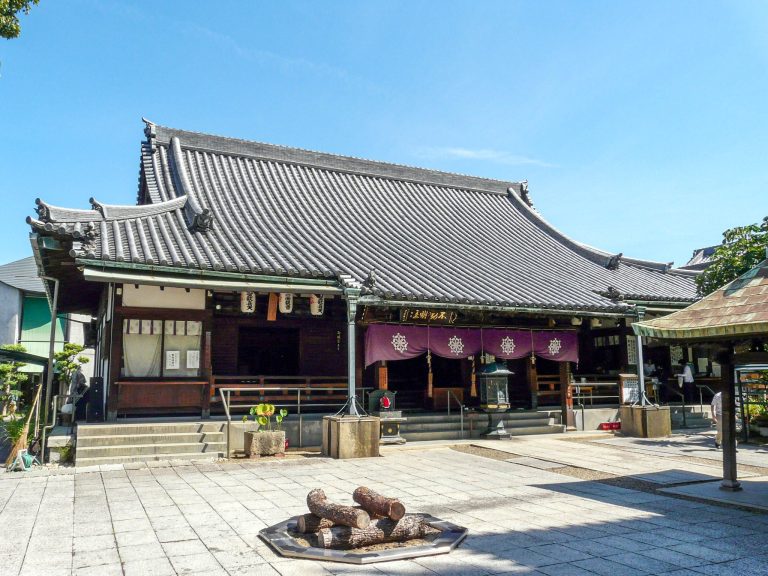
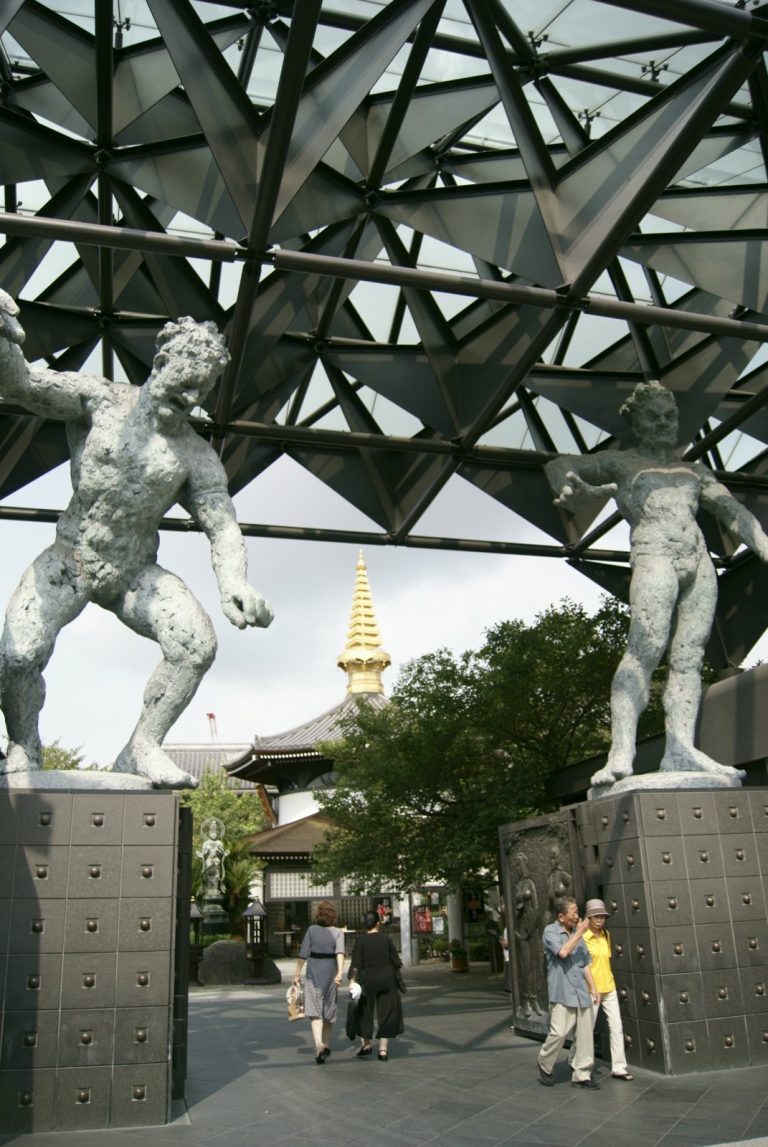
The Dainenbutsu-ji precinct covers approximately 24,000 square metres and contains more than 30 halls and other buildings. Its surviving complex includes the main hall, gates, a sutra repository, the Bishamonten Hall, and other religious facilities. The main hall is the largest wooden building in Osaka Prefecture, giving the precinct a substantial surviving timber structure at its center.
Gates and principal buildings
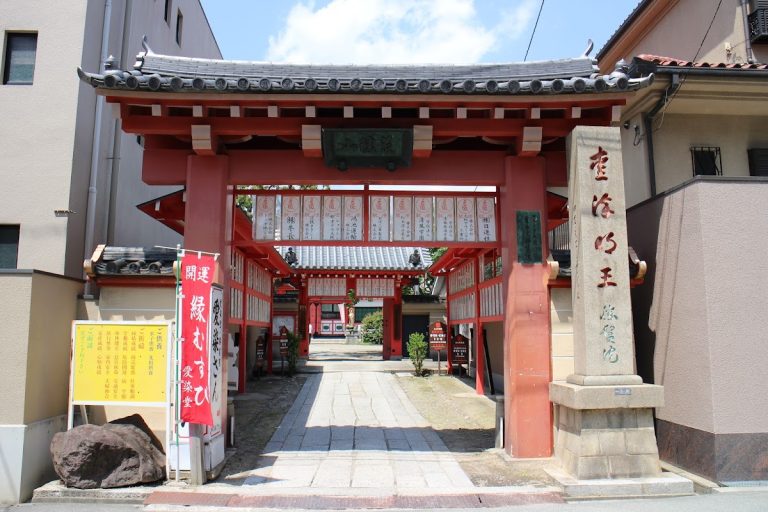
The south gate is an Edo-period gate formerly used as the front gate of Furukawa Jinya. It later served as the main gate of Hirano Elementary School until 1927, before being relocated to Dainenbutsu-ji in 1962. Together with the main gate and sutra repository, it forms part of the temple’s protected architectural fabric. The main hall provides the setting for the Manbu Oneri’s representation of the Pure Land.
Principal image
The Eleven-figure Tendetoku Buddha is a painted image unique to the Yuzu Nembutsu tradition. It shows Amitabha Buddha accompanied by ten bodhisattvas. The image’s circulation between affiliated temples and believers’ homes connects the principal image with ancestral memorial rites, household prayers, and the wider religious network of the school.
Bishamonten Hall sculptures
Bishamonten Hall houses standing images of Shakyamuni Buddha and the Sixteen Arhats, Buddhist practitioners who have attained liberation through practice. The group consists of 17 statues with 24 associated components: 17 pedestals, six halos, and one stupa-shaped tablet. The standing Buddha is 125.7 centimetres high, shows a pronounced influence of the Huangbo style, wears earrings, and holds a fly whisk and a bowl. Each of the 16 Arhat statues is 97 centimetres high.
Inscriptions state that Rakuzan, a Yuzu Nembutsu fundraiser, commissioned the sculptures in 1845. They were made by Imaki Taiuemon, one of the leading Buddhist sculptors in late Edo-period Osaka.