Tsukiyomi-no-Miya (Naikū): A Subsidiary Shrine of Ise Jingu


Site at a Glance
- Rating
- 4.6
- Popularity
- Medium
- Country
- Japan
- Primary era
- Medieval
- External website
- Open
- Eras represented
- Medieval
- Civilizations
- Japanese
- Site type
- Religious
- Remains
- Sanctuary
On this page12 sections
History
Tsukiyomi-no-Miya (Naikū) is a Shinto shrine in Ise, Japan, and a subsidiary shrine of the Inner Shrine, or Naikū, of Ise Jingu. Shinto is Japan’s indigenous religious tradition, centered on reverence for kami, sacred beings or powers associated with deities, ancestors, natural phenomena, and places. The four-sanctuary complex existed by 804 and follows the architectural and ritual traditions of Naikū. It is listed in the Engishiki shrine register and ranks as the highest-ranking subsidiary shrine located outside Naikū’s main precinct.
Early records and the four-shrine complex
The origin of Tsukiyomi-no-Miya is uncertain. The Daijingū Gishikichō of 804, however, records one institution of Tsukiyomi-no-Miya with four main sanctuaries enclosed within a single sacred fence. This indicates that the four-shrine complex was already established by the early ninth century.
In 867, during the reign of Emperor Seiwa, the sanctuaries later known as Izanagi-no-Miya and Izanami-no-Miya received their formal shrine names. The Engishiki, completed in 927, describes the four sanctuaries as two compounds. Izanagi-no-Miya and Izanami-no-Miya stood within one enclosure, while Tsukiyomi-no-Miya and Tsukiyomi-no-Aramitama-no-Miya formed another.
The principal deity is Tsukiyomi-no-Mikoto, a Shinto deity associated with the moon and night and traditionally regarded as a sibling of Amaterasu, the sun deity and principal deity of Ise Jingu. Tsukiyomi-no-Aramitama-no-Miya is dedicated to Tsukiyomi’s aramitama, the vigorous or active aspect of a kami’s spiritual presence. Izanagi-no-Miya and Izanami-no-Miya are dedicated to the primordial deities Izanagi and Izanami, who are traditionally associated with the creation of the Japanese islands and the birth of major kami.
Ritual continuity and modern rebuilding
The four shrines belong to the institutional system of Ise Jingu and conduct rites according to the practices of Naikū. Imperial offerings are made during the Toshigoi, Tsukinamisai, Kannamesai, and Niinamesai festivals. These ceremonies include prayers for imperial longevity, national peace, protection from destructive weather, abundant harvests, and thanksgiving for newly harvested grain.
The annual ritual cycle begins with the New Year Festival on January 1 and the Genshisai on January 3. The Kenkoku Kinen Festival follows on February 11, while the Toshigoi Festival is held on February 18. The Emperor’s Birthday Festival takes place on February 23. The Kazahinomi Festival is held on May 14 and August 4, the Tsukinamisai in June and December, the Kannamesai on October 18–19, and the Niinamesai on November 24. The New Year Festival prays for the unending continuation of the imperial line, while the Genshisai celebrates the beginning of the imperial succession.
From 1873, the four shrines were arranged in their present form, with each sanctuary enclosed by its own sacred fence. Their rebuilding tradition continued with the 62nd shikinen sengū ceremony for Tsukiyomi-no-Miya on October 6, 2014. A shikinen sengū is the periodic rebuilding or ritual relocation of an Ise Jingu sanctuary, during which sacred objects are transferred to a newly prepared building. The ceremony for Tsukiyomi-no-Aramitama-no-Miya took place later that evening, followed by the ceremonies for Izanagi-no-Miya and Izanami-no-Miya on October 10.
Timber from the dismantled Tsukiyomi-no-Aramitama-no-Miya was transferred in 2014 to Yakumo Shrine in Midorimachi, Ashikaga, Tochigi Prefecture. Yakumo Shrine’s main sanctuary had been destroyed by fire in 2012. The precinct also contains Ashihara Shrine, another subsidiary shrine of Naikū, whose deities are regarded as agricultural protectors of fields and crops.
Remains
The complex lies in Nakamura, Ise, in the middle reaches of the Isuzu River, approximately 3.8 kilometers from the Outer Shrine and 1.8 kilometers from Naikū. Four nearly similar, south-facing sanctuary buildings stand in a row from east to west. Their order is Tsukiyomi-no-Aramitama-no-Miya, Tsukiyomi-no-Miya, Izanagi-no-Miya, and Izanami-no-Miya, although worship follows a different sequence: Tsukiyomi-no-Miya, Tsukiyomi-no-Aramitama-no-Miya, Izanagi-no-Miya, and Izanami-no-Miya.
The four main sanctuaries
Tsukiyomi-no-Miya
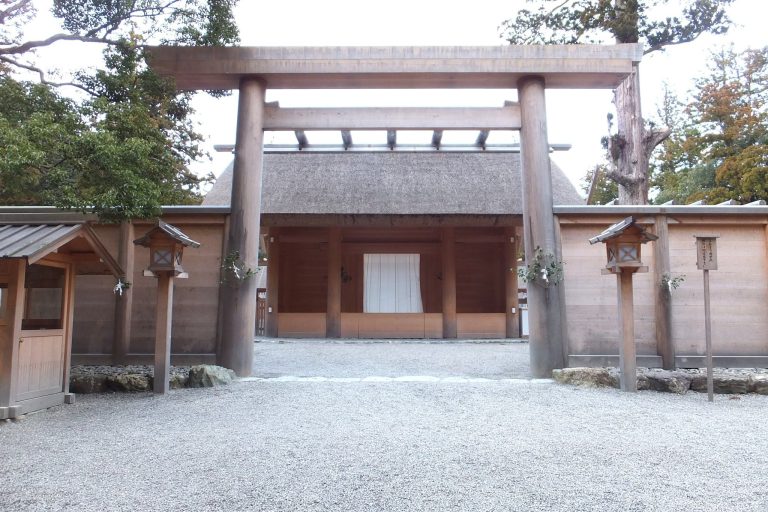
Tsukiyomi-no-Miya is slightly larger than the other three sanctuaries, and its entrance gate is also larger. Like the rest of the complex, it is built in the shinmei-zukuri style, the restrained timber sanctuary form characteristic of Ise Jingu. The style uses raised-floor construction, thatched roofing, and decorative elements derived from ancient granary architecture.
Tsukiyomi-no-Aramitama-no-Miya
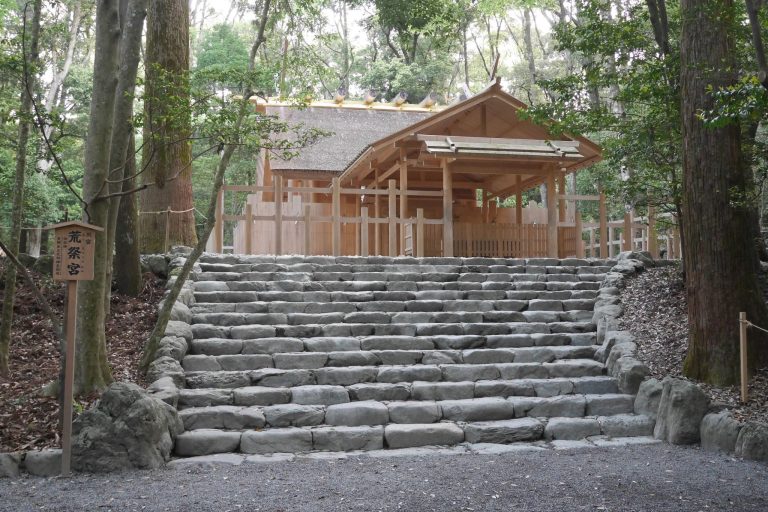
Tsukiyomi-no-Aramitama-no-Miya stands beside Tsukiyomi-no-Miya in the east-to-west sanctuary row. It has a south-facing timber structure, a thatched roof, inward-cut projecting forked finials, and six evenly numbered finials along the ridge beam. Its sanctuary is enclosed by its own sacred fence.
Izanagi-no-Miya
Izanagi-no-Miya is the third sanctuary in the physical row. Its form follows the standards of Naikū, with a south-facing shinmei-zukuri building, a thatched roof, inward-cut forked finials, and six evenly numbered ridge-beam finials. The sanctuary stands within a separate sacred fence.
Izanami-no-Miya
Izanami-no-Miya completes the row on the west. It shares the complex’s south-facing orientation and shinmei-zukuri form, including the thatched roof, inward-cut forked finials, and six ridge-beam finials. The four sanctuaries retain this common form regardless of whether the enshrined deity is regarded as male or female.
The former sanctuary sites used in the cyclical rebuilding arrangement lie to the north and south rather than in the usual adjacent east–west pattern. The four main sanctuaries are smaller than Ise Jingu’s main sanctuary, while their aligned buildings form a unified architectural composition.
Additional precinct buildings
Ashihara Shrine
Ashihara Shrine is an additional subsidiary shrine of Naikū within the precinct. Its agricultural deities are associated with the protection of fields and crops. The sanctuary has a board-covered roof in the shinmei-zukuri style, inward-cut forked finials, and four evenly numbered ridge-beam finials.
Shrine-guard building
The precinct also includes a shrine-guard building. Priests use it to provide amulets and protective talismans and to arrange requests for kagura performances and sacred food offerings.