Hōrai-ji Temple: A Buddhist Mountain Temple in Japan


Site at a Glance
- Rating
- 4.3
- Popularity
- Low
- Country
- Japan
- Primary era
- Early Modern
- External website
- Open
- Eras represented
- Medieval, Early Modern
- Civilizations
- Kamakura shogunate, Tokugawa
- Site type
- Religious
- Remains
- Monastery
On this page11 sections
History
Hōrai-ji Temple is a Buddhist temple in Japan near Shinshiro, Aichi Prefecture, traditionally founded in 702 by the holy ascetic Ryūshū Sennin on Mount Hōrai. It belongs to the Shingon tradition, a major Japanese Buddhist school centered on esoteric rituals, sacred formulas, mandalas, and disciplined practice. Hōrai-ji developed as both a Buddhist institution and a center of popular religious observance on the mountain.
Foundation traditions
Hōrai-ji’s foundation tradition connects its establishment with Emperor Mommu, an early eighth-century ruler of Japan. Ryūshū was summoned to pray for the emperor’s recovery from illness, and after seventeen days of prayer the emperor recovered. He then recognized the religious center and permitted the temple to be established. Tradition also holds that Ryūshū carved the principal image and related Buddhist figures from a sacred cedar on Mount Hōrai.
A separate story says that Ryūshū reached the imperial court riding a phoenix. This account is linked to the names Hōrai-ji and Mount Hōrai. The temple’s principal object of worship is Yakushi Nyōrai, the Buddha of healing and medicine. The foundation traditions also associate the site with Nikkō Bosatsu and Gakkō Bosatsu, attendants of Yakushi Nyōrai, as well as the Twelve Heavenly Generals, the Four Heavenly Kings, and other Buddhist deities.
Medieval development
Hōrai-ji was traditionally rebuilt during the Kamakura period by Minamoto no Yoritomo, founder and first shogun of Japan’s Kamakura shogunate. The tradition says that Yoritomo acted out of gratitude after receiving shelter at the temple during the Heiji Rebellion, a twelfth-century conflict that reshaped the balance of military power in Japan. The account that he remained there for three years is considered questionable, although the long stone approach of 1,425 steps is also attributed to him.
Adachi Morinaga, a Kamakura-period military retainer associated with Mikawa, is credited with constructing one of the temple’s chapels. Another tradition identifies Hōrai-ji’s Mida-do as one of the Seven Halls of Mikawa attributed to his foundation activity. Fires during the Kamakura and Muromachi periods destroyed much of the temple’s written documentation, but the site continued to function as an important center of Buddhism and popular religious practice into the Sengoku period, the era of civil warfare among competing military powers.
From Sengoku patronage to Tokugawa support
During the Sengoku period, the nearby Suganuma warrior clan donated estates to Hōrai-ji. Toyotomi Hideyoshi, the late-sixteenth-century military ruler of Japan, later confiscated most of those holdings. The temple was left with a kokudaka of 300 koku, an assessment of agricultural production used to measure rice-based land income, and its fortunes declined rapidly.
Hōrai-ji recovered under the Tokugawa shogunate. Its holdings rose to 850 koku, and during the rule of Tokugawa Iemitsu its revenues, including the operating estate of the Tōshō-gū, ultimately reached 1,350 koku. This renewed support was associated with the tradition that Odai no Kata, the mother of Tokugawa Ieyasu, had stayed and prayed on Mount Hōrai before his birth.
Under Iemitsu, the Hōraisan Tōshō-gū was constructed and completed in 1651. Until the Meiji period, its ceremonies were conducted by Hōrai-ji’s Buddhist monks and administrators. Hōrai-ji was affiliated with both the Shingon and Tendai traditions, the latter being another major Japanese Buddhist school with a broad range of teachings and practices. The temple attracted pilgrims and travelers, including those using the Tōkaidō route. The road from Goyu-shuku became known as the Hōrai-ji Road.
Decline, reorganization, and rebuilding
An Edo-period record lists numerous monastic residences within the temple complex. Repeated fires and financial hardship in the late nineteenth and early twentieth centuries reduced this group to the buildings of Matsukō-in and Iō-in, together with a surviving gate at Matsukō-in. Memorial stones mark the locations of residences that disappeared.
The Meiji separation of Buddhism and Shinto divided the Hōraisan Tōshō-gū from Hōrai-ji and severely weakened the temple. The loss of its estates and the opening of the Tōkaidō Main Line also reduced pilgrimage, while much of Mount Hōrai became national forest. In 1905, Hōrai-ji became a subsidiary of Hōrin-ji in Kyoto. On November 2, 1906, its parallel Tendai and Shingon affiliations were consolidated into Shingon, and administration passed to the Kōyasan branch under Kongōbu-ji on Mount Kōya. Reducing the temple’s scale was adopted as a way to preserve the institution.
Abbot Hattori Kensei, sent from Hōrin-ji under Kongōbu-ji’s authority, led the rebuilding effort in the early twentieth century. His campaign to recover former temple lands resulted in the paid transfer of part of the national forest to Hōrai-ji. Surplus funds from that transaction supported the construction of the Hōrai-ji and Taguchi railways and the establishment of Hōrai-ji Girls’ School, rather than being devoted entirely to rebuilding temple halls. The main hall burned in 1914 and was reconstructed in 1974.
Hōrai-ji’s religious role changed over time from a sacred mountain associated with a particular high-status social group to a popular religious center focused on worship of Yakushi Nyōrai. The temple is also the seventh site on the Mikawa Quasi-Shikoku Eighty-eight-temple pilgrimage, a regional circuit modeled on the eighty-eight-temple pilgrimage of Shikoku. Mount Hōrai has been designated a Place of Scenic Beauty and a Natural Monument since 1931, while the Niōmon gate received designation as an Important Cultural Property of Japan in 1953.
Remains
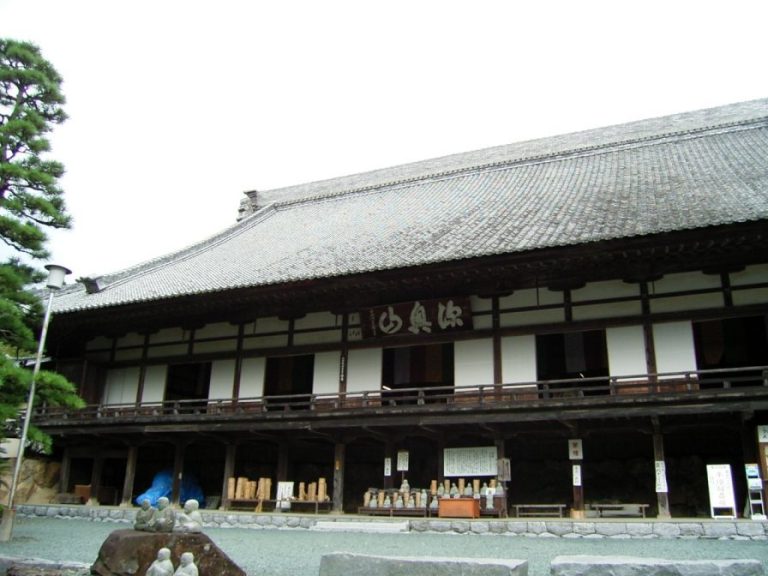
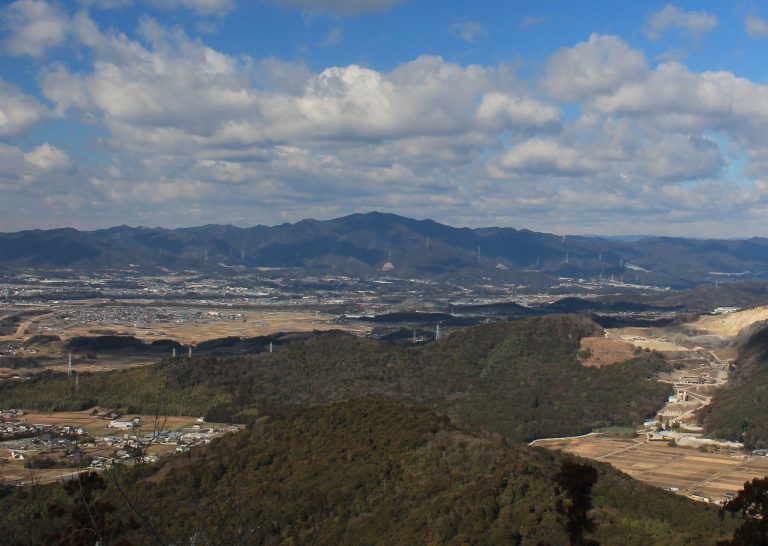
Hōrai-ji stands near the summit of 695-metre Mount Hōrai. The approach climbs 1,425 stone steps toward a complex that includes the reconstructed main hall, the Niōmon gate, a bell tower, the inner sanctuary known as the Okuno-in, the small Ko-dō hall, and surviving buildings from the former monastic residences. Mount Hōrai also supports a population of Eurasian scops owls, the prefectural bird of Aichi.
Mountain sanctuary and archaeological deposits
The principal image at Hōrai-ji is a statue of Yakushi Nyōrai, traditionally attributed to Ryūshū Sennin. The same foundation tradition links the mountain sanctuary with figures of Nikkō Bosatsu, Gakkō Bosatsu, the Twelve Heavenly Generals, the Four Heavenly Kings, and other deities carved from cedar.
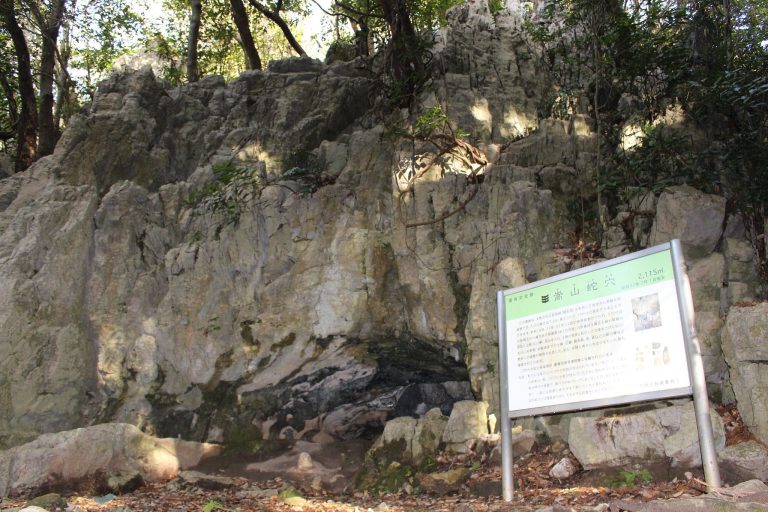
Excavations beneath Kagami-iwa, or Mirror Rock, recovered 194 pottery objects. The group included one ash-glazed ceramic bowl, 44 pieces from the Atsumi kilns, 23 from the Seto kilns, and 11 from the Tokoname kilns, with the remaining objects belonging to other categories. The archaeological sequence beneath the rock places the construction of a sutra mound, a deliberate religious deposit for scriptures or scripture-related objects, between the latter half of the twelfth century and the beginning of the thirteenth century.
From the thirteenth century onward, the area beneath Mirror Rock served as a medieval cemetery. Atsumi, Old Seto, and Tokoname vessels were used as funerary containers, and some burials contained bone fragments without such containers. Mirrors began to be placed in the rock face during the Muromachi period, with deposition reaching its highest level during the Edo period.
Historic buildings
Niōmon gate
The Niōmon, also called the Sanmon, is a two-story gate associated with the paired guardian figures known as Niō. Rebuilt in 1651 as a donation from Tokugawa Iemitsu, it is a three-bay, single-passage structure with an irimoya roof, a form combining a gabled upper section with hipped lower slopes. The roof was originally covered with cypress bark and is now clad in copper shingles.
The central bay provides the passage, while the two forward side bays contain the Niō statues. The gate is made of zelkova wood and painted vermilion. Its decoration includes bamboo and tiger on the front, peony and lion on the rear, waves and rhinoceros on the east side, and clouds and kirin on the west side. A major repair took place in 1988.
Main hall
The present main hall was reconstructed in 1974. It continues the role of the hall destroyed by fire in 1914 and forms part of the surviving temple complex near the summit of Mount Hōrai.
Other surviving structures
Other surviving elements include the bell tower, the Okuno-in inner sanctuary, and the Ko-dō hall. Matsukō-in and Iō-in preserve buildings from the former monastic complex, while a gate remains at Matsukō-in. Memorial stones identify the locations of additional residences that once stood within the wider complex.