Nishikawa Castle: A Saigo Clan Branch Castle in Japan

Site at a Glance
- Rating
- 4.4
- Popularity
- Very Low
- Country
- Japan
- Primary era
- Medieval
- Eras represented
- Medieval
- Civilizations
- Unclassified
- Site type
- Military
- Remains
- Castle
On this page8 sections
History
Saigo power in Mikawa
Nishikawa Castle is a former branch castle of the Saigo clan in Toyohashi, Japan, built in the Mikawa region during the Sengoku period, an era of prolonged warfare and political fragmentation among competing warrior houses. Saigo Kiyokazu probably constructed it between 1532 and 1555, during the Tenbun Period. The castle served as an outpost and rallying point, while Wachigaya Castle remained the Saigo family’s principal residence and headquarters.
The Saigo family’s position changed after forces led by Matsudaira Kiyoyasu stormed Yamanaka Castle in 1526. Following four generations of conflict with the Matsudaira, the Saigo surrendered control of northern Mikawa and became their loyal vassals. Nishikawa was probably intended to confront incursions by the Oda, Takeda, and other rival clans. The Mikawa Chorography, completed in 1740, instead states that the castle was built to face the neighboring Makino clan around present-day Toyokawa.
The name Nishikawa means “west river.” It was apparently created as an expression of loyalty to the Imagawa clan, the dominant ally of the Matsudaira, by combining the first character of Saigo with the second character of Imagawa. Despite their proximity, the Saigo and Makino clans never fought openly. Their shared allegiance to the Matsudaira, participation in campaigns led by Tokugawa Ieyasu, and pressure from outside enemies may have maintained an uneasy peace.
A forward post during the Sengoku period
Nishikawa Castle was never attacked, but it operated as a forward command post and staging point. In 1571, Takeda forces led by Akiyama Nobutomo invaded the area. Saigo Yoshikatsu and troops from Nishikawa drove them back at the Battle of Takehiro.
In 1575, Saigo troops assembled at Nishikawa before joining the combined Oda-Tokugawa army at the Battle of Nagashino. The battle took place during Takeda Katsuyori’s siege of Nagashino Castle. A Saigo family tradition also holds that Torii Suneemon, an ashigaru foot soldier, rested briefly at Nishikawa while carrying news to Tokugawa Ieyasu at Okazaki Castle. This episode has not been corroborated elsewhere.
Transfer and abandonment
After the Siege of Odawara in 1590, Toyotomi Hideyoshi transferred the newly acquired Kantō region to Tokugawa Ieyasu in exchange for five of Ieyasu’s domains, including Mikawa. Hideyoshi was the military leader who unified much of Japan before Ieyasu’s final consolidation of power. The Saigo accompanied Ieyasu eastward, and Saigo Iekazu, Kiyokazu’s son and lord of Nishikawa Castle, was ordered to move to Oyumi Castle in Shimōsa Province.
Custody of Nishikawa Castle and its surrounding lands then passed from the Saigo to the Ogasawara clan. As Mikawa became surrounded by vassals linked to the Toyotomi, Nishikawa lost its priority as a military installation. In 1661, Ogasawara Naga’aki, who administered the region, was promoted to lord of Yoshida Castle. Nishikawa was abandoned afterward, and local peasants probably removed stone and timber from the site for building materials.
Lady Saigo
Tozuka Masako was born at Nishikawa Castle in 1562. Her mother was Saigo Kiyokazu’s elder sister, and Kiyokazu later adopted Masako. She spent her childhood at the castle and became known as Lady Saigo, or Saigo-no-Tsubone, as well as by the nickname Oai.
Lady Saigo became Tokugawa Ieyasu’s first consort and bore him two sons, Tokugawa Hidetada and Matsudaira Tadayoshi. She died at Sunpu Castle on July 1, 1589, aged 37. The cause of her death was never established. Poisoning was suspected, but no culprit was identified.
Remains
Hilltop layout and defenses
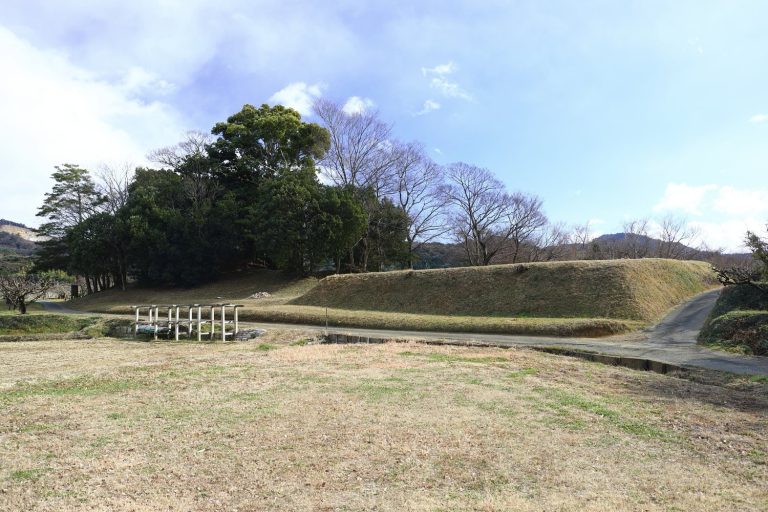
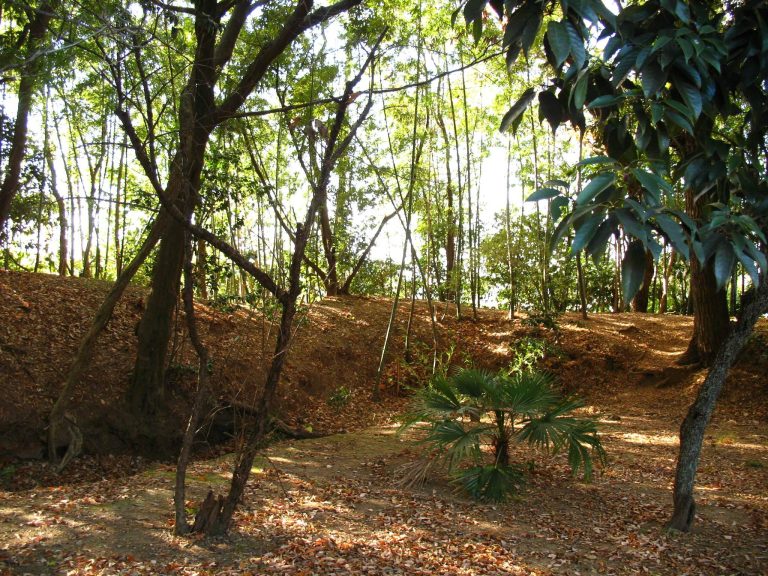
Nishikawa Castle occupied a modified natural hill rising from relatively level land. The summit was levelled to create the main courtyard, or hon-kuruwa, approximately 20 metres above ground level. Earthen ramparts encircled this courtyard, while a dry moat was cut around the hill. A sloping path followed the hillside and connected the summit with ground level.
The keep stood on the summit above smaller satellite courtyards. One of these occupied a terraced section of the hill, while others lay at ground level. No original buildings survive, but the dry moat, earthen ramparts, and an earthen foundation for a yagura, a fortified turret used for observation, defense, or storage, remain discernible.
Surviving summit landscape
The present site is dominated by the levelled hilltop courtyard where the keep once stood. Part of the summit is covered by a naturally growing stand of Japanese cedar, and the remainder is occupied by a cultivated chestnut orchard. The site is also locally known for abundant dogtooth violets, identified as Erythronium japonicum.
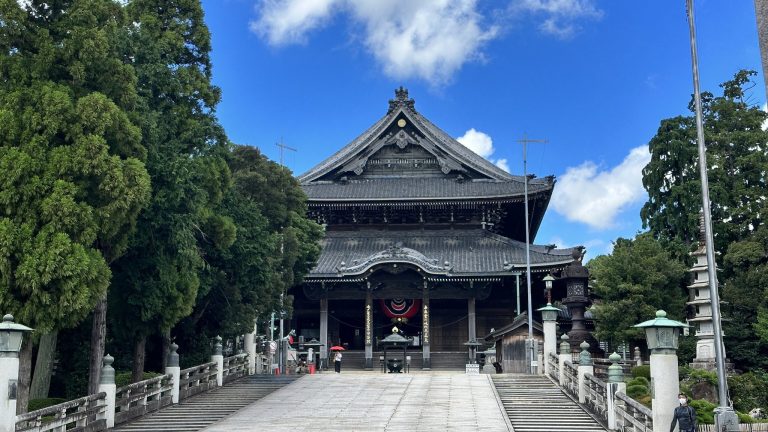
Daifuku Temple stands beside the castle site. A grass-covered path begins near the temple and leads around the hill toward the main courtyard, following part of the surviving physical setting of the former castle.