Egara Tenjinsha Shrine: A Shinto Shrine of Scholarship and Kamakura’s Warrior Government


Site at a Glance
- Rating
- 4.3
- Popularity
- Medium
- Country
- Japan
- Primary era
- Early Modern
- External website
- Open
- Eras represented
- Early Modern
- Civilizations
- Tokugawa
- Site type
- Religious
- Remains
- Sanctuary
On this page13 sections
History
Egara Tenjinsha Shrine is a Shinto shrine in Kamakura, Japan, dedicated to Sugawara no Michizane and traditionally founded in 1104. Michizane was a renowned scholar and statesman who was exiled from the capital and later deified as Tenjin, a sacred figure associated with learning, scholarship, and calligraphy. According to shrine tradition, a black image of Tenjin in court robes descended during a sudden storm on August 25. Local residents built a shrine at the place where it appeared, enshrined the image, and planted a ginkgo tree to mark the sacred spot.
Origins and the Kamakura shogunate
The shrine was formerly known as Egara-yama Tenmangu. The name Egara is thought to derive from the earlier place-name Egaya, which appears in an AD 735 tax register and in the Wamyō Ruijushō. From the early Kamakura period, Egara became closely connected with the Kamakura shogunate, Japan’s medieval warrior government established under Minamoto no Yoritomo.
After Yoritomo established his residence at Okura in 1180, Egara lay to its northeast. In traditional Japanese geomancy, the northeast was viewed as an inauspicious gateway through which harmful influences could enter. The shrine was therefore revered as a guardian of that direction and received a newly built shrine building. It subsequently became one of the shogunate’s principal objects of devotion, alongside Tsurugaoka Hachimangu.
The Azuma Kagami first records the shrine on September 11, 1202. On that occasion, the second Kamakura shogun, Minamoto no Yoriie, sent Oe no Hiromoto as an envoy to conduct a three-hundredth-anniversary memorial service for Michizane. The shrine also figured in an episode involving poetry and political danger in 1213.
That year, Shibukawa Kanemori was arrested for allegedly supporting the rebellion of Izumi Chikahira. While protesting his innocence, he presented ten waka poems to Egara. Their quality attracted the attention of the third shogun, Minamoto no Sanetomo, who pardoned Kanemori. The episode came to be interpreted as an example of the shrine’s divine efficacy and the power of poetry.
Patronage and rebuilding
During the Muromachi period, the shrine received the protection of the Ashikaga family of the Kamakura government. It was later patronized by the Go-Hojo family, Toyotomi Hideyoshi, and Tokugawa Ieyasu. In 1548, Hojo Ujiyasu, lord of Odawara Castle, established a toll station on the Kanazawa Road. Revenue from travelers and pack animals was used to finance construction of the shrine buildings.
Construction work at both Tsurugaoka Hachimangu and Egara Tenjin Shrine was ordered in 1590. The following year, Tokugawa Ieyasu donated land in the Kamakura area of Kosaka District, valued at 19 kan and 200 mon, to support repairs. In 1622, while Tokugawa Hidetada rebuilt Tsurugaoka Hachimangu, the former main building of its Wakamiya shrine was transferred to Egara. With assistance from the shogunate, Egara was thereafter repaired together with Tsurugaoka Hachimangu, generally every thirty to forty years, using old and surplus timber from that complex.
Religious administration and modern recognition
From the middle of the Edo period, Ichijoin of the Tō-ji school administered Egara as its betto, an official who supervised a religious institution. This arrangement belonged to the interconnected Buddhist and Shinto religious system of the time. The Meiji-era separation of Shinto and Buddhism ended it, and the shrine was classified as a village shrine.
Egara’s precinct preserves a religious environment associated with warrior-class devotion and is designated as a national historic site. It also became a component property of the Japan Heritage designation in 2016. The chief priest of Tsurugaoka Hachimangu serves as chief priest of Egara as well. In March 2024, Egara announced its withdrawal from the Association of Shinto Shrines, following Tsurugaoka Hachimangu; Shirahata Shrine in Kamakura also announced its withdrawal.
The shrine’s annual religious cycle includes New Year and seasonal rites, the First Tenjin Festival, needle memorial rites, a mikoshi procession through Nikaido, the annual grand festival, and ceremonies connected with writing brushes. A mikoshi is a portable shrine carried in a festival procession. The brush observances express Egara’s enduring association with scholarship, calligraphy, and intellectual pursuits.
Remains
Egara Tenjinsha Shrine occupies a small plateau about 300 meters beyond the entrance to its approach, east of Tsurugaoka Hachimangu. The approach connects with the Kanazawa Road, which links Kamakura with Mutsu in Kanazawa Ward, Yokohama. The precinct is an artificially levelled area approximately 55 meters from east to west and 50 meters from north to south, standing about 7 meters above its surroundings. A steep, artificially cut cliff rises behind the buildings, while ridge-like extensions project on both sides. The shaping of this ground has been compared with the formation of the site of Tsurugaoka Hachimangu’s Upper Shrine.
Sanctuary buildings
Main sanctuary
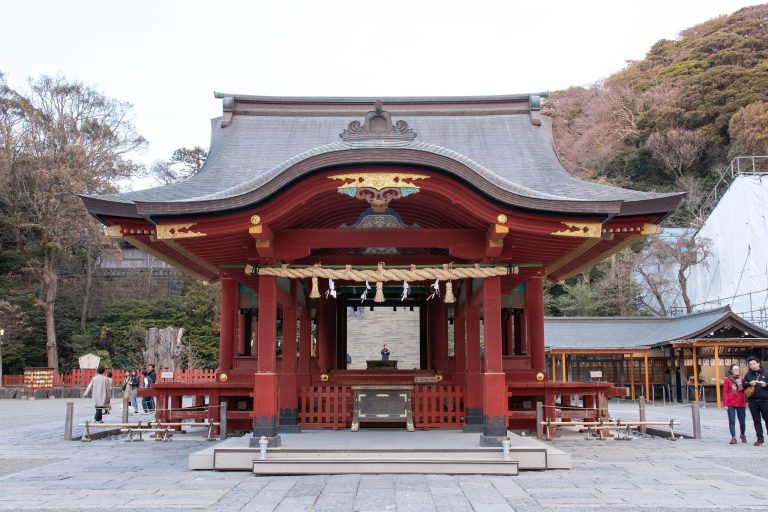
The honden, or main sanctuary, is a three-bay nagare-zukuri building with a copper-sheet roof. A bay is the structural span between supporting posts. The nagare-zukuri style has a gabled roof whose front slope extends forward to form a covered entrance. The building originally served as the main hall of Tsurugaoka Hachimangu’s Wakamiya shrine before being transferred to Egara in 1622. It is an Important Cultural Property, and its national designation dates from 2005.
Worship and offering halls
The haiden, or worship hall, and the heiden, or offering hall, were damaged in the Great Kanto Earthquake of 1923. They were rebuilt in 1936 during repairs to the honden. The worship hall and main sanctuary are painted the traditional vermilion color. Other structures within the precinct include a purification pavilion, a shrine office, a repository for old talismans, and a storehouse for the mikoshi.
Brush monuments and sacred tree
Kappa Brush Mound
The Kappa Brush Mound contains the drawing brush used by manga artist Shimizu Kon, who deposited it in gratitude for his spiritual association with Kamakura. Shimizu created the large image of a kappa carrying a brush on the front of the mound. The back bears the inscription “Kappa Brush Mound” by novelist Kawabata Yasunari.
Picture-Brush Mound
The Picture-Brush Mound is a bronze monument erected by manga artists including Yokoyama Ryuichi. It carries kappa reliefs made by 154 manga artists. The monument measures 3.2 meters in height and 1 meter in diameter, and weighs 800 kilograms. Together with the brush ceremonies, it connects the precinct’s material landscape with the shrine’s longstanding association with writing and artistic practice.
Sacred ginkgo
A large ginkgo tree in the precinct is estimated to be about 900 years old. Shrine tradition identifies it as the tree planted where the image of Tenjin descended, so that the sacred spot would not be trampled. The tree has municipal cultural-property designation, while the shrine precinct and its associated cultural materials have also received cultural-property recognition.
Hillside chambers
Two horizontally cut cave chambers, known as yagura, are set into the hillside on the right when facing the honden. A yagura is a rock-cut cave or chamber commonly found in the hills around medieval Kamakura and often associated with burial or memorial use. The two chambers are connected internally, but entry is prohibited. Until the Showa period, this area also contained the entrance to the Ten-en hiking route.