Hōkō-ji Temple: Head Temple of a Rinzai Buddhist Branch in Japan


Site at a Glance
- Rating
- 4.4
- Popularity
- Low
- Country
- Japan
- Primary era
- Medieval
- External website
- Open
- Eras represented
- Medieval
- Civilizations
- Ashikaga shogunate
- Site type
- Religious
- Remains
- Monastery
On this page7 sections
History
Hōkō-ji Temple is a Rinzai Buddhist temple in Hamamatsu, Japan, founded in the fourteenth century by Okuyama Tomofuji, a member of the powerful Ii family of Tōtomi. Rinzai is a major Japanese school of Zen Buddhism that emphasizes disciplined monastic practice and meditation. The temple’s principal image is Shaka Nyorai, the Japanese Buddhist name for Shakyamuni Buddha, and Hōkō-ji serves as the head temple of its own Rinzai branch.
Foundation and early history
Okuyama Tomofuji founded Hōkō-ji in 1371 as a follower of Mumon Gensen, although another tradition gives 1384 as the foundation date. Mumon, a fourteenth-century Rinzai monk and Zen teacher, was the son of Emperor Go-Daigo, the ruler associated with the fourteenth-century Kenmu Restoration. Before coming to Hōkō-ji, Mumon studied at Shōfuku-ji in Hakata, travelled to Yuan China, and received Dharma transmission from Kobai Shōyū at Daikaku-ji in Fuzhou.
After returning to Japan, Mumon stayed at Kōtaku-an in Mikawa. He accepted Tomofuji’s invitation and moved to the new temple, naming it Deep Interior Mountain Hōkō Manju Zen Temple. The name reflected a landscape that reminded him of Hōkō-ji on Mount Tiantai in China. Repeated fires later damaged the temple, and the destruction of its records left its detailed history before the end of the Muromachi period unclear.
Revival and institutional development
Tokugawa Ieyasu visited Hōkō-ji in December 1568 and found it in a deteriorated condition. He supported its revival, and an imperial authorization sought through his petition helped advance the temple within the Buddhist ecclesiastical order. In 1587, Toyotomi Hideyoshi, who unified Japan in the late sixteenth century, granted Hōkō-ji a red-seal land stipend of approximately 50 koku. This historical measure expressed the assessed agricultural yield of land. Hideyoshi also donated the surrounding temple forests and designated Hōkō-ji an imperial prayer temple, an institution supported for rites connected with the protection and welfare of the imperial state.
In 1786, Emperor Kōkaku bestowed on Mumon Gensen the posthumous Buddhist title “Greatly Compassionate Universal Response Zen Master.” The temple’s economic foundation was later weakened by the Meiji government’s anti-Buddhist policies, which transferred lands outside the immediate precincts to the state. In 1877, Imai Tōmei worked to preserve Hōkō-ji, including through a reconstruction project connected with its Hanshōbō guardian cult.
After the anti-Buddhist policies, Hōkō-ji belonged to the Nanzen-ji branch of Rinzai Buddhism. It became independent in 1903 and was established as the head temple of the Hōkō-ji branch. That year, Emperor Meiji bestowed on Mumon the title “National Teacher of Sacred Mirror.” Hōkō-ji is also known as Okuyama Hanshōbō, reflecting the importance of Hanshōbō Gongen, its guardian deity.
The Hanshōbō foundation legend
According to the temple’s foundation legend, Mumon encountered Hanshōbō Gongen during a stormy return voyage from China. When Mumon later entered Hōkō-ji, the protective being was said to have appeared again, received instruction from him, and promised to guard the Buddhist teaching. Hanshōbō consequently became the temple’s guardian. A gongen was understood in Japan’s historically blended Buddhist and kami traditions as a deity manifesting to perform a particular religious function.
Remains
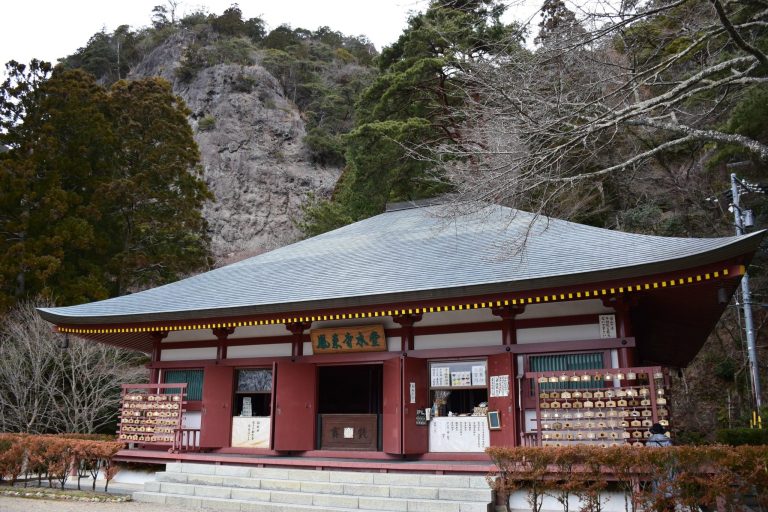
Hōkō-ji preserves a group of temple buildings and religious images associated with its medieval foundation and later history. The Seven Bodhisattva Hall is a small guardian hall, while the principal Shaka Nyorai image and its attendant statues predate the temple itself. The main hall and 23 other buildings were registered as nationally registered tangible cultural properties in September 2019.
Seven Bodhisattva Hall
Built in 1401, the Seven Bodhisattva Hall enshrines seven bodhisattvas, Buddhist beings who pursue enlightenment while assisting others. It is a small nagare-zukuri structure, a form in which the front slope of the roof extends over the entrance, and has a shingle roof. The building measures approximately 90 centimetres across the front and 150 centimetres in depth.
The hall preserves architectural characteristics associated with the late Kamakura period. Its projecting porch contains a rainbow beam formed in the karahafu style, a curved gable form used in traditional Japanese architecture. This treatment is particularly rare among the hall’s surviving features.
Shaka Nyorai image group
Hōkō-ji’s principal image is a statue of Shaka Nyorai. The associated seated wooden statues of Shaka Nyorai and two attendants were made in 1352 by three sculptors, before the temple was founded. The group originally stood at Seion-ji in present-day Shirosato, Ibaraki Prefecture, which served as a family temple of the Satake clan.
An inscription records that the statues were repaired through the strong devotion of Tokugawa Mitsukuni, a prominent seventeenth-century member of the Tokugawa house. Their presence at Hōkō-ji connects the temple’s later religious setting with a sculptural group created before its establishment.