Musa Otsuka Kofun: A Late-Sixth-Century Burial Mound in Japan


Site at a Glance
- Rating
- 4.2
- Popularity
- Very Low
- Country
- Japan
- Primary era
- Classical
- External website
- Open
- Eras represented
- Classical
- Civilizations
- Yamato
- Site type
- Burial
- Remains
- Burial Mound
On this page6 sections
History
Musa Otsuka Kofun is a late-sixth-century Japanese burial mound in Okayama, Japan. A kofun was a monumental mound built chiefly between the third and seventh centuries for members of ruling and elite groups. The tomb stands in Musa, Kita Ward, on the eastern bank of the Asahi River at the southern foot of the Takakura mountain massif.
A Kibi regional tomb
The mound was positioned near the former Sanyodo highway and the Musa ferry crossing, an important transportation point on the Asahi River. Its location has also been considered in relation to a ritual site on the mountain behind it. The tomb is regarded as that of a powerful regional chief of Kibi, an ancient political and cultural region corresponding broadly to present-day Okayama and neighboring areas. It has also been proposed as a mausoleum of the Kibi no Kamimichi clan, a ruling family associated with the region’s political tradition.
Among Okayama Prefecture’s three great megalithic tombs, Musa Otsuka Kofun is placed later than Komorizuka Kofun and Yata Otsuka Kofun, but earlier than Tojinzuka Kofun. This sequence places the monument within a later phase of the region’s large-scale tomb construction.
Recognition and investigation
The site was first reported in 1905, with further reports following in 1924 and 1932. Mound surveying and a measured survey of the stone chamber took place in 1968, and the results were reported in 1971. The kofun precinct received designation as a National Historic Site of Japan on February 28, 1930.
Remains
Mound and setting
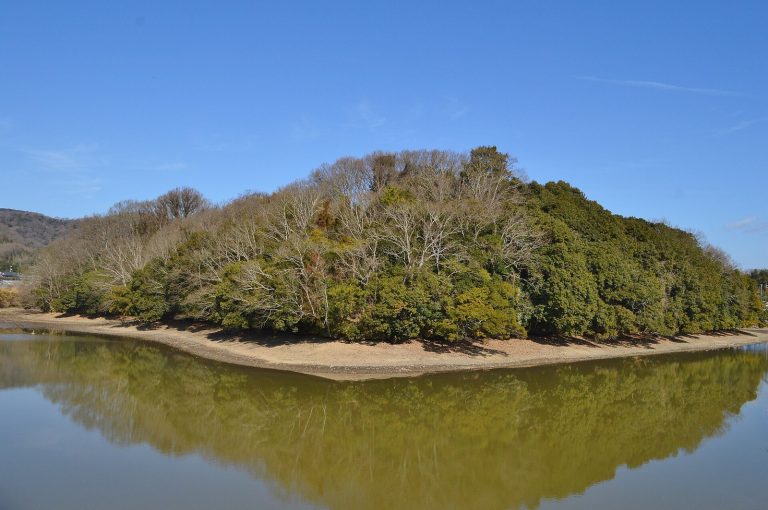
Musa Otsuka Kofun is an enpun, the circular form of Japanese burial mound. The surviving mound measures about 30 meters across and 8.5 meters high, while its estimated original dimensions exceeded 40 meters in diameter and 10 meters in height. The surrounding mound area has been levelled. Beneath the mound, the burial chamber opens toward the south, an orientation that connected the monument physically with the river-side setting and the mountain massif behind it.
Stone chamber and sarcophagus
The burial facility is a large double-sleeved tunnel-style stone chamber, meaning that a passage leads into the chamber and is flanked by projecting side sections. With a total length of 18 meters, it belongs among Japan’s largest examples of this form. Massive granite blocks make up the chamber. A single enormous stone forms the rear wall, while the side walls are arranged in three courses. The passage broadens toward the entrance in a trumpet-like plan.
Inside the chamber lies a hollowed, house-shaped stone sarcophagus aligned with the chamber’s long axis. Made from shell limestone quarried at Mount Namigata in Ibara, it measures 2.88 meters long, 1.6 meters wide, and 1.5 meters high. Its lid has reduced projections shaped like rope handles. A hole cut into the side of the coffin body facing the entrance is associated with tomb robbery, providing evidence of later disturbance to the burial facility.