Hîrjauca Monastery: An Eastern Orthodox Monastery in Moldova
Site at a Glance
- Popularity
- Medium
- Country
- Moldova
- Primary era
- Modern
- Eras represented
- Modern
- Civilizations
- Russian
- Site type
- Religious
- Remains
- Monastery
On this page11 sections
History
Hîrjauca Monastery is a men’s Eastern Orthodox monastery north of Hîrjauca village in Moldova. Its beginnings are uncertain, and accounts place the founding of its hermitage at different times. Researcher Pavel Crușevan attributed its first prayer house to Teodosie, an elderly monk who sheltered fugitives in the Codri forest region. Two monks later joined him: Varsonufie, a priest-monk, and Inochentie, who came from Călărași. A boyar, a member of the landed nobility, named Niculiță then built a small wooden church with a reed roof for the Dormition of the Virgin, an Orthodox feast commemorating the end of Mary’s earthly life and her assumption into heaven. This account dates the hermitage’s foundation to 1740.
A 1784 document about the Bulat family estates identifies Mihul Bulat as the monastery’s founder, but supplies no year. It says he served as gatekeeper under Mihai Racoviță, ruler of the Principality of Moldavia. A different tradition places the founding of a wooden Dormition church in 1642 and attributes it to freeholders from Hirișeni. That date is disputed because the story implies that a hermitage was already there. Local legend places the original hermitage beside a spring believed to have healing powers.
In 1749, Miron Bădică, Inochentie’s uncle, gave the hermitage the Sipoteni estate, comprising 26 desetine of arable land and 2,058 desetine of forest. A desetină was a historical unit of land area. Toward the end of the eighteenth century, Abbot Tarasie moved the community several hundred metres downhill after its original church had deteriorated. A new wooden church was built there, while the cemetery remained at the earlier site.
Monastery status and nineteenth-century expansion
After the Archdiocese of Chișinău was established, Metropolitan Gavriil Bănulescu-Bodoni, a senior Orthodox church leader, raised Hîrjauca to monastery status in 1815. Spiridon Filipovici, a military man and engineer from Šibenik, served as its archimandrite, a senior monastic title, from 1818 to 1846. In 1820 he arranged for one of the wooden churches to be moved to Hirișeni. A stone church dedicated to the Ascension was built in its place, with construction continuing until 1836.
Under Filipovici, the monastery added a brickmaking workshop, library, refectory, monks’ cells, and an enclosing wall. Paths, gardens, fountains, artificial lakes, and pavilions also formed part of the improvements. Work on a winter church began in 1840. Filipovici died before it was complete; the church was finished and consecrated in 1848 in honor of Saint Spyridon, an early Christian bishop venerated in the Eastern Orthodox Church. In 1845, a decision of the Russian Church’s Synod designated Hîrjauca a bishop’s monastery. Its first assigned bishop was Archbishop Irinarh of Chișinău.
Education and monastic life
Hîrjauca established a dependent monastic community, or skete, at Bocancea in 1869. It became an independent monastery in 1920. The monastery also opened a school and an orphanage during the second half of the nineteenth century. For a time, its school was the only monastic school in Bessarabia, the historical region between the Prut and Dniester rivers. It taught about 20 to 30 boys, mostly sons of church personnel, religion, singing, and reading and writing in Russian. A boarding school operated there as well.
In 1872 the school was reorganized on the model of a public school. Disagreements developed between the monks and staff appointed by the diocesan administration and theological seminary. The monks opposed the administration’s policy of promoting Russian language and culture.
Disruption, closure, and revival
Russian soldiers devastated the monastery in 1917 during the Bolshevik Revolution. After 1918, books from Bucharest and Iași were added to its library under the direction of Bishop Nicodim of Huși. Gurie Grosu served as archimandrite from 1920 to 1928 and later became Metropolitan of Bessarabia.
Soviet soldiers used the monastery as barracks in 1940. It reopened the following year as a military hospital for the Romanian army. The monastery was closed in 1953 and converted into a rest home, then into a sanatorium in 1958. Three hundred volumes and the churches’ icon screens were burned. The Ascension church was used as a dance club and shooting hall, and the Saint Spyridon church as a gym. The closure period also saw the destruction of 13 icons and 23 portraits by Bessarabian painter Pavel Piscariov.
The wooden Dormition church moved to Hirișeni continued to serve worshippers until a stone church was built in the village in 1928. It later became a cemetery chapel, deteriorated during the Soviet period, and was restored and transferred to the Chișinău Village Museum in 2009–2011. Hîrjauca is again an active men’s Eastern Orthodox monastery, under the Diocese of Ungheni and Nisporeni and the Metropolis of Chișinău and All Moldova, an Orthodox ecclesiastical province headed by a metropolitan.
Remains
Setting and layout
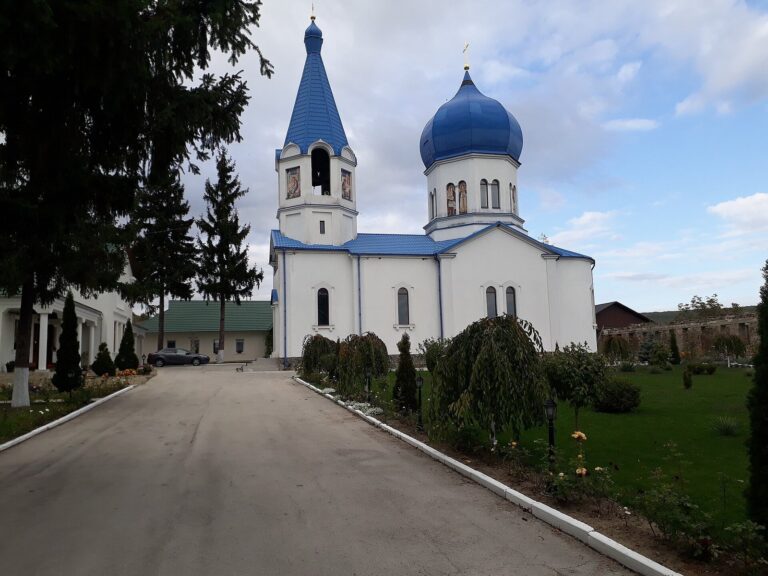
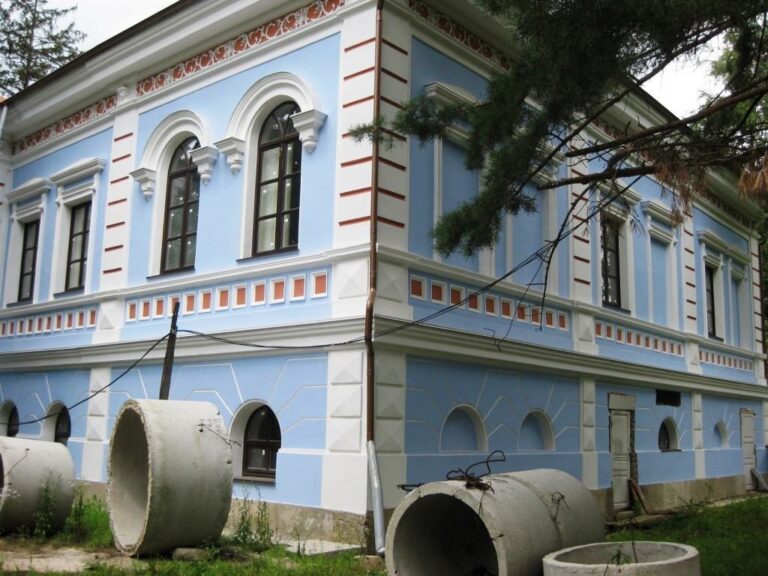
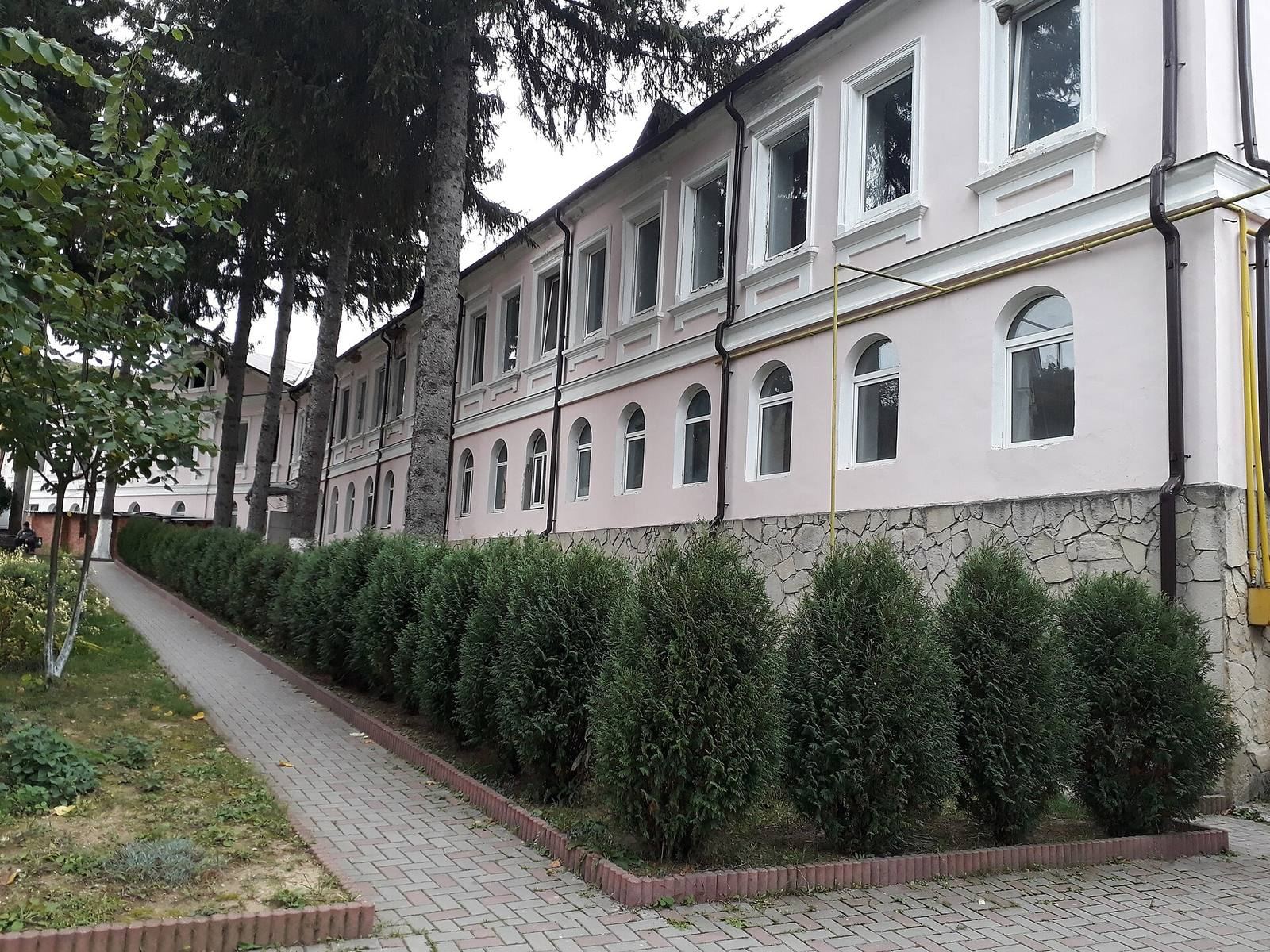
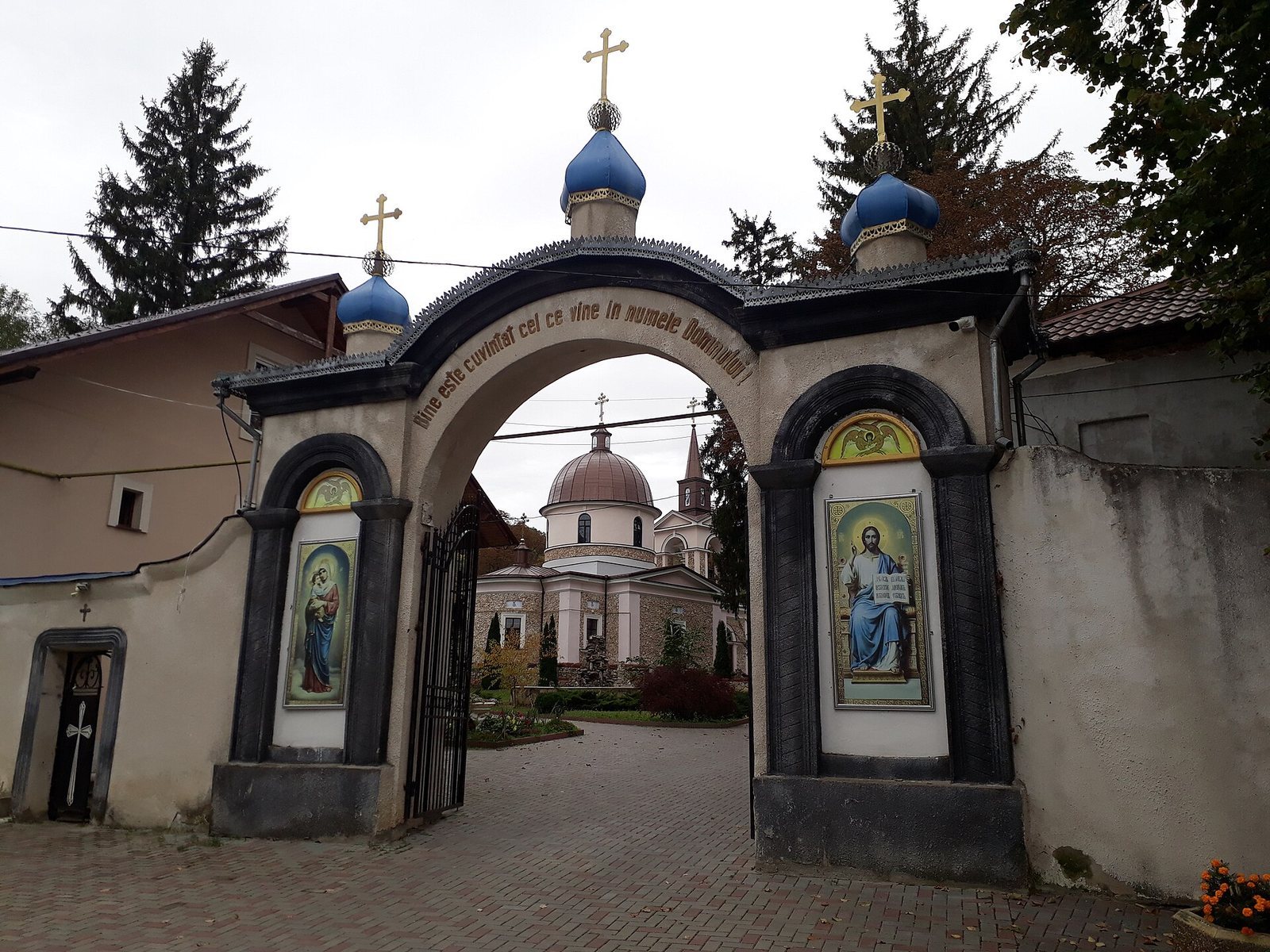
The monastery complex stands beside a small lake formed by the Hîrjauca stream, north of the village. The monastery and the Codru health resort occupy the lakeshore, and a mineral-water spring lies within the sanatorium grounds. The abbot’s residence, refectory, monks’ cells, and other buildings are arranged in a horseshoe around the summer church dedicated to the Ascension.
Ascension Church
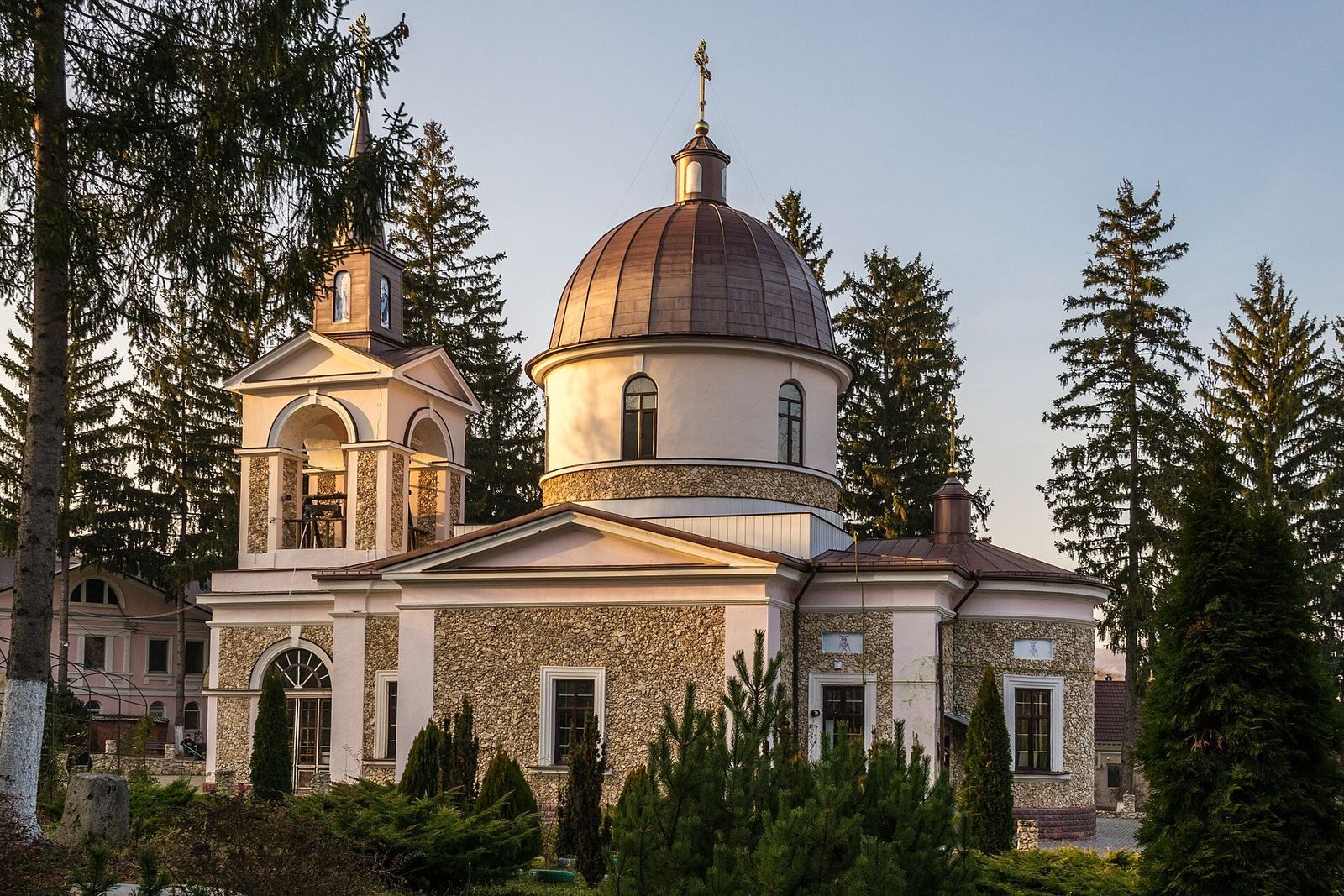
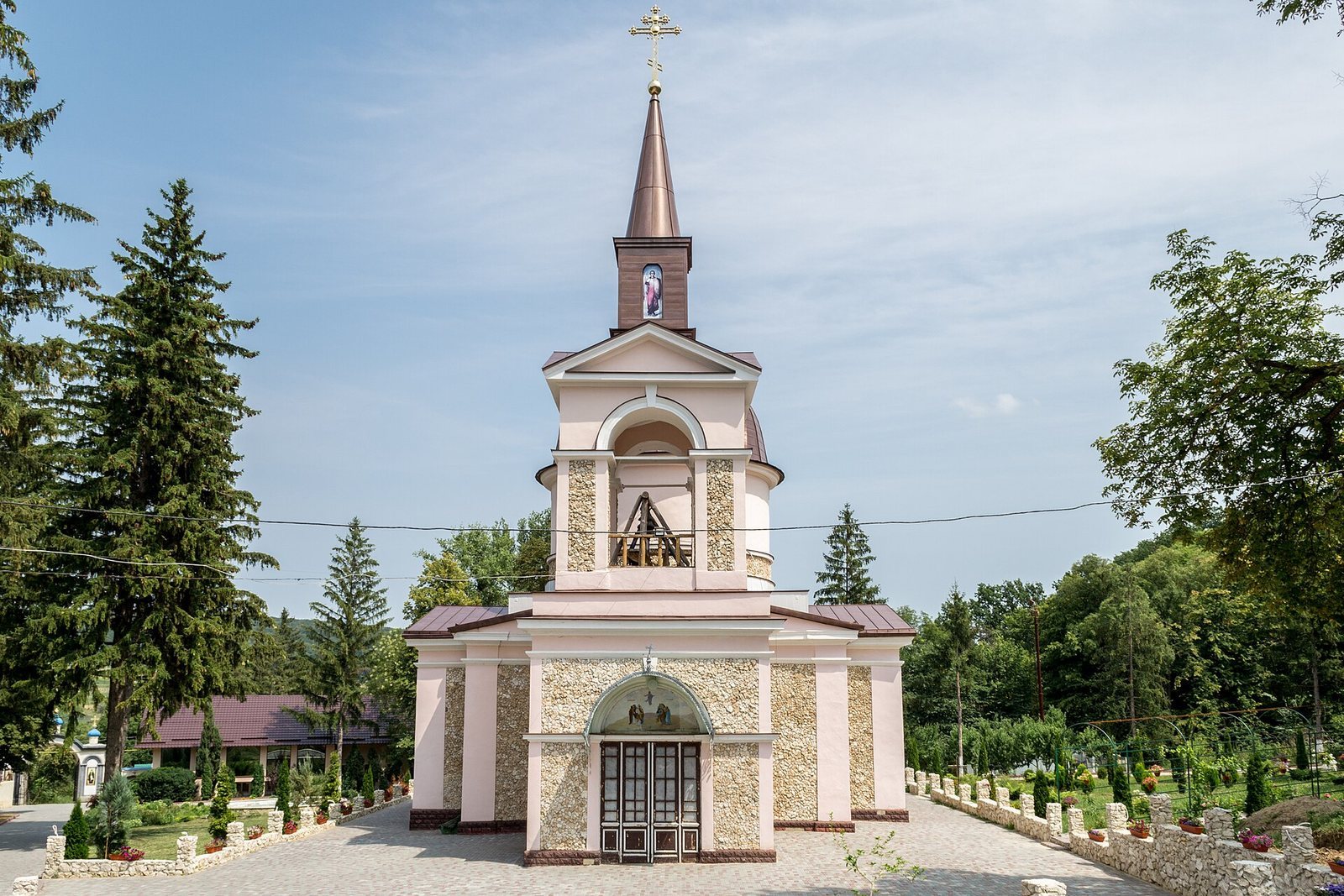
Designed by Luca Zaușkevici of Odesa, the church has a cross-shaped plan. Some interpretations call it triconch, meaning a plan with three apse-like projections, although it has only one apse at the altar; prominent pedimented projections form the side arms instead. Four shallow wall supports in the central space carry four semicircular arches spanning the interior. The altar apse is flanked by a preparation room and a service chamber. The main worship space is rectangular, and the two-level porch has a bell tower and four openings on its upper storey. A spiral stairway leads to that level.
A spherical dome rises on a circular base with six arched windows. Curved triangular supports connect it to the arches below. The exterior follows Russian Classicism, a style using classical forms and proportions in Russian architecture. Its features include corner pilasters, shallow vertical wall bands, shaped surrounds around doors and windows, and classically profiled cornices. Murals painted by Blinov, Stoianov, and Lemai between 1901 and 1906 decorate the interior; they were restored in 1981–1989.
Renovation in 2005–2008 changed the church’s exterior. Rough Butuceni stone was applied as facing, the base was covered in brick-red cladding, and a sheet-metal canopy was added above the entrance. Contemporary-style doors and windows were also installed. These alterations diminished the building’s artistic value.
Saint Spyridon Church
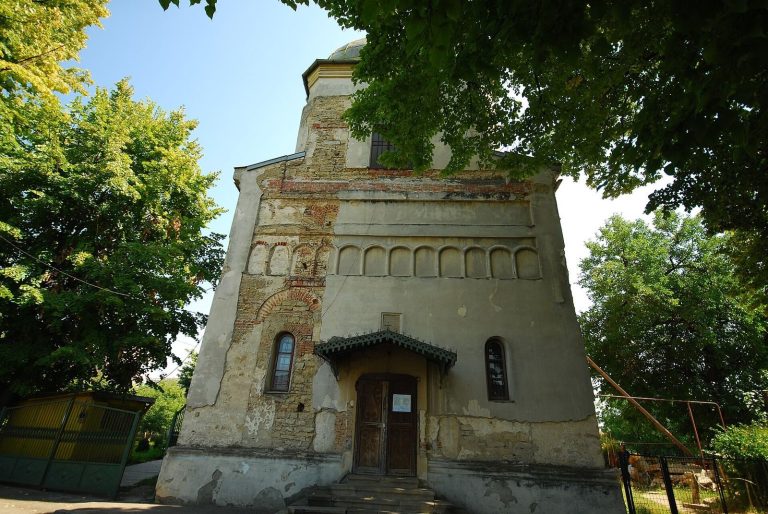
The winter church has a rectangular plan and a tower crowned by a spherical dome. On the courtyard façade, two engaged columns frame two windows and a rectangular niche. The interior retains severely deteriorated wall paintings made in watercolour by icon painter V. P. Tucanov in 1945. Fire damaged the church in 1991, and it remains in ruins. Two icons from the church survive, one depicting Christ and the other Saints Anthony and Theodosius of Kyiv Pechersk, monastic saints associated with the Kyiv Pechersk tradition.
Wooden Dormition Church
The wooden church now at the Chișinău Village Museum was built from oak beams secured at their middles and ends with wooden nails. It was originally plastered inside and out and covered with shingles. After being moved, decayed boards were replaced; the church was then plastered only inside, faced with wood on the exterior, and given a shingle roof again.
Library and books
In 1837 the library held six Slavonic Gospels with silver covers and two Romanian Gospels with metal covers. Notable Gospel editions included a Moscow printing from 1809 with a gold-and-silver cover, a 1817 edition with an artistically worked silver cover and five enamelled mounts, and editions from 1847 and 1854 with silver covers. Other holdings included a liturgical anthology printed at Iași in 1726, a Bible from Blaj dated 1795, and service books printed in Bucharest, Crit, and Iași between 1747 and 1793. By 1890 the library held more than 400 Slavonic and Romanian books.
Treasury and icons
An inventory from 1817 lists a silver cross plated with gold, two brass candlesticks, a gold-covered silver chalice, a lead chalice, and a censer coated with tombac, a copper-zinc alloy. The icon screen was decorated with inlaid gilded flowers; a brass chandelier had 12 candle holders, and five silver lamps stood before the icons. The treasury also included a silver tabernacle, an engraved silver chalice dated 1872, and an engraved silver diskos, the plate used to hold Eucharistic bread. Most of these objects are no longer at the monastery.
Several wooden icons painted in tempera during the first half of the nineteenth century and now kept at Bocancea originated at Hîrjauca. Their subjects include the Dormition of the Virgin, Christ, the Virgin and Child, Saints Constantine and Helen, and the enthroned Virgin and Child.