Căpriana Monastery: A Historic Orthodox Monastery in Moldova


Site at a Glance
- Rating
- 4.8
- Popularity
- Medium
- Country
- Moldova
- Primary era
- Modern
- Eras represented
- Medieval, Modern
- Civilizations
- Principality of Moldavia, Russian
- Site type
- Religious
- Remains
- Monastery
On this page10 sections
History
Căpriana Monastery is a historic Orthodox monastery in Căpriana, Moldova, whose origins reach back to the reign of Alexandru cel Bun and the early fifteenth century. Archaeological evidence places the construction of its first stone Church of the Dormition of the Mother of God around 1425, within the medieval Moldavian ecclesiastical tradition. The monastery is regarded as one of the oldest in Moldova and became an important religious and cultural center through its links with Moldavian rulers and, later, with the Bulgarian Zograf Monastery on Mount Athos.
Foundation and Moldavian patronage
A monastic settlement at the site appears in a 1429 grant by Alexandru cel Bun, the medieval ruler of the Principality of Moldavia. He gave the institution the status of a princely monastery, where it was identified as the monastery at Vâșnovăț under Abbot Chiprian. Its establishment was also associated with free peasants from the village of Mereni. Excavations in 1933 revealed traces of an earlier wooden church and a later stone church connected with the period of Alexandru cel Bun. The foundations of the first stone Church of the Dormition were uncovered again in 1993.
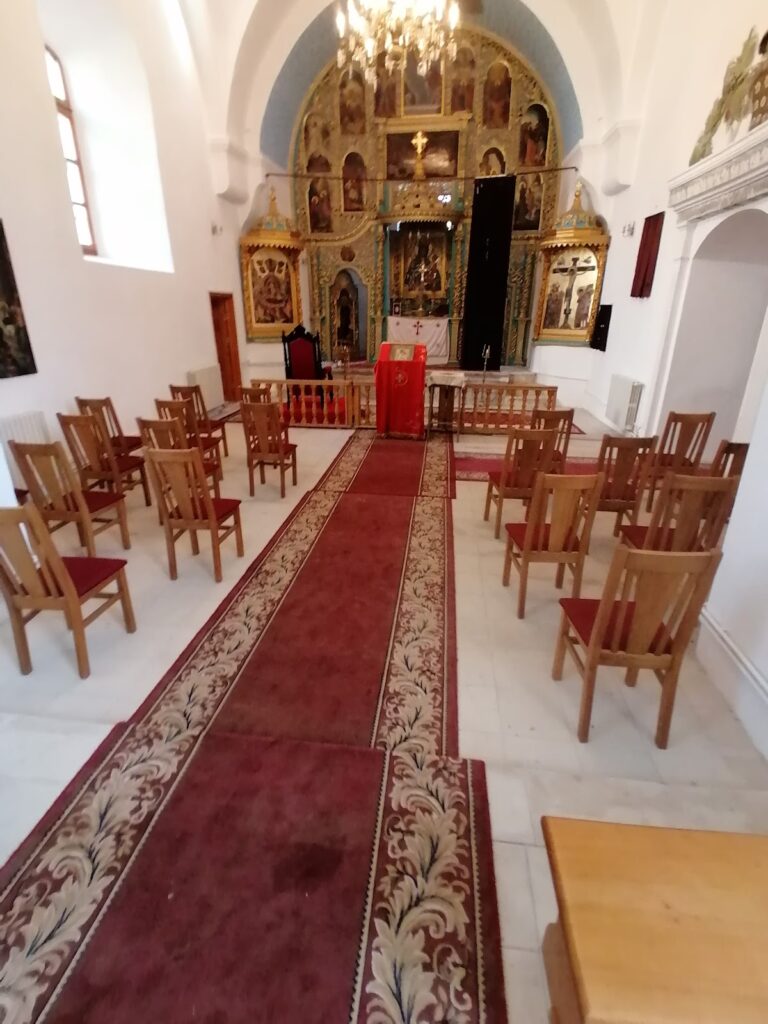
The monastery received continued support from Moldavian princes. Ștefan cel Mare repaired the first church after the earthquake of 1471, while a stronger earthquake in 1516 caused serious damage. Between 1542 and 1545, Petru Rareș began a major rebuilding campaign, reconstructing the principal church from its foundations. His successors continued the work. Alexandru Lăpușneanu strengthened and enlarged the monastery and made substantial donations, while Vasile Lupu renewed the church altar, pavement, and iconostasis, the screen separating the sanctuary from the main body of an Orthodox church.
The monastery’s estates expanded under princely patronage. On 11 April 1559, Alexandru Lăpușneanu granted it twelve villages with their cultivated land, vineyards, and forests. Earlier holdings had included apiaries, one or more mills, and estates comprising several villages. These resources supported the institution’s religious and agricultural life.
The Zograf connection
In the late seventeenth century, Căpriana entered a period of decline. In 1698, with the consent of the Moldavian bishops, it was transferred to the Bulgarian Zograf Monastery on Mount Athos, a major Bulgarian Orthodox monastic center in Greece. Căpriana remained under Zograf authority for more than two centuries.
During this period, many of Căpriana’s abbots and monks were Bulgarian. Bulgarian clergy supported the monastery’s buildings, church furnishings, agriculture, and literary activity. Services were held in Bulgarian Church Slavonic, Greek, and Moldavian. The monastery also helped publish Bulgarian literature and maintained connections with Bulgarian intellectuals and students.
A Bulgarian school was founded at Căpriana in 1846 through the efforts of Vasil Aprilov. More than twenty Bulgarian monks and laypeople studied there, including Meletius, who later became metropolitan of Sofia. Bulgarian figures such as Georgi Rakovski, Hristo Botev, Panayot Hitov, and Filip Totyu were associated with the monastery as refugees, workers, patients, or visitors. This history gave Căpriana a lasting place in Bulgarian religious and cultural activity in Bessarabia.
Russian administration and changing authority
After the Russian annexation of Bessarabia in 1812, Căpriana came under the newly established Bessarabian archbishopric in 1813. During the Russo-Turkish War, Russian military authorities controlling the territory issued the monastery a protective charter. From 1813 to 1837, the Chisinau archbishop administered Căpriana, although the monastery continued to pay Zograf an annual sum of 1,500 leva. In 1837, it returned to Zograf authority in exchange for the transfer of Girzhevo Monastery to the diocese.
Russian state control over the monastery’s finances increased after a decree of 1873 placed its income and property under state administration. The revenues were divided among the Russian state, Zograf Monastery, and Căpriana. The monastery remained under Bulgarian ecclesiastical authority until the First World War. It was then transferred to the direct authority of the Holy Synod in Saint Petersburg, and its property was confiscated in 1915.
In 1916, fourteen Bulgarian monks were exiled to Siberia during the deportation of Bulgarian citizens from Bessarabia. Some monks returned after the war, and the monastery subsequently came under the Romanian Patriarchate. Căpriana was also associated with the residence of the Moldavian metropolitan and with the chronicler Eftimie.
Twentieth-century suppression and revival
Soviet authorities closed the monastery in 1962, following earlier attempts to suppress it because of resistance to collectivization. Monks had been expelled in 1947, and the monastery’s property was transferred to the state. During the Soviet period, the churches and monastic buildings were put to secular and medical uses, and the complex fell into neglect. One building became a cultural center, one church served as a tuberculosis hospital or children’s sanatorium, and another was used for chemical storage. The library, bells, and many religious objects disappeared despite the complex’s status as a state-protected architectural monument.
Monastic activity resumed in 1989 during Moldova’s national revival and the more liberal policies associated with Mikhail Gorbachev. Major restoration took place from 2003 to 2005 with state and private funding. After 2009, the interior restoration of the principal voivodal Church of the Dormition remained unfinished. Căpriana is now a male Orthodox monastery administered by the Moldovan Orthodox Church, which forms part of the Russian Orthodox Church.
The monastery also preserves the memory of Metropolitan Gavriil Bănulescu-Bodoni, who led the Bessarabian ecclesiastical administration from 1813 to 1821 and was buried at Căpriana in 1821. His remains were discovered at the monastery in 2016, the year in which he was canonized as a locally venerated saint. Excavations in 1933 uncovered the graves of thirty founders and patrons, together with the grave of Maria, daughter of the boyar Spanchios and a contemporary of Alexandru Lăpușneanu. They also revealed remains identified with the boyars Dimitru Bizu and Gheorghe Costachi, the latter dated to 1767. The monastery’s reopening and renewed religious life have made it an important symbol of Moldova’s national revival.
Remains
Căpriana Monastery stands in the wooded Codri region of central Moldova, within or near a forest reserve. The Ishnovets River passes beside the complex and broadens into a large artificial lake before the entrance. The ensemble is organized around the Church of the Dormition of the Mother of God and includes the winter churches of Saint George and Saint Nicholas, monastic cells, a refectory, agricultural buildings, fountains, gazebos, shelters, vineyards, woodland, pavilions, and artesian wells built in a national style.
Church of the Dormition
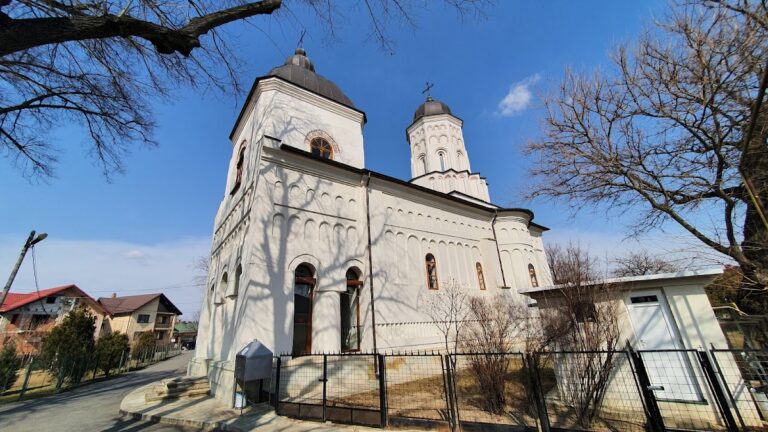
The Church of the Dormition is the central building of the monastery. It was repeatedly extended and reconstructed, particularly after the earthquake of 1820, when Metropolitan Gavriil Bănulescu-Bodoni restored it in the manner of Athonite churches. The richly decorated apses are the principal elements retained from the earlier structure. The later church was enlarged at the expense of its bell tower and received a substantial domed drum, the polygonal structure supporting a dome.
Its large octagonal drum, dome, and bell tower with a pyramidal top were reconstructed. The altar and three apses are arranged centrally along the southern side, while an oval room extends from south to north. During services, the monastery’s administrative officers and clergy stand on the two sides of this room. The church retains the general character of medieval Moldavian ecclesiastical architecture, although its vaulting system was reconstructed in the modern period in a neoclassical style. The surviving medieval fabric consists principally of walls rising toward the cornice.
The tomb of Metropolitan Gavriil Bănulescu-Bodoni lies behind the bell tower. His remains were later found there, connecting the physical monument with the monastery’s nineteenth-century ecclesiastical history.
Churches of Saint George and Saint Nicholas
The Church of Saint George is a stone building erected in 1840 by Hilarion, a former administrator and abbot. Built in a late-Baroque style, it stands beside the monastic cells. A well is positioned to the left of its entrance, forming part of the church’s immediate setting.
The Church of Saint Nicholas was built in 1903 as a winter church. It was designed in the style of medieval Moldavian churches and is regarded as the most valuable church in the complex. Together with the Church of Saint George and the Church of the Dormition, it forms the monastery’s group of three churches.
Monastic buildings and landscape
In 1826, the monastery acquired a large two-storey stone building, two brick wings on stone foundations with a cellar beneath them, and a wooden building. These structures contained monastic cells. Other surviving elements of the complex include the refectory, agricultural buildings, pavilions, fountains, gazebos, shelters, vineyards, and artesian wells. An ancient oak near the monastery is traditionally called the Oak of Ștefan cel Mare. Local tradition holds that the Moldavian prince rested beneath it after a difficult battle.
Library and surviving religious objects
Căpriana’s historic library was once among the richest monastic libraries in Moldova. It held manuscripts, books donated by prominent figures, Old Bulgarian ecclesiastical literature, and religious and secular works sent from Zograf Monastery.
Among the notable objects associated with the monastery is a Slavonic Gospel donated by Petru Rareș on 11 October 1545. It was written entirely on parchment in an elaborate, clear script. Its covers feature gilded repoussé silver and multicolored precious stones. The front shows the Resurrection of Jesus Christ and the release of the righteous of the Old Testament from Hell, while the back depicts the Dormition of the Mother of God and carries a long engraved inscription.
Another exceptional object is an embroidered epitrachelion, a long priestly vestment worn around the neck during Orthodox services. Donated by Marena, the wife of Alexandru cel Bun, and produced between 1427 and 1431, it is described as the oldest known embroidery of its type. It bears holy figures together with portraits of Alexandru cel Bun and his wife.